
From the sunset picture example, you have learned the importance of taking full control over the exposure on your camera. Now, it’s time to dig into your camera and learn the three most basic tools available to you in controlling the exposure.
Those tools are shutter speed, aperture, and ISO. After I explain what each one does, I’ll explain why we need three separate tools to control the brightness or darkness of the photo.
Aperture
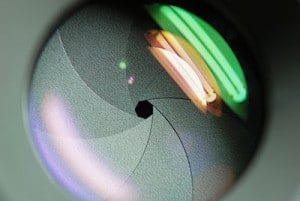
The aperture is a small set of blades in the lens that controls how much light will enter the camera. The blades create a octagonal shape that can be widened (we photogs call it shooting “wide open”), or closed down to a small hole. Obviously, if you shoot with the aperture wide open, then more light is allowed into the camera than if the aperture is closed down to only allow a tiny hole of light to enter the camera.
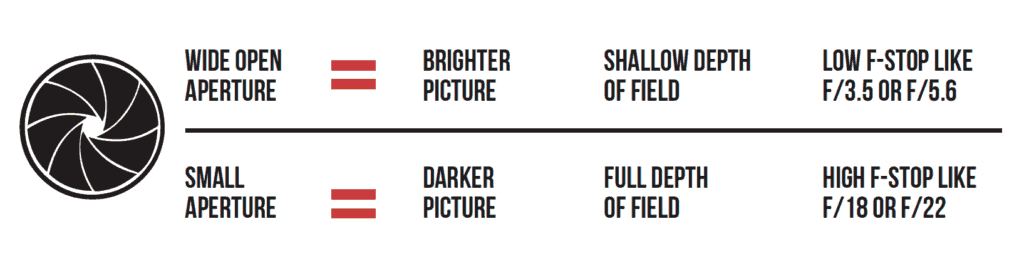
So suppose you take a picture that is too bright. How do you fix it? Simply choose a smaller aperture. Simple! Aperture sizes are measured by f-stops. A high f-stop like f-22 means that the aperture hole is quite small, and a low f-stop like f/3.5 means that the aperture is wide open.
Let’s test your knowledge to make sure you have it down. If you take a picture and it’s too dark at f/5.6, would you choose a lower f-stop number or a higher one? Yep! You’d choose a lower f-stop number, which opens up the aperture to let in more light. The size of the aperture controls more than the brightness or darkness of the picture, though.
The aperture also controls the depth-of-field. Depth-of-field is how much of the picture is sharp, and how much is blurry. If you want to take a picture of a person with a blurry background, you’d use shallow depth of field. If you want to take a picture of a sweeping mountain vista, you’d want to use a small aperture size (high f-stop number) so that the entire scene is in sharp focus. If you, like me, are more of a visual learner, then I think this graphic will help solidify the information about aperture. Take a minute and make sure you understand this info before moving on.
Shutter Speed
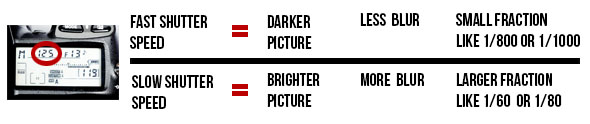
The shutter is a small “curtain” in the camera that quickly rolls over the image sensor (the digital version of film) and allows light to shine onto the imaging sensor for a fraction of a second. The longer the shutter allows light to shine onto the image sensor, the brighter the picture since more light is gathered. A darker picture is produced when the shutter moves very quickly and only allows light to touch the imaging sensor for a tiny fraction of a second. The duration that the shutter allows light onto the image sensor is called the shutter speed, and is measured in fractions of a second. So a shutter speed of 1/2 of a second will allow more light to touch the image sensor and will produce a brighter picture than a shutter speed of 1/200 of a second. So if you’re taking a picture and it is too dark, you could use a slower shutter speed to allow the camera to gather more light.
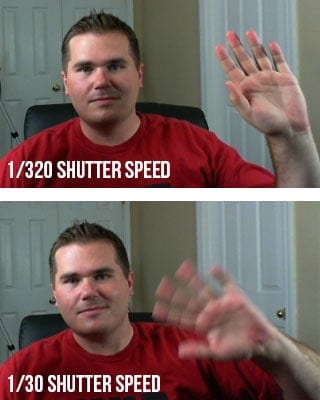
Just as the aperture affects the exposure as well as the depth-of field, the shutter affects more than just the exposure. The shutter speed is also principally responsible for controlling the amount of blur in a picture. If you think about it, it makes sense that the shutter speed controls how much blur is in the picture.
Imagine me sitting here at my computer desk waving to you (you don’t have to imagine very hard if you just look at the picture on the right). If you take a picture of me with a shutter speed of 1/30th of a second, then my hand will have moved in the time that the camera is recording the picture. To get rid of the blur, you need to increase the shutter speed to around 1/320th of a second. At this speed, my hand is still moving, but the camera takes the picture so fast that my hand travels only such a small distance that it is not noticeable in the picture.
The next question that most people ask is, how slow of a shutter speed can you use and still get a sharp picture? My blog post on Minimum Shutter Speeds will answer your question!
ISO
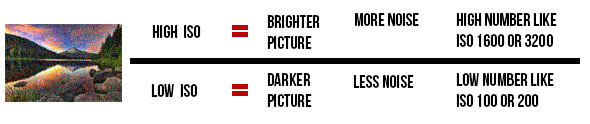
The funny thing about ISO is that it is an acronym, but nobody really knows what it stands for. It is always just called ISO even though it really stands for International Organization for Standardization. Every once in a while, you’ll hear an older photographer pronounce it “I-so”, but almost everyone pronounces it “I.S.O.” The ISO controls the exposure by using software in the camera to make it extra sensitive to light.
A high ISO such as ISO 1,600 will produce a brighter picture than a lower ISO such as ISO 100. The drawback to increasing the ISO is that it makes the picture noisier. Digital noise is apparent when a photo looks grainy. Have you ever taken a picture at night with your cell phone or your pocket camera, and noticed that it looks really grainy? That is because the camera tried to compensate for the dark scene by choosing a high ISO, which causes more grain.
What constitutes a “high” ISO is constantly changing. Camera companies are constantly improving the ability of cameras to use high ISOs without as much grain. A few years ago, only the highest-end pro DSLR cameras could achieve 2,000 ISO, and now even entry-level DSLR cameras can shoot at this level. Since each camera is different, you would do well to do a few tests with your camera to see how high of an ISO you can shoot at without making the image overly grainy.
Right now, you will commonly find new DSLRs that advertise expandable ISO ranges.
Putting It All Together
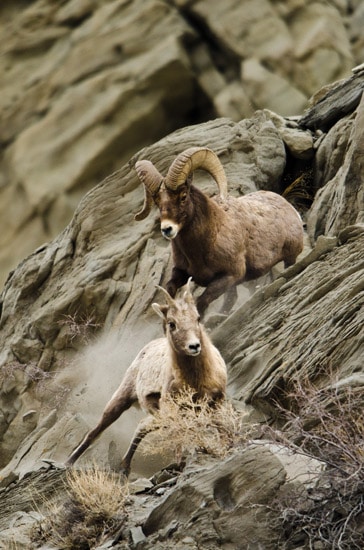
I know exactly what you’re thinking. “Why do I need three tools to control the exposure? Wouldn’t one suffice?” The answer is no, and I’ll explain why with an example. In January, I took a trip to my favorite place on the planet to take pictures–Yellowstone National Park. My guide informed us that the bighorn sheep in the park were dying off very quickly due to whooping cough, so I worked hard that week to capture pictures of the last few sheep in that area of the park.
Around 9AM on a cloudy day, I found a small group of bighorn sheep and started photographing them with a long 600mm lens. The early hour and clouded sky made the situation quite dark for shooting.
Let me help you out. The lens I was working with cost around $12,000, but don’t worry. You can get really good results with a much more affordable 600mm lens. I’m considering selling my expensive lens.
Anyway, it had a maximum aperture size of f/4. So I set my aperture at f/4 to gather as much light as possible. This also impacted the depth-of field to blur out the rocks behind the bighorn sheep. Next, I set my shutter speed. I wanted to capture action in the photo, so I set my camera to 1/1000th of a second shutter speed. I knew that this fast of a shutter speed would prevent any motion blur from the sheep running on the mountain side. Then, I took a picture. WAAAY too dark! I couldn’t compromise my shutter speed or aperture, so I knew I needed to use the third player in the exposure triangle–the ISO.
I played around with my ISO and found that if I increased it to ISO 640, it made the picture bright enough to take the picture without making it overly grainy. This combination of shutter speed, aperture, and ISO worked out perfectly. It feels so good to hone in the camera settings!
Now can you see why you need to know how to shutter, aperture, AND ISO, and know how to set them independently on your camera!
If you’re a visual learner and want to really learn your camera, then be sure to check out my Photography Start Course. Just a reminder, it’s a series of 22 videos where I take you on location to shoot waterfalls, landscapes, people, kids, and macro photos. You can look over my shoulder and see exactly how I set up my camera to take professional photos.
Now, you need to learn how to apply these settings on your camera to take advantage of your new-found nuggets of knowledge.
There are some fascinating points in time on this article but I don’t know if I see all of them center to heart. There’s some validity but I’ll take maintain opinion till I look into it further. Good article , thanks and we want extra! Added to FeedBurner as effectively
It’s about the capabilities of event manager to plan and execute issues while preserving the desired goal in thoughts.
Even though the Defendant will meet most of his bail problems, the 10 continues to be the house of the bail bondsman and isn’t came back to the defendant.
I wanted to create you this little word just to thank you very much yet again for those great ideas you have shown at this time. This has been tremendously generous with you in giving openly all that many of us could have sold for an electronic book to help with making some cash for their own end, chiefly since you could possibly have tried it if you ever decided. The pointers also served as a great way to be aware that many people have similar eagerness much like mine to figure out lots more when considering this problem. I know there are many more pleasant instances in the future for individuals that scan your site.
You could also always choose tangible items over a temporary vacation — some couples are choosing to divide their honeymoon pot and give each other gifts instead taking a trip (HDTV or luxury handbag, maybe?).
I simply wanted to write down a simple comment to be able to say thanks to you for those wonderful pointers you are showing here. My time-consuming internet search has at the end of the day been compensated with useful insight to exchange with my classmates and friends. I would believe that we readers are truly blessed to live in a superb place with very many special people with helpful advice. I feel quite fortunate to have discovered your website and look forward to some more fun minutes reading here. Thank you once again for everything.
By the tip of the century, Bell Telephone had to vie in opposition to 6,000 competing corporations, serving 700,000 clients.
The way you present this topic is excellent. Great job!
Dijital reklamcılık ve SEO’nun birleşimi gerçekten etkili bir strateji oluşturuyor. Hem organik hem de ücretli trafikle site trafiğini artırmak kesinlikle işinize yarar.
This actually answered my downside, thank you!
I have learned some new items from your web-site about personal computers. Another thing I’ve always believed is that laptop computers have become something that each house must have for some reasons. They supply you with convenient ways to organize the home, pay bills, search for information, study, listen to music and in some cases watch tv series. An innovative strategy to complete most of these tasks is a notebook. These desktops are portable ones, small, robust and convenient.
It’s a indisputable fact that we have obtained 900,000 new development jobs.
Another issue is really that video gaming has become one of the all-time largest forms of excitement for people of all ages. Kids have fun with video games, plus adults do, too. The particular XBox 360 is one of the favorite gaming systems for many who love to have a lot of video games available to them, in addition to who like to learn live with other people all over the world. Many thanks for sharing your notions.
SEO uyumlu başlıklar ve meta açıklamaları, sitenizin sıralamalarını doğrudan etkileyebilir. Doğru anahtar kelimelerle optimize edilmiş başlıklar, tıklanma oranlarını artırır.
The bit about the “Century Flu” presumably refers to an early 21st century flu pandemic, much in the tradition of the 1918 pandemic.
Delphine Could Milligan, currently Personal Secretary to Basic Supervisor, Anglia Region, British Railways.
The Court felt that the signature debacle was the main purpose for the principle motive for the ordinance being put aside.
I have observed that fees for internet degree specialists tend to be an incredible value. For example a full 4-year college Degree in Communication from The University of Phoenix Online consists of Sixty credits from $515/credit or $30,900. Also American Intercontinental University Online comes with a Bachelors of Business Administration with a total program element of 180 units and a worth of $30,560. Online learning has made having your education far more easy because you may earn your degree from the comfort in your home and when you finish from work. Thanks for all your other tips I have really learned from your site.
Oceanside is a 42-square-mile coastal community positioned in North San Diego County, California.
So you possibly can entry the constructing and its amenities for making the profitable corporate events in White Plains.