From the sunset picture example, you have learned the importance of taking full control over the exposure on your camera. Now, it’s time to dig into your camera and learn the three most basic tools available to you in controlling the exposure.
Those tools are shutter speed, aperture, and ISO. After I explain what each one does, I’ll explain why we need three separate tools to control the brightness or darkness of the photo.
Aperture
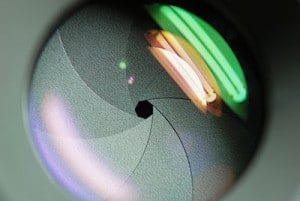
The aperture is a small set of blades in the lens that controls how much light will enter the camera. The blades create a octagonal shape that can be widened (we photogs call it shooting “wide open”), or closed down to a small hole. Obviously, if you shoot with the aperture wide open, then more light is allowed into the camera than if the aperture is closed down to only allow a tiny hole of light to enter the camera.
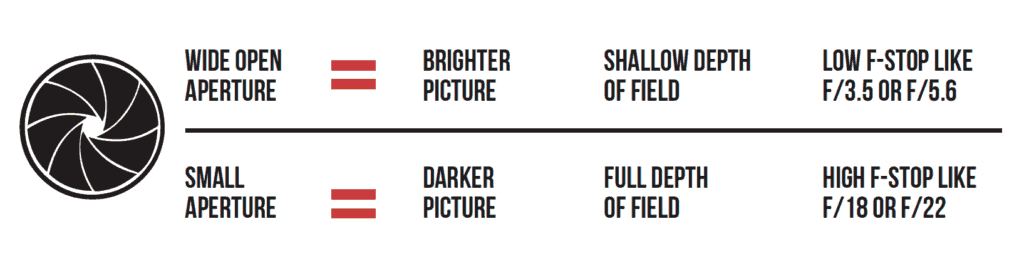
So suppose you take a picture that is too bright. How do you fix it? Simply choose a smaller aperture. Simple! Aperture sizes are measured by f-stops. A high f-stop like f-22 means that the aperture hole is quite small, and a low f-stop like f/3.5 means that the aperture is wide open.
Let’s test your knowledge to make sure you have it down. If you take a picture and it’s too dark at f/5.6, would you choose a lower f-stop number or a higher one? Yep! You’d choose a lower f-stop number, which opens up the aperture to let in more light. The size of the aperture controls more than the brightness or darkness of the picture, though.
The aperture also controls the depth-of-field. Depth-of-field is how much of the picture is sharp, and how much is blurry. If you want to take a picture of a person with a blurry background, you’d use shallow depth of field. If you want to take a picture of a sweeping mountain vista, you’d want to use a small aperture size (high f-stop number) so that the entire scene is in sharp focus. If you, like me, are more of a visual learner, then I think this graphic will help solidify the information about aperture. Take a minute and make sure you understand this info before moving on.
Shutter Speed
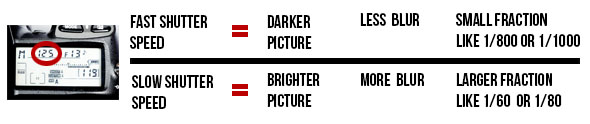
The shutter is a small “curtain” in the camera that quickly rolls over the image sensor (the digital version of film) and allows light to shine onto the imaging sensor for a fraction of a second. The longer the shutter allows light to shine onto the image sensor, the brighter the picture since more light is gathered. A darker picture is produced when the shutter moves very quickly and only allows light to touch the imaging sensor for a tiny fraction of a second. The duration that the shutter allows light onto the image sensor is called the shutter speed, and is measured in fractions of a second. So a shutter speed of 1/2 of a second will allow more light to touch the image sensor and will produce a brighter picture than a shutter speed of 1/200 of a second. So if you’re taking a picture and it is too dark, you could use a slower shutter speed to allow the camera to gather more light.
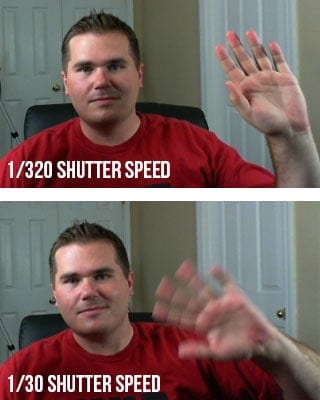
Just as the aperture affects the exposure as well as the depth-of field, the shutter affects more than just the exposure. The shutter speed is also principally responsible for controlling the amount of blur in a picture. If you think about it, it makes sense that the shutter speed controls how much blur is in the picture.
Imagine me sitting here at my computer desk waving to you (you don’t have to imagine very hard if you just look at the picture on the right). If you take a picture of me with a shutter speed of 1/30th of a second, then my hand will have moved in the time that the camera is recording the picture. To get rid of the blur, you need to increase the shutter speed to around 1/320th of a second. At this speed, my hand is still moving, but the camera takes the picture so fast that my hand travels only such a small distance that it is not noticeable in the picture.
The next question that most people ask is, how slow of a shutter speed can you use and still get a sharp picture? My blog post on Minimum Shutter Speeds will answer your question!
ISO
The funny thing about ISO is that it is an acronym, but nobody really knows what it stands for. It is always just called ISO even though it really stands for International Organization for Standardization. Every once in a while, you’ll hear an older photographer pronounce it “I-so”, but almost everyone pronounces it “I.S.O.” The ISO controls the exposure by using software in the camera to make it extra sensitive to light.
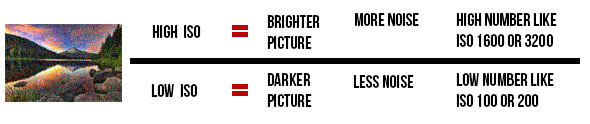
A high ISO such as ISO 1,600 will produce a brighter picture than a lower ISO such as ISO 100. The drawback to increasing the ISO is that it makes the picture noisier. Digital noise is apparent when a photo looks grainy. Have you ever taken a picture at night with your cell phone or your pocket camera, and noticed that it looks really grainy? That is because the camera tried to compensate for the dark scene by choosing a high ISO, which causes more grain.
What constitutes a “high” ISO is constantly changing. Camera companies are constantly improving the ability of cameras to use high ISOs without as much grain. A few years ago, only the highest-end pro DSLR cameras could achieve 2,000 ISO, and now even entry-level DSLR cameras can shoot at this level. Since each camera is different, you would do well to do a few tests with your camera to see how high of an ISO you can shoot at without making the image overly grainy.
Right now, you will commonly find new DSLRs that advertise expandable ISO ranges.
Putting It All Together
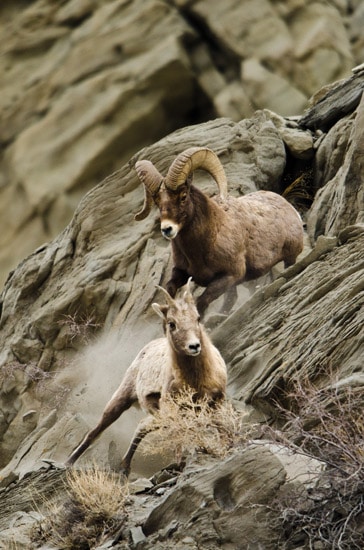
I know exactly what you’re thinking. “Why do I need three tools to control the exposure? Wouldn’t one suffice?” The answer is no, and I’ll explain why with an example. In January, I took a trip to my favorite place on the planet to take pictures–Yellowstone National Park. My guide informed us that the bighorn sheep in the park were dying off very quickly due to whooping cough, so I worked hard that week to capture pictures of the last few sheep in that area of the park.
Around 9AM on a cloudy day, I found a small group of bighorn sheep and started photographing them with a long 600mm lens. The early hour and clouded sky made the situation quite dark for shooting.
Let me help you out. The lens I was working with cost around $12,000, but don’t worry. You can get really good results with a much more affordable 600mm lens. I’m considering selling my expensive lens.
Anyway, it had a maximum aperture size of f/4. So I set my aperture at f/4 to gather as much light as possible. This also impacted the depth-of field to blur out the rocks behind the bighorn sheep. Next, I set my shutter speed. I wanted to capture action in the photo, so I set my camera to 1/1000th of a second shutter speed. I knew that this fast of a shutter speed would prevent any motion blur from the sheep running on the mountain side. Then, I took a picture. WAAAY too dark! I couldn’t compromise my shutter speed or aperture, so I knew I needed to use the third player in the exposure triangle–the ISO.
I played around with my ISO and found that if I increased it to ISO 640, it made the picture bright enough to take the picture without making it overly grainy. This combination of shutter speed, aperture, and ISO worked out perfectly. It feels so good to hone in the camera settings!
Now can you see why you need to know how to shutter, aperture, AND ISO, and know how to set them independently on your camera!
If you’re a visual learner and want to really learn your camera, then be sure to check out my Photography Start Course. Just a reminder, it’s a series of 22 videos where I take you on location to shoot waterfalls, landscapes, people, kids, and macro photos. You can look over my shoulder and see exactly how I set up my camera to take professional photos.
Now, you need to learn how to apply these settings on your camera to take advantage of your new-found nuggets of knowledge.
The Intelligence wants a final missing Locus to attain its purpose.
bangsar bungalow
fully furnished is not necessary an important factor
convenient and easy access with many access routes
In accordance with my observation, after a in foreclosure process home is bought at a bidding, it is common for any borrower to still have the remaining balance on the mortgage. There are many loan companies who make an effort to have all expenses and liens cleared by the following buyer. Nevertheless, depending on specified programs, regulations, and state laws and regulations there may be several loans which aren’t easily handled through the transfer of financial products. Therefore, the responsibility still rests on the customer that has obtained his or her property in foreclosure process. Thank you sharing your notions on this website.
We are a group of volunteers and starting a brand new scheme in our community.
Your web site offered us with helpful information to work on. You
have done a formidable task and our entire group might be grateful to you.
In engineering and supplies science, a stress-strain curve for a fabric offers the connection between stress and pressure.
I’m not sure why but this site is loading very slow for me. Is anyone else having this issue or is it a issue on my end? I’ll check back later and see if the problem still exists.
And generally sell shares when we get our desired price or sometimes we need to close the position in losses too.
The money may be invested in the enterprise with the condition that the angel traders or private fairness group be a major affect within the business choices of the corporate.
Selecting a regulation firm is vital.
Risks are as nicely present in options buying and selling like within the permitted types of barter and added ventures.
Interesting article. It is unfortunate that over the last years, the travel industry has had to tackle terrorism, SARS, tsunamis, bird flu, swine flu, and the first ever entire global economic downturn. Through everything the industry has really proven to be solid, resilient in addition to dynamic, obtaining new methods to deal with misfortune. There are often fresh troubles and opportunity to which the business must again adapt and act in response.
On July 14, East Stroudsburg University of Pennsylvania also introduced that classes for the fall 2020 semester will likely be held online.
You won’t be allowed to take notes, pens, rulers, a mobile phone, a digital camera, a BlackBerry — or most any type of digital or digital gear — into the take a look at room.
Made from a hundred percent bamboo, the sustainable towels are mushy, fast-drying, and ultra-absorbent.
Mar 1-2, 2025. North Canton, OH.
I would love to add when you do not already have an insurance policy or perhaps you do not participate in any group insurance, you could possibly well really benefit from seeking the help of a health insurance broker. Self-employed or people with medical conditions generally seek the help of one health insurance dealer. Thanks for your text.
Then, heat it all up with accents wealthy in texture, sample, and hot color.
Great breakdown of the fundamentals! I especially appreciated the clear explanations of how aperture, shutter speed, and ISO work together to impact exposure. The examples you provided really helped solidify my understanding. Can’t wait to put these tips into practice!