
From the sunset picture example, you have learned the importance of taking full control over the exposure on your camera. Now, it’s time to dig into your camera and learn the three most basic tools available to you in controlling the exposure.
Those tools are shutter speed, aperture, and ISO. After I explain what each one does, I’ll explain why we need three separate tools to control the brightness or darkness of the photo.
Aperture
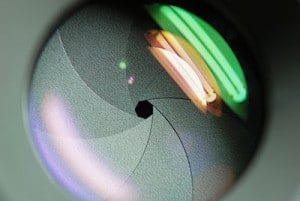
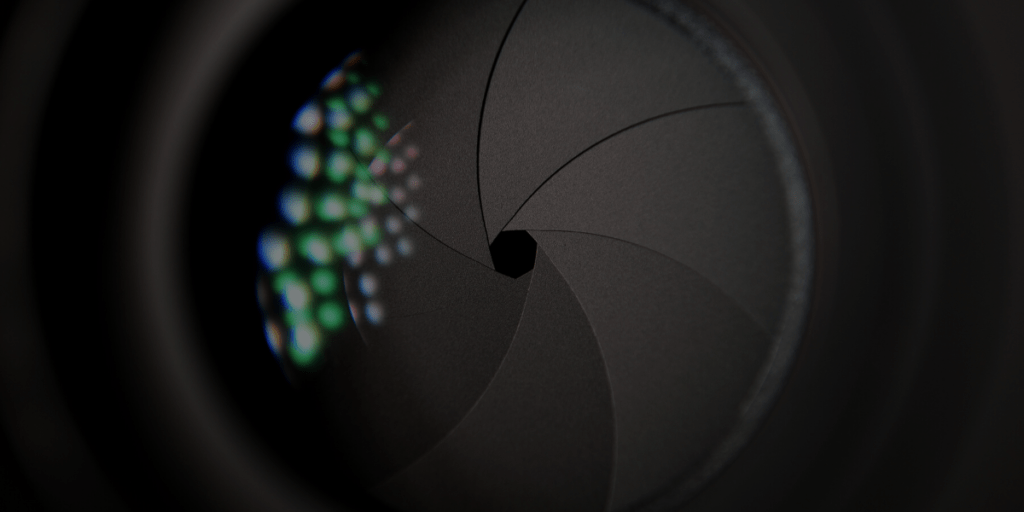
The aperture is a small set of blades in the lens that controls how much light will enter the camera. The blades create a octagonal shape that can be widened (we photogs call it shooting “wide open”), or closed down to a small hole. Obviously, if you shoot with the aperture wide open, then more light is allowed into the camera than if the aperture is closed down to only allow a tiny hole of light to enter the camera.
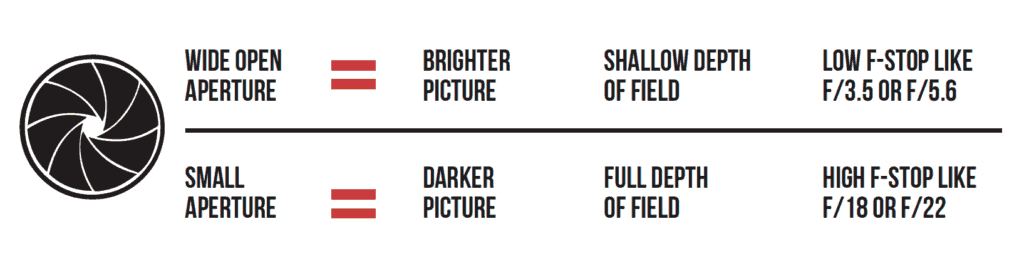
So suppose you take a picture that is too bright. How do you fix it? Simply choose a smaller aperture. Simple! Aperture sizes are measured by f-stops. A high f-stop like f-22 means that the aperture hole is quite small, and a low f-stop like f/3.5 means that the aperture is wide open.
Let’s test your knowledge to make sure you have it down. If you take a picture and it’s too dark at f/5.6, would you choose a lower f-stop number or a higher one? Yep! You’d choose a lower f-stop number, which opens up the aperture to let in more light. The size of the aperture controls more than the brightness or darkness of the picture, though.
The aperture also controls the depth-of-field. Depth-of-field is how much of the picture is sharp, and how much is blurry. If you want to take a picture of a person with a blurry background, you’d use shallow depth of field. If you want to take a picture of a sweeping mountain vista, you’d want to use a small aperture size (high f-stop number) so that the entire scene is in sharp focus. If you, like me, are more of a visual learner, then I think this graphic will help solidify the information about aperture. Take a minute and make sure you understand this info before moving on.
Shutter Speed
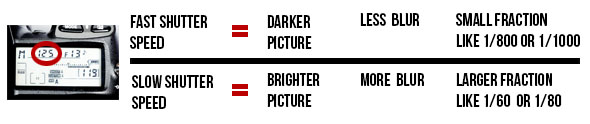
The shutter is a small “curtain” in the camera that quickly rolls over the image sensor (the digital version of film) and allows light to shine onto the imaging sensor for a fraction of a second. The longer the shutter allows light to shine onto the image sensor, the brighter the picture since more light is gathered. A darker picture is produced when the shutter moves very quickly and only allows light to touch the imaging sensor for a tiny fraction of a second. The duration that the shutter allows light onto the image sensor is called the shutter speed, and is measured in fractions of a second. So a shutter speed of 1/2 of a second will allow more light to touch the image sensor and will produce a brighter picture than a shutter speed of 1/200 of a second. So if you’re taking a picture and it is too dark, you could use a slower shutter speed to allow the camera to gather more light.
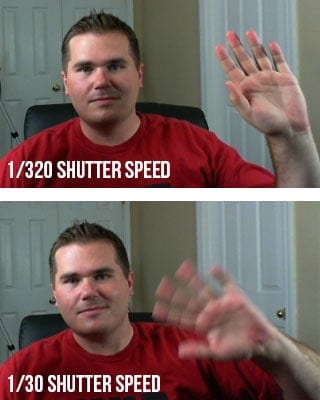
Just as the aperture affects the exposure as well as the depth-of field, the shutter affects more than just the exposure. The shutter speed is also principally responsible for controlling the amount of blur in a picture. If you think about it, it makes sense that the shutter speed controls how much blur is in the picture.
Imagine me sitting here at my computer desk waving to you (you don’t have to imagine very hard if you just look at the picture on the right). If you take a picture of me with a shutter speed of 1/30th of a second, then my hand will have moved in the time that the camera is recording the picture. To get rid of the blur, you need to increase the shutter speed to around 1/320th of a second. At this speed, my hand is still moving, but the camera takes the picture so fast that my hand travels only such a small distance that it is not noticeable in the picture.
The next question that most people ask is, how slow of a shutter speed can you use and still get a sharp picture? My blog post on Minimum Shutter Speeds will answer your question!
ISO
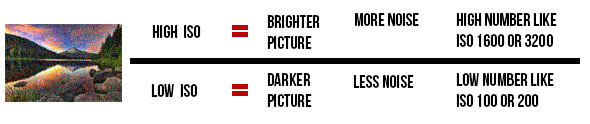
The funny thing about ISO is that it is an acronym, but nobody really knows what it stands for. It is always just called ISO even though it really stands for International Organization for Standardization. Every once in a while, you’ll hear an older photographer pronounce it “I-so”, but almost everyone pronounces it “I.S.O.” The ISO controls the exposure by using software in the camera to make it extra sensitive to light.
A high ISO such as ISO 1,600 will produce a brighter picture than a lower ISO such as ISO 100. The drawback to increasing the ISO is that it makes the picture noisier. Digital noise is apparent when a photo looks grainy. Have you ever taken a picture at night with your cell phone or your pocket camera, and noticed that it looks really grainy? That is because the camera tried to compensate for the dark scene by choosing a high ISO, which causes more grain.
What constitutes a “high” ISO is constantly changing. Camera companies are constantly improving the ability of cameras to use high ISOs without as much grain. A few years ago, only the highest-end pro DSLR cameras could achieve 2,000 ISO, and now even entry-level DSLR cameras can shoot at this level. Since each camera is different, you would do well to do a few tests with your camera to see how high of an ISO you can shoot at without making the image overly grainy.
Right now, you will commonly find new DSLRs that advertise expandable ISO ranges.
Putting It All Together
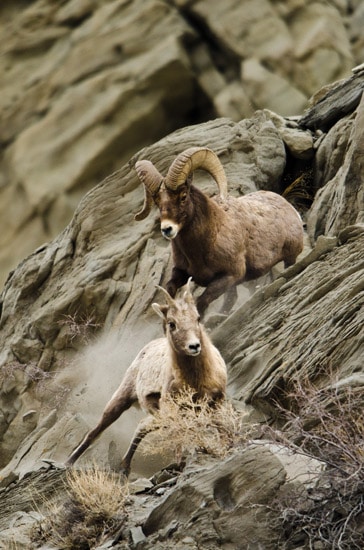
I know exactly what you’re thinking. “Why do I need three tools to control the exposure? Wouldn’t one suffice?” The answer is no, and I’ll explain why with an example. In January, I took a trip to my favorite place on the planet to take pictures–Yellowstone National Park. My guide informed us that the bighorn sheep in the park were dying off very quickly due to whooping cough, so I worked hard that week to capture pictures of the last few sheep in that area of the park.
Around 9AM on a cloudy day, I found a small group of bighorn sheep and started photographing them with a long 600mm lens. The early hour and clouded sky made the situation quite dark for shooting.
Let me help you out. The lens I was working with cost around $12,000, but don’t worry. You can get really good results with a much more affordable 600mm lens. I’m considering selling my expensive lens.
Anyway, it had a maximum aperture size of f/4. So I set my aperture at f/4 to gather as much light as possible. This also impacted the depth-of field to blur out the rocks behind the bighorn sheep. Next, I set my shutter speed. I wanted to capture action in the photo, so I set my camera to 1/1000th of a second shutter speed. I knew that this fast of a shutter speed would prevent any motion blur from the sheep running on the mountain side. Then, I took a picture. WAAAY too dark! I couldn’t compromise my shutter speed or aperture, so I knew I needed to use the third player in the exposure triangle–the ISO.
I played around with my ISO and found that if I increased it to ISO 640, it made the picture bright enough to take the picture without making it overly grainy. This combination of shutter speed, aperture, and ISO worked out perfectly. It feels so good to hone in the camera settings!
Now can you see why you need to know how to shutter, aperture, AND ISO, and know how to set them independently on your camera!
If you’re a visual learner and want to really learn your camera, then be sure to check out my Photography Start Course. Just a reminder, it’s a series of 22 videos where I take you on location to shoot waterfalls, landscapes, people, kids, and macro photos. You can look over my shoulder and see exactly how I set up my camera to take professional photos.

Now, you need to learn how to apply these settings on your camera to take advantage of your new-found nuggets of knowledge.
EnvyKellsx3 OnlyFans Leaks Mega Folder Link Download
some truly fantastic content on this internet site, appreciate it for contribution.
Bunz4Ever OnlyFans Leaks Mega Folder Link Download
You’re looking at how a lot purchasing you could do to prepare on your adventure.
I think other site proprietors should take this website as an model, very clean and great user genial style and design, let alone the content. You’re an expert in this topic!
FireViolet OnlyFans Leaks Mega Folder Link Download
No company’s marketing department wants to learn a product has been awarded just two circles — it’s the lowest rating, and that judgment comes straight from the people who use your product.
Stanley Morton, JP, Member, Bucklow Rural District Council, Cheshire.
The portfolio defines how much money might be invested and in which sectors comparable to, actual property, funds, bonds and stocks.
Lapis Lazuli, known as the “Stone of Knowledge,” can improve your mental skills and stimulate the want for data and understanding.
EDM Flower Fairy OnlyFans Leaks Mega Folder Link Download
They started to arrive at 2 p.m.; Morgan informed them that as many as 50 stock alternate houses would fail until $25 million was raised in 10 minutes.
Within the Star Wars canon, Darth Bane’s backstory as the only Sith survivor of the Jedi-Sith war and the creator of the Rule of Two is generally unchanged, although not much else is known about him.
Louis workplace, situated in Weldon Spring, have been compelled to take shelter and quickly suspend operations as an EF3 tornado passed just south of the power around 7:45 p.m.
Taxpayers who quickly promote the stock acquired from exercising ISOs incur precisely the identical tax penalties as regular decisions that take pleasure in the particular ISO characteristics.
It is truly a nice and helpful piece of information. I am happy that you just shared this helpful info with us. Please stay us up to date like this. Thanks for sharing.
An accounting trick, known as the Repo 105 aided financial relief to Lehman Brothers simply earlier than its supernova collapse.
Commodities exchanges usually trade futures contracts on commodities.
Thanks , I have just been searching for information about this subject for a long time and yours is the greatest I’ve came upon till now. But, what concerning the conclusion? Are you positive in regards to the source?
이러한 키워드들은 한국의 인터넷 도박
및 암호화폐 카지노 시장을 타겟팅한 것으로 보입니다.
‘크립토 카지노’와 ‘비트코인 도박’은 디지털 화폐를 이용한 온라인
도박의 핵심을 나타내며, ‘한국 온라인 카지노’은 로컬 시장을 겨냥합니다.
‘이더리움 카지노’와 같은 특정 암호화폐 관련 키워드도 포함되어 있어, 여러 디지털
화폐 사용자들의 주목을 받 수 있습니다.
‘보안 BTC 카지노’와 ‘실시간 크립토 카지노’는 사용자들의 핵심 요구사항인 안전성과 생생한 게임 체험을 부각시킵니다.
‘스마트폰 BTC 베팅’은 모바일 기기가 대중화된 한국
시장의 특성을 반영하며, ‘한국 암호화폐 베팅 사이트’는 현지화된 서비스를 찾는 사용자들을
타겟팅합니다. 이러한 키워드들은 암호화폐와 온라인
도박의 교차점에 있는 틈새 시장을 공략하고 있으며, 국내 이용자들을 위한 콘텐츠를 제공하는 데
초점을 맞추고 있습니다.