

Now, I’ll teach you all about focus and why your photos may not be as sharp as you’d like them to be.
This morning, I got an email from one of the students in my Photography Start Course who said she spent $2,000 on an expensive camera and another $1,500 on a high-end lens. Still, her pictures don’t look as sharp as she would like them to, and wondered why that is. I have to admit that I get this type of question SO OFTEN that I dedicated an entire WEEK of training in my beginner class to teach how to get crystal clear and sharp photos.
It is not uncommon for photographers to think that something must be wrong with their equipment if the photos don’t come out sharp, but most of the time I find that the reason is simply a product of mistakes the photographer makes when shooting. You can avoid those issues by understanding how to properly focus your camera.
The #1 focusing mistake of beginning photographers
The #1 mistake I see from beginning photographers in terms of getting clear pictures is that they aren’t being precise with their focus. I often ask students where they are focusing, and I get answers like, “On the model’s face.” The fact of the matter is that “the face” is far too large of an area to focus on for intimate portraits.
Suppose you’re taking a portrait of someone. Now that you’ve learned how to use shallow depth-of-field from the second part of this series, you want to use it all the time in your portraits to get a creamy background behind the subject. This means you’re usually shooting your portraits at f/2.8 or a similar low aperture.
Suppose that you’re using a 100mm lens and standing 7 feet (2.1 meters) from the subject. Did you know that, with these settings, only 1.4 inches (3.5 centimeters) of the photo is sharp? That means that, if you focus on the person’s cheek, their eyes and nose will be partially blurry.
So if you want your photos to come out crystal clear and sharp, you need to focus PRECISELY and make sure you have enough depth-of-field to make the subject come out sharp.
When shooting portraits, you will almost always focus on the person’s eye, since that is where the viewer of the photo will look first. For landscape photographers, check out this article on where to focus in landscape photography.
How to focus on one spot
When you were shooting in automatic mode on your camera, the camera would automatically find the subject and focus for you. Now that you’re shooting manually, it’s time to take control of your focus as well.
Your camera ALWAYS focuses on one specific spot in the scene. It is physically impossible for a lens to focus on two spots at once. When you look through your viewfinder, you see a bunch of dots (Canon) or small boxes (Nikon). Those markings show you where the camera is focusing. This spot generally blinks red when the camera sets focus.
In the picture below, I chose to focus on the ant on the flower, since that is where I wanted people to look. To do this, I set the camera to spot focus and used the four-way selector on the back of my DSLR to move the focus point onto the ant.
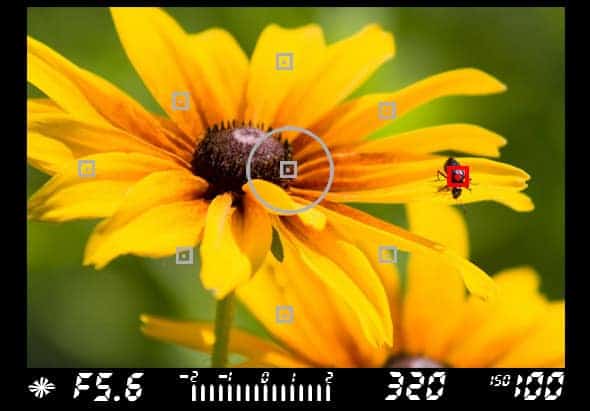
Sometimes, the spot in the picture where you want to focus will not have a focus point available. This is especially true on entry-level Canon Rebel or Nikon D3500 DSLRs, which do not have many focus points. If you find that this is the case, check out this article on focusing and recomposing.
Focus Selections
I hope I didn’t confuse you earlier when I said that the camera can ONLY focus on one specific spot in the photo. There are ways that you can activate multiple focus points at once, but in doing so, the camera is just choosing the best of both worlds and compromising between the focus selections to set the focus in the middle somewhere.
99% of the time when I’m out shooting I use spot focus, which allows me to move around the focus point in the viewfinder. My thumb has become adept at constantly moving around the focus point using the four-way selector on the back of the camera as I compose a shot through the viewfinder. Spot focus is great because you have exact control over where the focus is placed.
However, there are other focus selection options on most DSLR cameras. Other than spot focus, you have the ability to choose a small group of between 3 and 5 focus points and tell the camera to choose the best of those points, or you could set your camera to determine which focus point to use all on its own.
I never let the camera take control of focus–it’s a recipe for blurry pictures. When I’m shooting sports or fast-moving wildlife, I’ll sometimes set the camera to use any of the center area focus points and choose the best one, because the action happens faster than I can move the focus point.
Although there are certainly situations to use other focus selections, I would encourage you to use spot focus and get used to constantly moving around the focus point around the frame as you shoot for the next few months.
Focus Modes
Aside from selecting which focus point(s) the camera is using, you also need to set which type of autofocus the camera will use. For most uses, you’ll want to leave your camera on “AF-S” (Nikon) or “One Shot” (Canon). This means that the camera will acquire focus when you press half-way down on the shutter button, and then take the picture when you finish pressing all the way down on the shutter button.
The other main option is continuous focus (displayed on the camera as “AF-C” for Nikon cameras and “AI Servo” for Canon cameras). This mode is used when the subject is moving. Suppose you’re shooting a soccer player running toward you. If you use one shot, then the camera focuses when you press half way down on the shutter, and by the time you finish pressing all the way down, the camera takes the picture. In that split second, the athlete will have moved, so the picture will not turn out sharp. Continuous focus (AF-C or AI SERVO) means that the camera continues to find focus all the way up to the instant that you snap the picture.
So why wouldn’t you want to use continuous focus all the time? Because it’s slightly less precise than one shot. So here’s the rule… use one shot (“AF-S” on Nikon, and “One Shot” on Canon) for all shots where the subject is reasonably still like landscapes or most portraits. Use continuous focus (“AF-C” on Nikon, and “AI Servo” on Canon) for all fast-moving shots.
Note: Canon users will also see the option for “AI Focus” when choosing a focus mode. There is a specific use for this, but honestly it’s just outdated technology. I have tried it extensively even in the best case scenarios for this focus mode and have always achieved better results with AI Servo.
You have just learned a LOT of the basics of how your camera works, but there is much more to learn. If you want more information like this in video format that you can watch at your own pace, you should really check out the Photography Start Course. It’s 22 videos, many filmed on-location, with all the camera settings for each picture, videos of exactly how to put a composition together, and training on getting tack sharp photos.

What’s Next?
We have a plethora of resources to help you take your photography to the next level!
First, I would recommend joining the Improve Your Photography Facebook Group. Feel free to ask as many questions as you want and have them answered by photographers just like you!
Check out our amazing Premium Tutorials to learn from some of the top photographers in the world.
Join our Improve Photography Plus Membership for training designed by experts – start a 14-day free trial today!
Find the best photography locations near you!
Our recommended gear list so you don’t have to worry about wasting money on the wrong stuff. See our top picks!
Oh, and in case you forgot…
Roses are red,
Violets are blue.
Photography is great,
And you are too.
музыка [url=https://mailsco.online/]mailsco[/url] вдохновляет людей, объединяя общества. Через музыку взаимодействие становится ближе.
The focus and sharpness basics are really well explained here. Something that helped me a lot was creating a reference sheet with all my gear settings and keeping it accessible while shooting. Being able to quickly check settings without fumbling through menus makes a huge difference in the field.
Excellent web site. Lots of useful information here. I?m sending it to a few friends ans also sharing in delicious. And obviously, thanks for your sweat!
Hi there, You’ve performed an excellent job. I?ll definitely digg it and in my opinion recommend to my friends. I am sure they’ll be benefited from this web site.
Thanks for the auspicious writeup. It in fact used to be a leisure account it. Look complex to more introduced agreeable from you! By the way, how can we be in contact?
Terrific work! That is the type of info that are supposed to be shared around the internet. Shame on the search engines for now not positioning this put up upper! Come on over and consult with my web site . Thank you =)
Spot on with this write-up, I truly think this website needs way more consideration. I?ll most likely be once more to read much more, thanks for that info.
Looking for the Best Drive School of Motoring? Get expert driving lessons at best driving school for affordable and quality driving instruction.
Together with everything that seems to be developing within this specific subject matter, a significant percentage of points of view tend to be rather refreshing. Having said that, I beg your pardon, because I can not subscribe to your whole plan, all be it exciting none the less. It would seem to me that your opinions are not entirely validated and in actuality you are your self not really thoroughly convinced of your assertion. In any case I did take pleasure in reading through it.
Thanks for the recommendations you have contributed here. Something important I would like to express is that laptop memory demands generally rise along with other improvements in the know-how. For instance, any time new generations of processor chips are brought to the market, there is usually a similar increase in the size and style preferences of all pc memory as well as hard drive space. This is because the application operated by simply these cpus will inevitably surge in power to use the new technological innovation.
I am now not certain the place you are getting your info, however good topic. I needs to spend a while finding out much more or understanding more. Thank you for great info I used to be in search of this information for my mission.
It is indeed my belief that mesothelioma is most fatal cancer. It’s got unusual traits. The more I actually look at it the more I am sure it does not react like a real solid tissue cancer. In case mesothelioma is a rogue viral infection, so there is the chance for developing a vaccine and also offering vaccination to asbestos exposed people who are at high risk connected with developing long term asbestos relevant malignancies. Thanks for sharing your ideas on this important health issue.
I have fun with, lead to I found just what I was looking for. You’ve ended my 4 day long hunt! God Bless you man. Have a nice day. Bye
It?s laborious to seek out knowledgeable people on this matter, however you sound like you understand what you?re talking about! Thanks
Thanks for this glorious article. One other thing is that many digital cameras come equipped with a new zoom lens that enables more or less of a scene for being included by way of ‘zooming’ in and out. Most of these changes in {focus|focusing|concentration|target|the a**** length are generally reflected inside the viewfinder and on large display screen on the back of any camera.
A large percentage of of what you say happens to be astonishingly appropriate and it makes me wonder why I had not looked at this with this light before. This particular piece truly did switch the light on for me as far as this specific issue goes. But there is one particular factor I am not too comfy with so whilst I try to reconcile that with the core theme of your issue, allow me see just what all the rest of your readers have to point out.Well done.
The other day, while I was at work, my cousin stole my iphone and tested to see if it can survive a 30 foot drop, just so she can be a youtube sensation. My iPad is now destroyed and she has 83 views. I know this is completely off topic but I had to share it with someone!
I loved up to you will obtain carried out right here. The sketch is tasteful, your authored material stylish. nevertheless, you command get bought an impatience over that you wish be delivering the following. ill surely come further in the past once more since exactly the same nearly very regularly inside case you defend this increase.
Thanks for the ideas you are revealing on this site. Another thing I’d like to say is that often getting hold of copies of your credit rating in order to check out accuracy of each detail will be the first step you have to execute in fixing credit. You are looking to thoroughly clean your credit profile from detrimental details faults that ruin your credit score.
Your home is valueble for me. Thanks!?