I’m so glad you found your way onto my Photography Basics series. I have taught the basics of photography to millions of photographers around the world through Improve Photography, so I know just exactly how difficult it can seem to learn the basics of photography.
My goal is to make this Photography Basics series the absolute simplest way to learn the basics of photography.
I hope you’ll love this series because of what you learn here, and I hope you’ll join the Improve Photography community after you get your feet wet with the photo basics. Let’s get going.
Basic Equipment You’ll Need
You can do photography with even the simplest of cameras, but the principles that I’d like to teach are for people who want to learn to use a DSLR camera, a micro four-thirds camera, or at least a camera that allows the photographer to adjust the shutter speed, aperture, and ISO. Even some pocket cameras have this functionality.
Here are some of our entry level DSLR options. The (with Accessories) link will show you a kit that comes with the camera, lens, case, extra battery, and a memory card:
Canon EOS Rebel T6 with 18-55mm and 75-300mm Lenses (with Accessories)
Nikon D5600 with 18-55mm and 70-300mm Lenses (with Accessories)
Canon EOS Rebel T7i with 18-135mm Lens (with Accessories)
Now that you have your camera, it is time to learn exposure.
Exposure–the most basic element of photography
When photographers talk about “exposure,” we simply mean the brightness or darkness of a photo. It seems simple enough to take a photo that is correctly exposed (has the proper brightness or darkness), but in reality it can be quite the trick.

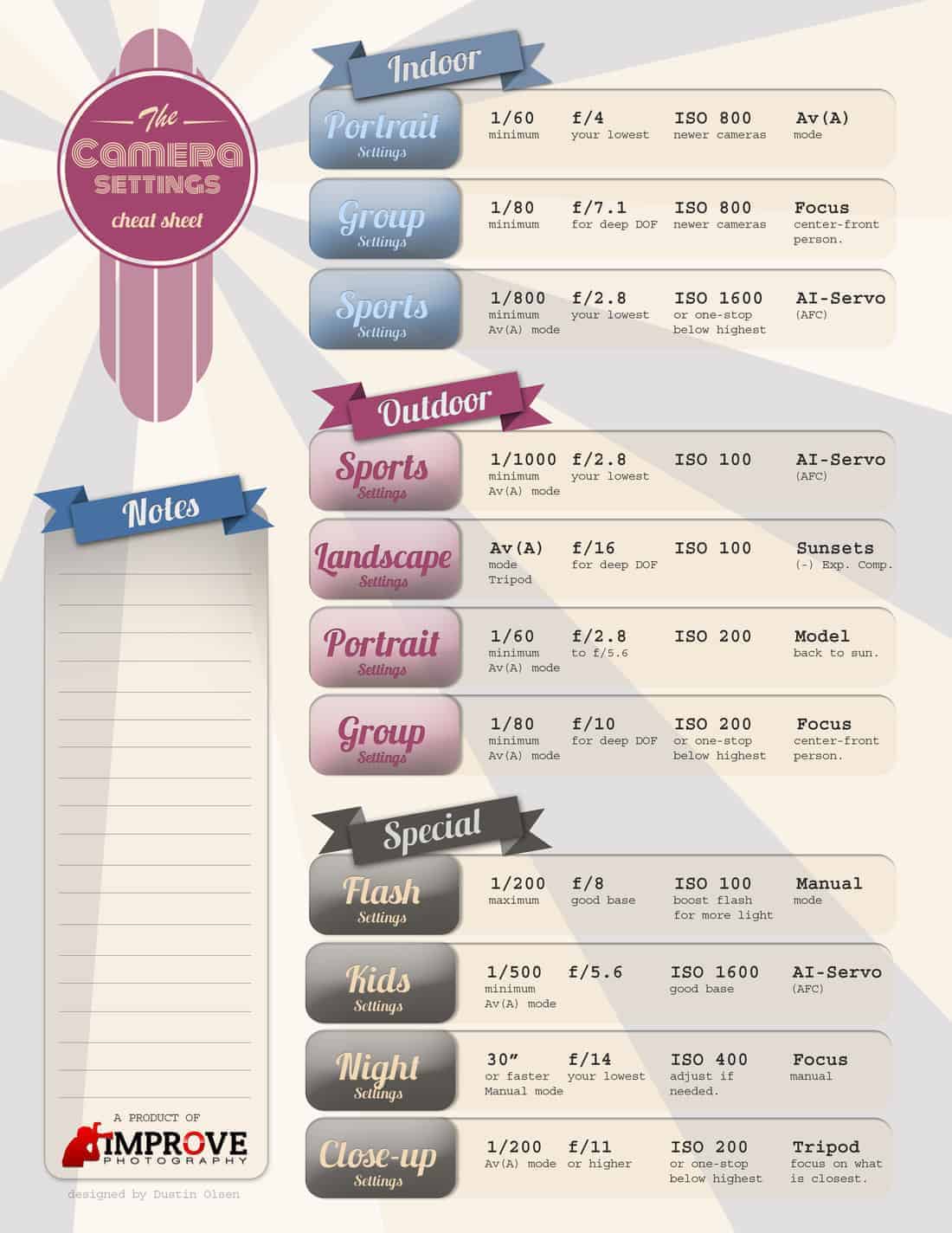
To help get the right exposure with your camera settings – you can download this Camera Settings Cheat Sheet guide.
If you’re reading this Photo Basics series, it probably means that you currently shoot on the “Green mode” of your camera–or the automatic setting. That means the camera entirely controls the exposure of the picture. When you shoot on automatic mode, your camera selects an aperture setting, an ISO setting, a shutter speed, and a host of other settings for you.
Automatic can be handy, but it also seriously limits your creative ability to make a beautiful picture.
Want proof that automatic isn’t the best way to shoot? Check out the picture below. On the left, the picture was taken entirely in automatic mode on a Canon Rebel DSLR. That might look okay to you… until you see the picture on the right. Same sunset. Same camera. The pictures were taken only seconds apart. The difference? The picture on the right was taken using manual exposure.

Which photo do you prefer? Probably the picture on the right! By choosing a creatively dark exposure, the rich colors in the sunset were allowed to shine through.
However, technically, the photo on the left is “correct,” and the photo on the right is “incorrect.” The camera saw through the lens and tried to expose the bird so that it wouldn’t become a shadow. To me, the photo was not about exposing the bird properly, but exposing the sunset properly. The bird was just a nice shape to include in the foreground. This is exactly why you must learn exposure–because sometimes the “scientifically correct” exposure is not the best exposure to make the photo look how you want it to.
What’s next?
Now that you understand why it is so important to take control over the exposure, let’s move on to shutter, aperture and ISO–which are the tools you need to control the exposure. Soon you’ll understand the basics of how to shoot in manual mode on your camera. I promise shooting in manual mode isn’t nearly as scary as you might think.
Once you’re ready to deepen your knowledge of manual mode, get tack sharp focus, and master lighting, consider buying my Photography Start Course. It’s a series of 22 video tutorials where I walk you step-by-step through the things that it normally takes my photography students two years to learn. Other photography websites sell a very similar course for $300. I’ve priced it at a REALLY reasonable price because I remember how tight money was when I was a beginner.
It is in point of fact a great and useful piece
of information. I’m satisfied that you just shared this helpful information with us.
Please stay us up to date like this. Thanks for sharing.
Great introduction to exposure! I appreciated the clear explanations and practical tips. Can’t wait to try out what I’ve learned in my next photography session!
When enthusiasts find your vast cosmos of SA GAMING, users
immediately perceive where said site stands over various rivals across
the business. With the attractive imagery and perfect interface, SA
GAMING supplies an unmatched adventure for devotees looking for real amusement alternatives online.
If a person is new for casino activities including some professional gamer, said provider accommodates persons by unobstructed limbs.
I’ve recently started a site, the information you offer on this website has helped me greatly. Thank you for all of your time & work.
Thanks for sharing useful details! If you need safe Pigeon Net for Balcony Bangalore, we specialize in customized net installations with guaranteed durability.
Great intro — clear, encouraging, and perfect for beginners learning why exposure and manual control truly matter.
Clear, simple, and super helpful—your exposure explanation finally made photography click for me. Great guide
Great article! If you’re searching for the Best Gynecologist for PCOS in Hyderabad, our specialist provides advanced diagnosis, hormonal care, and personalized treatment plans.
Clear, beginner-friendly explanation! This makes exposure so much easier to grasp—excited to practice manual mode confidently now.
This is such a helpful introduction to exposure! The way you explained the relationship between shutter speed, aperture, and ISO makes it much easier to understand compared to many other guides I’ve seen. For beginners, exposure can feel overwhelming, but your examples really simplify the learning curve. Looking forward to the next part of the series—excited to dive deeper into camera basics!
Great introduction to exposure—simple, clear, and practical. This guide makes learning photography feel easy and enjoyable for beginners starting their journey.
Great breakdown of the essential gear! It’s easy to get overwhelmed by all the options out there, but focusing on the basics really keeps things simple and budget-friendly. I appreciate how you highlighted the must-haves without overcomplicating it. Perfect guide for beginners who just want to get started with the right setup.
Photography starts with understanding exposure. Learning manual control of shutter, aperture, and ISO gives creative power far beyond the camera’s automatic mode.
rf0yu3
here best photography also Througgh AI
Hi,
Great Article! Your insights are spot on in Incredicool.The Ultimate Solution for Social Media Growth. I especially appreciate your points. You’ve done your research. Keep up the excellent work! I’m looking forward to reading more from you.
Here is sharing SAP Integrated Business Planning (IBP) Training & Certification | GoLogica-related stuff that may be helpful to you.
I do enjoy the way you have presented this specific challenge and it does indeed present me some fodder for consideration. Nevertheless, coming from what I have experienced, I just trust when other comments pack on that people today remain on point and in no way embark upon a soap box associated with the news of the day. All the same, thank you for this superb point and while I can not necessarily agree with this in totality, I regard the point of view.
Great introduction to the basics of exposure! I really appreciated the clear explanations and examples. Can’t wait to apply these tips in my next photoshoot!
Great insights on exposure! I always struggled with understanding the relationship between aperture, shutter speed, and ISO, but your breakdown made it so much clearer. Excited to apply these tips on my next shoot!
Thanks designed for sharing such a fastidious thought, piece of writing is fastidious, thats why i have read it completely