I’m so glad you found your way onto my Photography Basics series. I have taught the basics of photography to millions of photographers around the world through Improve Photography, so I know just exactly how difficult it can seem to learn the basics of photography.
My goal is to make this Photography Basics series the absolute simplest way to learn the basics of photography.
I hope you’ll love this series because of what you learn here, and I hope you’ll join the Improve Photography community after you get your feet wet with the photo basics. Let’s get going.
Basic Equipment You’ll Need
You can do photography with even the simplest of cameras, but the principles that I’d like to teach are for people who want to learn to use a DSLR camera, a micro four-thirds camera, or at least a camera that allows the photographer to adjust the shutter speed, aperture, and ISO. Even some pocket cameras have this functionality.
Here are some of our entry level DSLR options. The (with Accessories) link will show you a kit that comes with the camera, lens, case, extra battery, and a memory card:
Canon EOS Rebel T6 with 18-55mm and 75-300mm Lenses (with Accessories)
Nikon D5600 with 18-55mm and 70-300mm Lenses (with Accessories)
Canon EOS Rebel T7i with 18-135mm Lens (with Accessories)
Now that you have your camera, it is time to learn exposure.
Exposure–the most basic element of photography
When photographers talk about “exposure,” we simply mean the brightness or darkness of a photo. It seems simple enough to take a photo that is correctly exposed (has the proper brightness or darkness), but in reality it can be quite the trick.

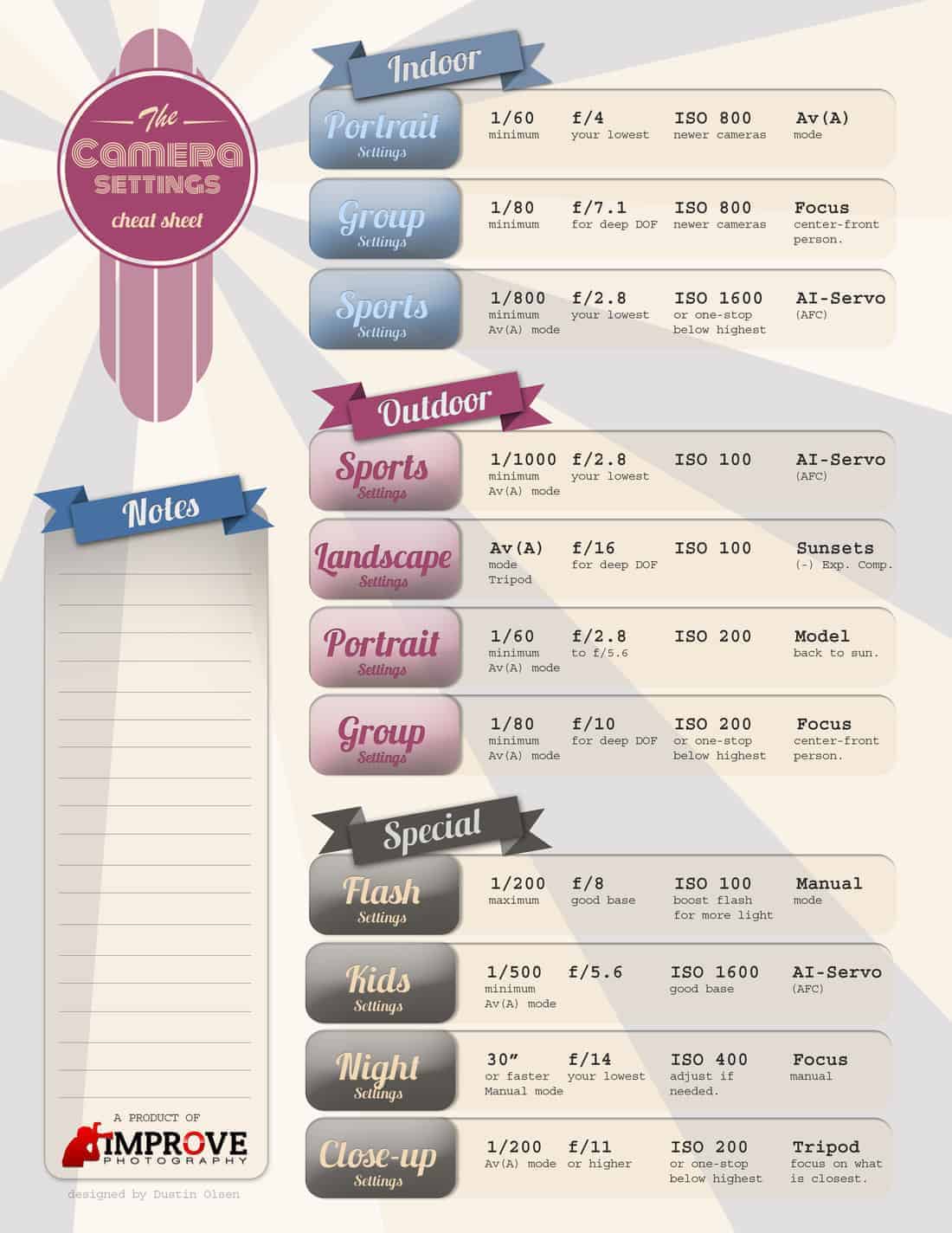
To help get the right exposure with your camera settings – you can download this Camera Settings Cheat Sheet guide.
If you’re reading this Photo Basics series, it probably means that you currently shoot on the “Green mode” of your camera–or the automatic setting. That means the camera entirely controls the exposure of the picture. When you shoot on automatic mode, your camera selects an aperture setting, an ISO setting, a shutter speed, and a host of other settings for you.
Automatic can be handy, but it also seriously limits your creative ability to make a beautiful picture.
Want proof that automatic isn’t the best way to shoot? Check out the picture below. On the left, the picture was taken entirely in automatic mode on a Canon Rebel DSLR. That might look okay to you… until you see the picture on the right. Same sunset. Same camera. The pictures were taken only seconds apart. The difference? The picture on the right was taken using manual exposure.

Which photo do you prefer? Probably the picture on the right! By choosing a creatively dark exposure, the rich colors in the sunset were allowed to shine through.
However, technically, the photo on the left is “correct,” and the photo on the right is “incorrect.” The camera saw through the lens and tried to expose the bird so that it wouldn’t become a shadow. To me, the photo was not about exposing the bird properly, but exposing the sunset properly. The bird was just a nice shape to include in the foreground. This is exactly why you must learn exposure–because sometimes the “scientifically correct” exposure is not the best exposure to make the photo look how you want it to.
What’s next?
Now that you understand why it is so important to take control over the exposure, let’s move on to shutter, aperture and ISO–which are the tools you need to control the exposure. Soon you’ll understand the basics of how to shoot in manual mode on your camera. I promise shooting in manual mode isn’t nearly as scary as you might think.
Once you’re ready to deepen your knowledge of manual mode, get tack sharp focus, and master lighting, consider buying my Photography Start Course. It’s a series of 22 video tutorials where I walk you step-by-step through the things that it normally takes my photography students two years to learn. Other photography websites sell a very similar course for $300. I’ve priced it at a REALLY reasonable price because I remember how tight money was when I was a beginner.
Thank you, I have just been searching for info approximately
this topic for a long time and yours is the best I’ve came upon till now.
However, what in regards to the conclusion? Are you sure concerning the source?
Hit satın alarak web sitenizin trafiğini hızlıca artırın! Gerçek ziyaretçilerle SEO performansınızı yükseltin, arama motorlarında üst sıralara çıkın. Güvenli ve etkili hit hizmeti sizi bekliyor.
I delight in, result in I found exactly what I used to
be looking for. You’ve ended my four day long hunt!
God Bless you man. Have a nice day. Bye
I was curious if you ever thought of changing the page layout of your site? Its very well written; I love what youve got to say. But maybe you could a little more in the way of content so people could connect with it better. Youve got an awful lot of text for only having one or two images. Maybe you could space it out better?
Great introduction to the fundamentals of exposure! I especially appreciated the breakdown of the exposure triangle. It really helped clarify how aperture, shutter speed, and ISO work together. Looking forward to implementing these tips in my photography!
Keep on working, great job!
Great introduction to exposure! I appreciate how you broke down the concepts so clearly. Can’t wait to apply these tips in my next shoot!
Having read this I thought it was extremely enlightening.
I appreciate you finding the time and effort to put
this informative article together. I once again find myself spending way too much time both reading and
leaving comments. But so what, it was still worth it!
The other day, while I was at work, my sister stole my apple ipad and tested to see
if it can survive a 40 foot drop, just so she can be a youtube sensation.
My iPad is now destroyed and she has 83 views. I know this
is entirely off topic but I had to share it with someone!
Great introduction to exposure! I appreciate how you broke down the concepts in an easily digestible way. I’m excited to put these tips into practice and improve my photography skills!
I believe this is one of the so much significant information for me.
And i am happy studying your article. However should
observation on few basic issues, The website taste is perfect, the articles is really
great : D. Excellent job, cheers
If you are going for finest contents like I do, only visit this web site everyday
because it gives quality contents, thanks
ruipeknpdneizeqptvvutduymdyihh
Great introduction to photography! I never realized how much exposure impacts the overall quality of a photo. Excited to apply these tips in my own shooting!
For newest news you have to pay a visit world-wide-web and on web I found this
web site as a most excellent site for newest updates.
Нello just wanted to give you a brief heads up and
let you know a few of the images arеn’t loading correctly.
I’m not sure why but I think its a linking issue.
I’vе tried it in two different internet browsers and both show
the same results.
“DhakaMovers is a reliable and efficient moving company that truly understands customer needs. Their team handles packing, shifting, and delivery with great care and professionalism. Highly recommended for anyone looking for a smooth and stress-free moving experience in Dhaka.”
Great introduction to the basics of photography! I really appreciate how clearly you explained exposure. Can’t wait to dive deeper into the next topics!
Great introduction to the basics of exposure! I especially appreciated the clear explanations and examples. Can’t wait to apply these tips in my photography practice!
I really enjoyed how this guide breaks down the basics of photography—it makes it feel way less intimidating for beginners. Understanding light, composition, and timing is everything, and the examples make it click instantly. When I work on growing an agency, I notice the same principle applies: having the right framework and tools lets you focus on creativity without getting lost in technical details. That’s one of the reasons I value white label seo it handles the backend work so you can focus on the craft, just like mastering the fundamentals in photography makes every shot more intentional and impactful.