I’m so glad you found your way onto my Photography Basics series. I have taught the basics of photography to millions of photographers around the world through Improve Photography, so I know just exactly how difficult it can seem to learn the basics of photography.
My goal is to make this Photography Basics series the absolute simplest way to learn the basics of photography.
I hope you’ll love this series because of what you learn here, and I hope you’ll join the Improve Photography community after you get your feet wet with the photo basics. Let’s get going.
Basic Equipment You’ll Need
You can do photography with even the simplest of cameras, but the principles that I’d like to teach are for people who want to learn to use a DSLR camera, a micro four-thirds camera, or at least a camera that allows the photographer to adjust the shutter speed, aperture, and ISO. Even some pocket cameras have this functionality.
Here are some of our entry level DSLR options. The (with Accessories) link will show you a kit that comes with the camera, lens, case, extra battery, and a memory card:
Canon EOS Rebel T6 with 18-55mm and 75-300mm Lenses (with Accessories)
Nikon D5600 with 18-55mm and 70-300mm Lenses (with Accessories)
Canon EOS Rebel T7i with 18-135mm Lens (with Accessories)
Now that you have your camera, it is time to learn exposure.
Exposure–the most basic element of photography
When photographers talk about “exposure,” we simply mean the brightness or darkness of a photo. It seems simple enough to take a photo that is correctly exposed (has the proper brightness or darkness), but in reality it can be quite the trick.
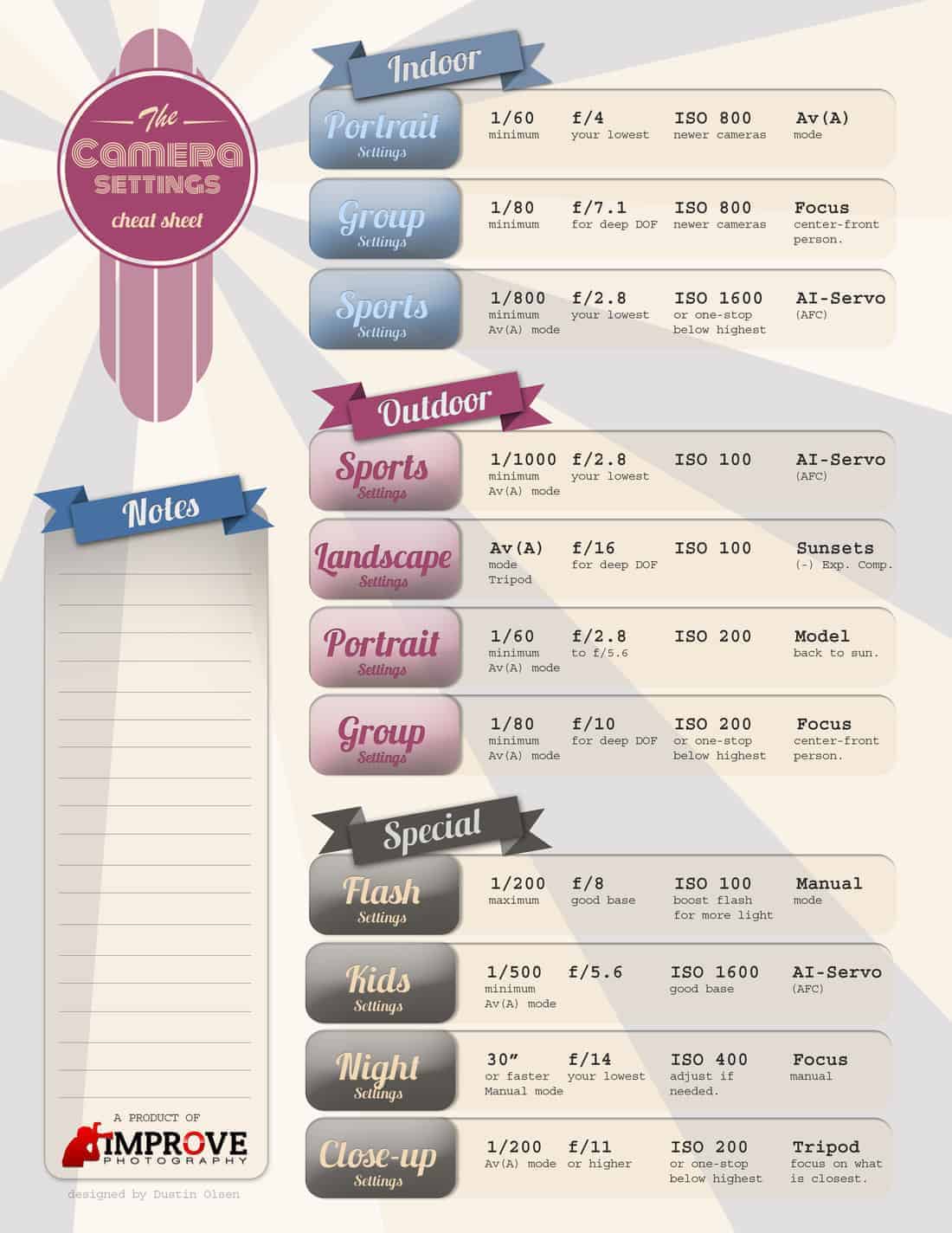
To help get the right exposure with your camera settings – you can download this Camera Settings Cheat Sheet guide.
If you’re reading this Photo Basics series, it probably means that you currently shoot on the “Green mode” of your camera–or the automatic setting. That means the camera entirely controls the exposure of the picture. When you shoot on automatic mode, your camera selects an aperture setting, an ISO setting, a shutter speed, and a host of other settings for you.
Automatic can be handy, but it also seriously limits your creative ability to make a beautiful picture.
Want proof that automatic isn’t the best way to shoot? Check out the picture below. On the left, the picture was taken entirely in automatic mode on a Canon Rebel DSLR. That might look okay to you… until you see the picture on the right. Same sunset. Same camera. The pictures were taken only seconds apart. The difference? The picture on the right was taken using manual exposure.

Which photo do you prefer? Probably the picture on the right! By choosing a creatively dark exposure, the rich colors in the sunset were allowed to shine through.
However, technically, the photo on the left is “correct,” and the photo on the right is “incorrect.” The camera saw through the lens and tried to expose the bird so that it wouldn’t become a shadow. To me, the photo was not about exposing the bird properly, but exposing the sunset properly. The bird was just a nice shape to include in the foreground. This is exactly why you must learn exposure–because sometimes the “scientifically correct” exposure is not the best exposure to make the photo look how you want it to.
What’s next?
Now that you understand why it is so important to take control over the exposure, let’s move on to shutter, aperture and ISO–which are the tools you need to control the exposure. Soon you’ll understand the basics of how to shoot in manual mode on your camera. I promise shooting in manual mode isn’t nearly as scary as you might think.
Once you’re ready to deepen your knowledge of manual mode, get tack sharp focus, and master lighting, consider buying my Photography Start Course. It’s a series of 22 video tutorials where I walk you step-by-step through the things that it normally takes my photography students two years to learn. Other photography websites sell a very similar course for $300. I’ve priced it at a REALLY reasonable price because I remember how tight money was when I was a beginner.
The other day, while I was at work, my cousin stole my iPad and tested to see if it can survive a 30
foot drop, just so she can be a youtube sensation. My apple ipad is now destroyed annd she has 83
views. I know this is entirely off topic but I had to share it with someone!
Together with every thing that seems to be building throughout this particular subject material, all your opinions happen to be fairly stimulating. Nonetheless, I beg your pardon, but I do not give credence to your whole suggestion, all be it refreshing none the less. It seems to us that your comments are not completely justified and in actuality you are generally your self not even entirely certain of your argument. In any case I did appreciate looking at it.
Shop Botticelli olive oil online Vital Grocer deal and elevate your cooking game with this rich, flavorful, and authentic extra virgin olive oil. Whether you’re drizzling over a fresh salad, roasting veggies, or finishing a pasta dish, Botticelli EVOO brings bold Mediterranean flavor to your kitchen. This unbeatable deal gives you top-quality oil at a price that’s hard to resist. Order now and stock your pantry the smart way!
When using the same focal length, aperture, and distance, a full-frame camera actually has more depth of field than a crop sensor. The crop sensor shows less DOF only when you adjust focal length or distance to get the same framing. That’s why it seems confusing, but both are correct depending on how you compare them.
Hi Sophia! That’s awesome to hear—you don’t need fancy gear to have a great eye, and the iPhone 6 can still capture some amazing shots. If you’re ready to upgrade, I’d recommend starting with something beginner-friendly like the Canon EOS Rebel T7 or Nikon D3500—both are affordable, easy to use, and take beautiful photos. If you prefer something more compact, the Sony ZV-E10 is a great mirrorless option. Happy shooting! 📸
8dcbi7
بلیچینگ دندان در شمال تهران
Great introduction to the basics of exposure! I appreciate the clear explanations and examples. Can’t wait to dive deeper into my photography skills!
I have noticed that in digital cameras, specialized devices help to {focus|concentrate|maintain focus|target|a**** automatically. These sensors associated with some digital cameras change in contrast, while others employ a beam involving infra-red (IR) light, particularly in low light. Higher specs cameras sometimes use a mix of both models and will often have Face Priority AF where the photographic camera can ‘See’ the face while keeping your focus only on that. Thanks for sharing your notions on this website.
This is such a helpful breakdown for beginners! I’ve always been intimidated by manual mode, but your comparison photo really drives the point home — exposure can completely change the story a photo tells. I also appreciate the clear explanation of ISO, aperture, and shutter speed. Looking forward to diving deeper into the series. Thanks for simplifying such a complex topic!
You need to be a part of a contest for one of the finest sites on the internet.
I am going to recommend this website!
You actually make it seem really easy with your presentation however I to find this matter to be actualply one
thing that I think I would never understand. It seems too complicated and extremely huge for me.
I am having a look forward on your next submit, I’ll try to get the hold of it!
I could not refrain from commenting. Well written!
We are a group of volunteers and starting a new scheme in our community. Your site offered us with helpful information to paintings on. You have done an impressive task and our entire neighborhood will probably be grateful to you.
What an eye-opening and thoroughly-researched article! The author’s thoroughness and capability to present complicated ideas in a understandable manner is truly praiseworthy. I’m extremely captivated by the scope of knowledge showcased in this piece. Thank you, author, for offering your wisdom with us. This article has been a true revelation!
Thank you for the auspicious writeup. It in fact was a amusement account it. Look advanced to far added agreeable from you! By the way, how can we communicate?
Would you be keen on exchanging links?
“Just starting out and this made things so much clearer. Grateful for content like this!”
Great introduction to the basics of exposure! I really appreciated the clear examples and tips provided. Can’t wait to apply these concepts to my own photography!
ijjm8n