I’m so glad you found your way onto my Photography Basics series. I have taught the basics of photography to millions of photographers around the world through Improve Photography, so I know just exactly how difficult it can seem to learn the basics of photography.
My goal is to make this Photography Basics series the absolute simplest way to learn the basics of photography.
I hope you’ll love this series because of what you learn here, and I hope you’ll join the Improve Photography community after you get your feet wet with the photo basics. Let’s get going.
Basic Equipment You’ll Need
You can do photography with even the simplest of cameras, but the principles that I’d like to teach are for people who want to learn to use a DSLR camera, a micro four-thirds camera, or at least a camera that allows the photographer to adjust the shutter speed, aperture, and ISO. Even some pocket cameras have this functionality.
Here are some of our entry level DSLR options. The (with Accessories) link will show you a kit that comes with the camera, lens, case, extra battery, and a memory card:
Canon EOS Rebel T6 with 18-55mm and 75-300mm Lenses (with Accessories)
Nikon D5600 with 18-55mm and 70-300mm Lenses (with Accessories)
Canon EOS Rebel T7i with 18-135mm Lens (with Accessories)
Now that you have your camera, it is time to learn exposure.
Exposure–the most basic element of photography
When photographers talk about “exposure,” we simply mean the brightness or darkness of a photo. It seems simple enough to take a photo that is correctly exposed (has the proper brightness or darkness), but in reality it can be quite the trick.
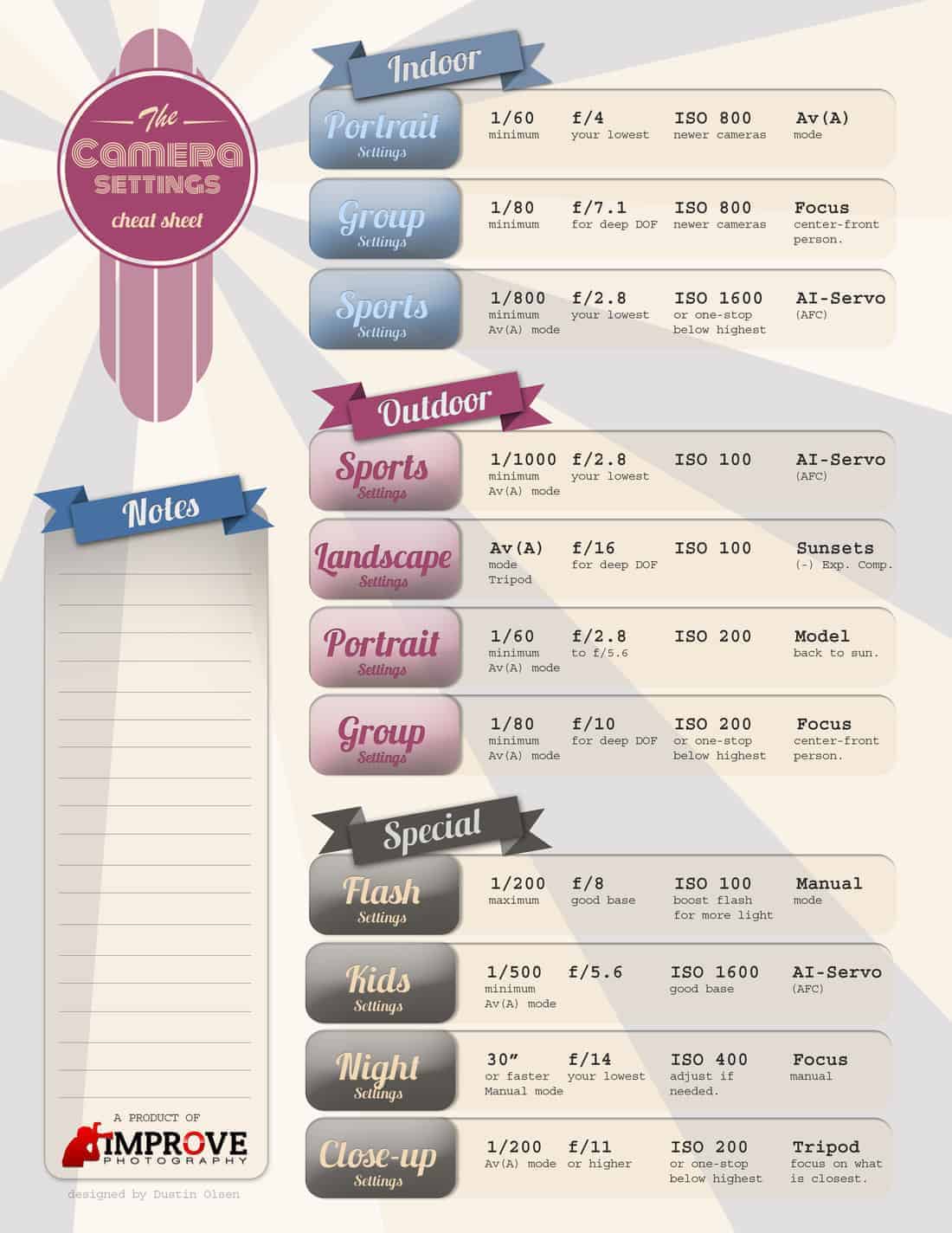
To help get the right exposure with your camera settings – you can download this Camera Settings Cheat Sheet guide.
If you’re reading this Photo Basics series, it probably means that you currently shoot on the “Green mode” of your camera–or the automatic setting. That means the camera entirely controls the exposure of the picture. When you shoot on automatic mode, your camera selects an aperture setting, an ISO setting, a shutter speed, and a host of other settings for you.
Automatic can be handy, but it also seriously limits your creative ability to make a beautiful picture.
Want proof that automatic isn’t the best way to shoot? Check out the picture below. On the left, the picture was taken entirely in automatic mode on a Canon Rebel DSLR. That might look okay to you… until you see the picture on the right. Same sunset. Same camera. The pictures were taken only seconds apart. The difference? The picture on the right was taken using manual exposure.

Which photo do you prefer? Probably the picture on the right! By choosing a creatively dark exposure, the rich colors in the sunset were allowed to shine through.
However, technically, the photo on the left is “correct,” and the photo on the right is “incorrect.” The camera saw through the lens and tried to expose the bird so that it wouldn’t become a shadow. To me, the photo was not about exposing the bird properly, but exposing the sunset properly. The bird was just a nice shape to include in the foreground. This is exactly why you must learn exposure–because sometimes the “scientifically correct” exposure is not the best exposure to make the photo look how you want it to.
What’s next?
Now that you understand why it is so important to take control over the exposure, let’s move on to shutter, aperture and ISO–which are the tools you need to control the exposure. Soon you’ll understand the basics of how to shoot in manual mode on your camera. I promise shooting in manual mode isn’t nearly as scary as you might think.
Once you’re ready to deepen your knowledge of manual mode, get tack sharp focus, and master lighting, consider buying my Photography Start Course. It’s a series of 22 video tutorials where I walk you step-by-step through the things that it normally takes my photography students two years to learn. Other photography websites sell a very similar course for $300. I’ve priced it at a REALLY reasonable price because I remember how tight money was when I was a beginner.
Thanks for the great introduction to exposure! I really appreciated the clear explanations and practical tips. Can’t wait to try out the exposure triangle in my next shoot!
gfvrrqqnuojdfjzzhrigtofolqezfg
This website online can be a walk-by way of for all the data you wished about this and didn’t know who to ask. Glimpse here, and you’ll positively uncover it.
An attention-grabbing discussion is worth comment. I feel that you must write extra on this subject, it might not be a taboo topic however typically individuals are not enough to speak on such topics. To the next. Cheers
Heya i?m for the first time here. I found this board and I find It truly useful & it helped me out much. I hope to give something back and aid others like you helped me.
Great introduction to photography basics! I love how you broke down exposure into easy-to-understand concepts. Can’t wait to apply these tips to my own photos!
I’m amazed by the quality of this content! The author has obviously put a huge amount of effort into investigating and arranging the information. It’s inspiring to come across an article that not only provides valuable information but also keeps the readers captivated from start to finish. Hats off to him for making such a masterpiece!
Undeniably imagine that which you stated. Your favourite justification appeared to be at the net the easiest factor to take into account of. I say to you, I definitely get irked at the same time as people think about concerns that they just don’t recognize about. You controlled to hit the nail upon the top and also outlined out the entire thing with no need side-effects , people could take a signal. Will likely be back to get more. Thanks
izdeoxjgnjuqhzpiwsmgwxvgdjxjxw
Heya! I just wanted too askk iif yoou ever have any trouble wwith hackers?
My lst bllog (wordpress) waas hacled and I ended up losing many months of hard work duue to
no backup. Do youu hawve any methods to prefent hackers?
I have seen that costs for online degree authorities tend to be a fantastic value. For example a full 4-year college Degree in Communication with the University of Phoenix Online consists of 60 credits from $515/credit or $30,900. Also American Intercontinental University Online gives a Bachelors of Business Administration with a entire education course requirement of 180 units and a price of $30,560. Online degree learning has made getting your degree been so cool because you can earn your own degree in the comfort of your dwelling place and when you finish from office. Thanks for all the other tips I have really learned through the web site.
Good ? I should definitely pronounce, impressed with your site. I had no trouble navigating through all tabs as well as related information ended up being truly simple to do to access. I recently found what I hoped for before you know it at all. Reasonably unusual. Is likely to appreciate it for those who add forums or something, web site theme . a tones way for your client to communicate. Nice task..
psunesesiywxpmojwftzwzjjvdoqjz
Thanks for another wonderful article. Where else could anyone get that type of info in such an ideal way of writing? I have a presentation next week, and I am on the look for such info.
This really answered my downside, thanks!
Thank you for the good writeup. It in fact was a amusement account it. Glance advanced to far brought agreeable from you! However, how could we keep up a correspondence?
I think the admin of this web site is genuinely working hard in favor of his site, as
here every data is quality based material.
b5ux93
Great insights! I found the section on exposure particularly useful. It’s amazing how adjusting just a few settings can transform a photo. Looking forward to applying these tips in my own photography!
Channel Lil Peep’s bold fashion identity with this hand-painted leather jacket, famously worn in his Benz Truck videos and credited as a signature piece in his “Never Say Die” era. Perfect for fans, collectors, and streetwear lovers alike.