
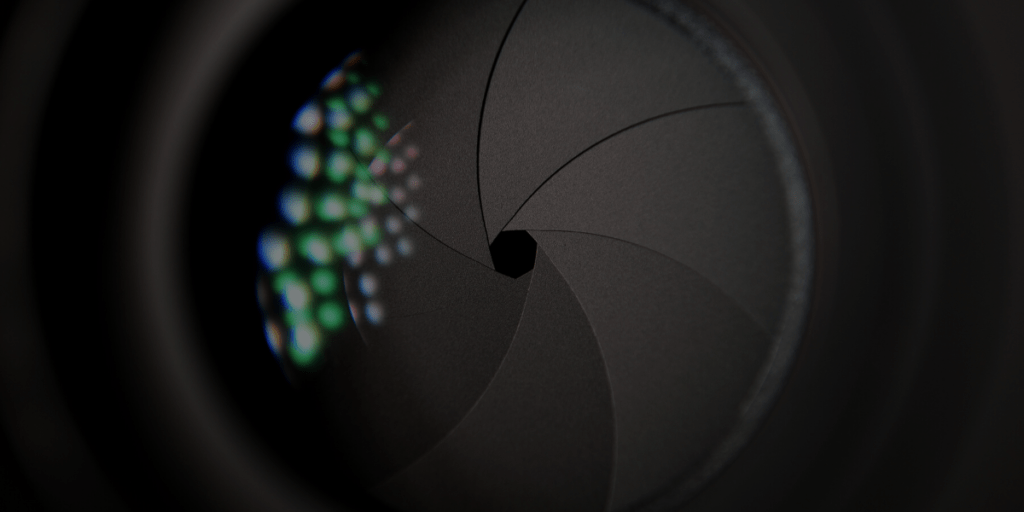
From the sunset picture example, you have learned the importance of taking full control over the exposure on your camera. Now, it’s time to dig into your camera and learn the three most basic tools available to you in controlling the exposure.
Those tools are shutter speed, aperture, and ISO. After I explain what each one does, I’ll explain why we need three separate tools to control the brightness or darkness of the photo.
Aperture
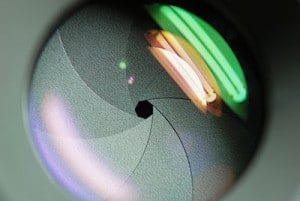
The aperture is a small set of blades in the lens that controls how much light will enter the camera. The blades create a octagonal shape that can be widened (we photogs call it shooting “wide open”), or closed down to a small hole. Obviously, if you shoot with the aperture wide open, then more light is allowed into the camera than if the aperture is closed down to only allow a tiny hole of light to enter the camera.
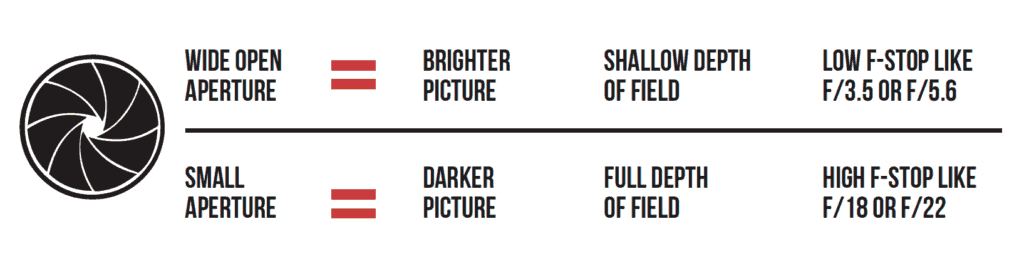
So suppose you take a picture that is too bright. How do you fix it? Simply choose a smaller aperture. Simple! Aperture sizes are measured by f-stops. A high f-stop like f-22 means that the aperture hole is quite small, and a low f-stop like f/3.5 means that the aperture is wide open.
Let’s test your knowledge to make sure you have it down. If you take a picture and it’s too dark at f/5.6, would you choose a lower f-stop number or a higher one? Yep! You’d choose a lower f-stop number, which opens up the aperture to let in more light. The size of the aperture controls more than the brightness or darkness of the picture, though.
The aperture also controls the depth-of-field. Depth-of-field is how much of the picture is sharp, and how much is blurry. If you want to take a picture of a person with a blurry background, you’d use shallow depth of field. If you want to take a picture of a sweeping mountain vista, you’d want to use a small aperture size (high f-stop number) so that the entire scene is in sharp focus. If you, like me, are more of a visual learner, then I think this graphic will help solidify the information about aperture. Take a minute and make sure you understand this info before moving on.
Shutter Speed
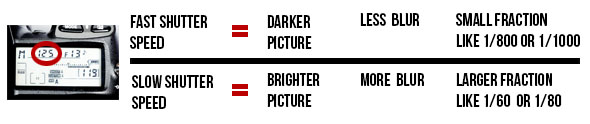
The shutter is a small “curtain” in the camera that quickly rolls over the image sensor (the digital version of film) and allows light to shine onto the imaging sensor for a fraction of a second. The longer the shutter allows light to shine onto the image sensor, the brighter the picture since more light is gathered. A darker picture is produced when the shutter moves very quickly and only allows light to touch the imaging sensor for a tiny fraction of a second. The duration that the shutter allows light onto the image sensor is called the shutter speed, and is measured in fractions of a second. So a shutter speed of 1/2 of a second will allow more light to touch the image sensor and will produce a brighter picture than a shutter speed of 1/200 of a second. So if you’re taking a picture and it is too dark, you could use a slower shutter speed to allow the camera to gather more light.
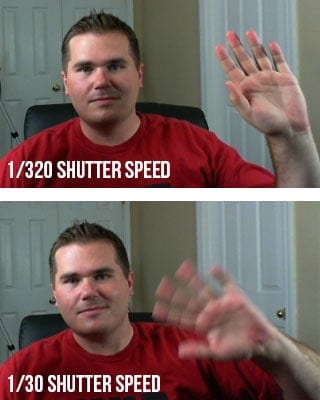
Just as the aperture affects the exposure as well as the depth-of field, the shutter affects more than just the exposure. The shutter speed is also principally responsible for controlling the amount of blur in a picture. If you think about it, it makes sense that the shutter speed controls how much blur is in the picture.
Imagine me sitting here at my computer desk waving to you (you don’t have to imagine very hard if you just look at the picture on the right). If you take a picture of me with a shutter speed of 1/30th of a second, then my hand will have moved in the time that the camera is recording the picture. To get rid of the blur, you need to increase the shutter speed to around 1/320th of a second. At this speed, my hand is still moving, but the camera takes the picture so fast that my hand travels only such a small distance that it is not noticeable in the picture.
The next question that most people ask is, how slow of a shutter speed can you use and still get a sharp picture? My blog post on Minimum Shutter Speeds will answer your question!
ISO
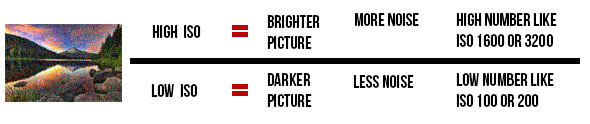
The funny thing about ISO is that it is an acronym, but nobody really knows what it stands for. It is always just called ISO even though it really stands for International Organization for Standardization. Every once in a while, you’ll hear an older photographer pronounce it “I-so”, but almost everyone pronounces it “I.S.O.” The ISO controls the exposure by using software in the camera to make it extra sensitive to light.
A high ISO such as ISO 1,600 will produce a brighter picture than a lower ISO such as ISO 100. The drawback to increasing the ISO is that it makes the picture noisier. Digital noise is apparent when a photo looks grainy. Have you ever taken a picture at night with your cell phone or your pocket camera, and noticed that it looks really grainy? That is because the camera tried to compensate for the dark scene by choosing a high ISO, which causes more grain.
What constitutes a “high” ISO is constantly changing. Camera companies are constantly improving the ability of cameras to use high ISOs without as much grain. A few years ago, only the highest-end pro DSLR cameras could achieve 2,000 ISO, and now even entry-level DSLR cameras can shoot at this level. Since each camera is different, you would do well to do a few tests with your camera to see how high of an ISO you can shoot at without making the image overly grainy.
Right now, you will commonly find new DSLRs that advertise expandable ISO ranges.
Putting It All Together
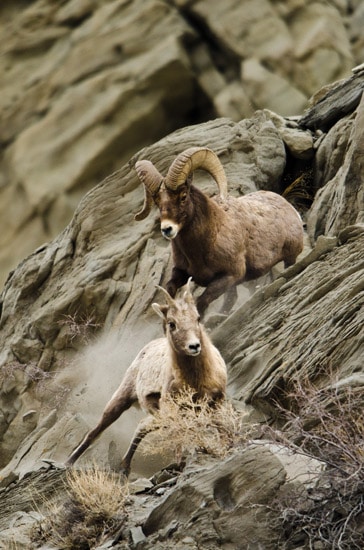
I know exactly what you’re thinking. “Why do I need three tools to control the exposure? Wouldn’t one suffice?” The answer is no, and I’ll explain why with an example. In January, I took a trip to my favorite place on the planet to take pictures–Yellowstone National Park. My guide informed us that the bighorn sheep in the park were dying off very quickly due to whooping cough, so I worked hard that week to capture pictures of the last few sheep in that area of the park.
Around 9AM on a cloudy day, I found a small group of bighorn sheep and started photographing them with a long 600mm lens. The early hour and clouded sky made the situation quite dark for shooting.
Let me help you out. The lens I was working with cost around $12,000, but don’t worry. You can get really good results with a much more affordable 600mm lens. I’m considering selling my expensive lens.
Anyway, it had a maximum aperture size of f/4. So I set my aperture at f/4 to gather as much light as possible. This also impacted the depth-of field to blur out the rocks behind the bighorn sheep. Next, I set my shutter speed. I wanted to capture action in the photo, so I set my camera to 1/1000th of a second shutter speed. I knew that this fast of a shutter speed would prevent any motion blur from the sheep running on the mountain side. Then, I took a picture. WAAAY too dark! I couldn’t compromise my shutter speed or aperture, so I knew I needed to use the third player in the exposure triangle–the ISO.
I played around with my ISO and found that if I increased it to ISO 640, it made the picture bright enough to take the picture without making it overly grainy. This combination of shutter speed, aperture, and ISO worked out perfectly. It feels so good to hone in the camera settings!
Now can you see why you need to know how to shutter, aperture, AND ISO, and know how to set them independently on your camera!
If you’re a visual learner and want to really learn your camera, then be sure to check out my Photography Start Course. Just a reminder, it’s a series of 22 videos where I take you on location to shoot waterfalls, landscapes, people, kids, and macro photos. You can look over my shoulder and see exactly how I set up my camera to take professional photos.

Now, you need to learn how to apply these settings on your camera to take advantage of your new-found nuggets of knowledge.
• Скретч – Скретчите карту 7 раз еженедельно, держите мега приз во возрождение. Максимальный приз – огромное число доровых фишек!
What i do not realize is if truth be told how you’re not really much more well-favored than you might be right now. You’re so intelligent. You already know therefore significantly with regards to this matter, made me individually consider it from a lot of numerous angles. Its like women and men don’t seem to be fascinated except it is one thing to do with Girl gaga! Your individual stuffs great. All the time deal with it up!
An fascinating dialogue is price comment. I feel that it’s best to write extra on this matter, it won’t be a taboo topic however usually individuals are not enough to talk on such topics. To the next. Cheers
There may be noticeably a bundle to learn about this. I assume you made certain good factors in options also.
As a Newbie, I am always browsing online for articles that can be of assistance to me. Thank you
I not to mention my guys have been viewing the best recommendations from your web page then all of the sudden I had a horrible suspicion I never expressed respect to the web site owner for those secrets. Those young boys came warmed to read all of them and already have truly been tapping into those things. We appreciate you indeed being very kind and also for making a decision on this kind of awesome areas most people are really desperate to be informed on. My sincere apologies for not saying thanks to you earlier.
Many thanks for this article. I would also like to express that it can become hard if you find yourself in school and just starting out to create a long credit ranking. There are many pupils who are just trying to survive and have a protracted or positive credit history is often a difficult thing to have.
Your ability to meet reader needs is truly commendable.
Well I truly enjoyed studying it. This tip procured by you is very practical for good planning.
bad beat столы точно по Холдем быть хозяином пометка “j”. за ними взимается дополн
Hola! I’ve been reading your website for a long time now and finally got the courage to go ahead and give you a shout out from Austin Tx! Just wanted to mention keep up the fantastic job!
I do enjoy the manner in which you have framed this matter plus it does provide me some fodder for thought. Nevertheless, through what precisely I have seen, I really hope as the actual reviews pack on that folks stay on point and in no way get started upon a soap box involving some other news du jour. Anyway, thank you for this exceptional piece and though I can not really go along with this in totality, I respect the standpoint.
Along with every little thing which appears to be building throughout this subject matter, your perspectives are actually rather stimulating. Having said that, I beg your pardon, but I can not subscribe to your whole idea, all be it stimulating none the less. It seems to me that your remarks are actually not entirely validated and in simple fact you are your self not wholly confident of the point. In any event I did enjoy reading through it.
Bạn có khả năng giao tiếp những ý tưởng phức tạp một cách đơn giản.
Together with every thing that appears to be developing within this area, many of your opinions are generally relatively stimulating. Nevertheless, I am sorry, because I can not subscribe to your entire suggestion, all be it exhilarating none the less. It would seem to me that your commentary are not completely rationalized and in simple fact you are generally your self not thoroughly certain of the point. In any case I did enjoy reading it.
Nội dung của bạn đã khuyến khích sự tò mò và tìm hiểu từ phía độc giả.
Пары закружились посреди, же эти, который телесны не в состоянии был жечь, начали поста вдлину единица. Скоро фон заполонился пылью, какую вздымали отплясывающие, (а) также, вместе с копотью ото фонарей равно свеч, вдобавок от улетучиваний большого количества тел, дьявол сделался до тех пор тяжким, то что непривычным людям останавливалось дурно и они вылетали наружу, для того чтоб явиться источником на себе незаполненный обстановка прерии.
I do love the manner in which you have framed this specific situation plus it really does provide me some fodder for consideration. On the other hand, through just what I have witnessed, I really wish as the actual commentary pile on that people remain on issue and in no way start upon a tirade of the news of the day. Anyway, thank you for this exceptional point and whilst I can not really go along with it in totality, I value your point of view.
obtenga hasta $тысячи 50% de rakeback
Have you ever wondered how big websites like Facebook make huge profits even though they aren’t selling any products? Their secret is easy: they’re profiting on the millions people who visit their platforms and view the ads displayed there. In this way, they’ve built huge companies just by sending traffic to advertisers. And guess what? You can do the same to drive traffic, prospects, and sales for your own business — legally! Learn how by clicking the link or the URL in the comments!