
From the sunset picture example, you have learned the importance of taking full control over the exposure on your camera. Now, it’s time to dig into your camera and learn the three most basic tools available to you in controlling the exposure.
Those tools are shutter speed, aperture, and ISO. After I explain what each one does, I’ll explain why we need three separate tools to control the brightness or darkness of the photo.
Aperture
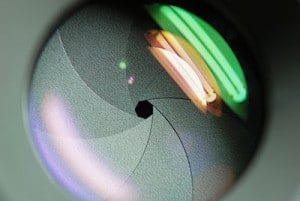
The aperture is a small set of blades in the lens that controls how much light will enter the camera. The blades create a octagonal shape that can be widened (we photogs call it shooting “wide open”), or closed down to a small hole. Obviously, if you shoot with the aperture wide open, then more light is allowed into the camera than if the aperture is closed down to only allow a tiny hole of light to enter the camera.
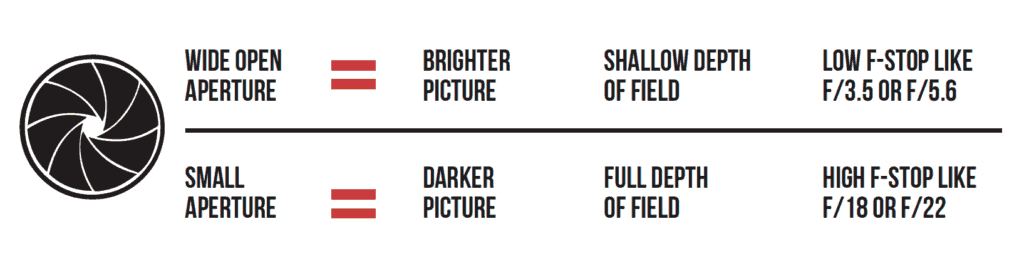
So suppose you take a picture that is too bright. How do you fix it? Simply choose a smaller aperture. Simple! Aperture sizes are measured by f-stops. A high f-stop like f-22 means that the aperture hole is quite small, and a low f-stop like f/3.5 means that the aperture is wide open.
Let’s test your knowledge to make sure you have it down. If you take a picture and it’s too dark at f/5.6, would you choose a lower f-stop number or a higher one? Yep! You’d choose a lower f-stop number, which opens up the aperture to let in more light. The size of the aperture controls more than the brightness or darkness of the picture, though.
The aperture also controls the depth-of-field. Depth-of-field is how much of the picture is sharp, and how much is blurry. If you want to take a picture of a person with a blurry background, you’d use shallow depth of field. If you want to take a picture of a sweeping mountain vista, you’d want to use a small aperture size (high f-stop number) so that the entire scene is in sharp focus. If you, like me, are more of a visual learner, then I think this graphic will help solidify the information about aperture. Take a minute and make sure you understand this info before moving on.
Shutter Speed
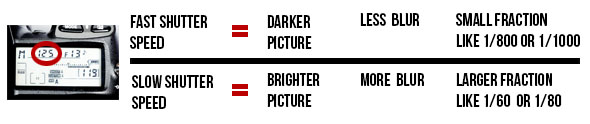
The shutter is a small “curtain” in the camera that quickly rolls over the image sensor (the digital version of film) and allows light to shine onto the imaging sensor for a fraction of a second. The longer the shutter allows light to shine onto the image sensor, the brighter the picture since more light is gathered. A darker picture is produced when the shutter moves very quickly and only allows light to touch the imaging sensor for a tiny fraction of a second. The duration that the shutter allows light onto the image sensor is called the shutter speed, and is measured in fractions of a second. So a shutter speed of 1/2 of a second will allow more light to touch the image sensor and will produce a brighter picture than a shutter speed of 1/200 of a second. So if you’re taking a picture and it is too dark, you could use a slower shutter speed to allow the camera to gather more light.
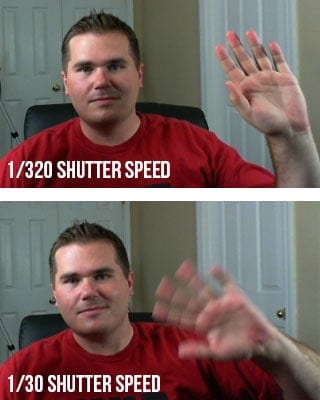
Just as the aperture affects the exposure as well as the depth-of field, the shutter affects more than just the exposure. The shutter speed is also principally responsible for controlling the amount of blur in a picture. If you think about it, it makes sense that the shutter speed controls how much blur is in the picture.
Imagine me sitting here at my computer desk waving to you (you don’t have to imagine very hard if you just look at the picture on the right). If you take a picture of me with a shutter speed of 1/30th of a second, then my hand will have moved in the time that the camera is recording the picture. To get rid of the blur, you need to increase the shutter speed to around 1/320th of a second. At this speed, my hand is still moving, but the camera takes the picture so fast that my hand travels only such a small distance that it is not noticeable in the picture.
The next question that most people ask is, how slow of a shutter speed can you use and still get a sharp picture? My blog post on Minimum Shutter Speeds will answer your question!
ISO
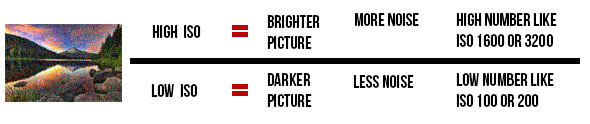
The funny thing about ISO is that it is an acronym, but nobody really knows what it stands for. It is always just called ISO even though it really stands for International Organization for Standardization. Every once in a while, you’ll hear an older photographer pronounce it “I-so”, but almost everyone pronounces it “I.S.O.” The ISO controls the exposure by using software in the camera to make it extra sensitive to light.
A high ISO such as ISO 1,600 will produce a brighter picture than a lower ISO such as ISO 100. The drawback to increasing the ISO is that it makes the picture noisier. Digital noise is apparent when a photo looks grainy. Have you ever taken a picture at night with your cell phone or your pocket camera, and noticed that it looks really grainy? That is because the camera tried to compensate for the dark scene by choosing a high ISO, which causes more grain.
What constitutes a “high” ISO is constantly changing. Camera companies are constantly improving the ability of cameras to use high ISOs without as much grain. A few years ago, only the highest-end pro DSLR cameras could achieve 2,000 ISO, and now even entry-level DSLR cameras can shoot at this level. Since each camera is different, you would do well to do a few tests with your camera to see how high of an ISO you can shoot at without making the image overly grainy.
Right now, you will commonly find new DSLRs that advertise expandable ISO ranges.
Putting It All Together
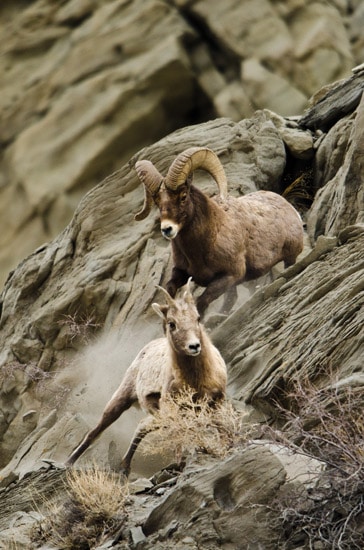
I know exactly what you’re thinking. “Why do I need three tools to control the exposure? Wouldn’t one suffice?” The answer is no, and I’ll explain why with an example. In January, I took a trip to my favorite place on the planet to take pictures–Yellowstone National Park. My guide informed us that the bighorn sheep in the park were dying off very quickly due to whooping cough, so I worked hard that week to capture pictures of the last few sheep in that area of the park.
Around 9AM on a cloudy day, I found a small group of bighorn sheep and started photographing them with a long 600mm lens. The early hour and clouded sky made the situation quite dark for shooting.
Let me help you out. The lens I was working with cost around $12,000, but don’t worry. You can get really good results with a much more affordable 600mm lens. I’m considering selling my expensive lens.
Anyway, it had a maximum aperture size of f/4. So I set my aperture at f/4 to gather as much light as possible. This also impacted the depth-of field to blur out the rocks behind the bighorn sheep. Next, I set my shutter speed. I wanted to capture action in the photo, so I set my camera to 1/1000th of a second shutter speed. I knew that this fast of a shutter speed would prevent any motion blur from the sheep running on the mountain side. Then, I took a picture. WAAAY too dark! I couldn’t compromise my shutter speed or aperture, so I knew I needed to use the third player in the exposure triangle–the ISO.
I played around with my ISO and found that if I increased it to ISO 640, it made the picture bright enough to take the picture without making it overly grainy. This combination of shutter speed, aperture, and ISO worked out perfectly. It feels so good to hone in the camera settings!
Now can you see why you need to know how to shutter, aperture, AND ISO, and know how to set them independently on your camera!
If you’re a visual learner and want to really learn your camera, then be sure to check out my Photography Start Course. Just a reminder, it’s a series of 22 videos where I take you on location to shoot waterfalls, landscapes, people, kids, and macro photos. You can look over my shoulder and see exactly how I set up my camera to take professional photos.
Now, you need to learn how to apply these settings on your camera to take advantage of your new-found nuggets of knowledge.
Thanks, I’ve recently been looking for information about this subject for ages and yours is the best I’ve located so far.
I was curious if you ever considered changing the structure of your site? Its very well written; I love what youve got to say. But maybe you could a little more in the way of content so people could connect with it better. Youve got an awful lot of text for only having 1 or two pictures. Maybe you could space it out better?
I have noticed that online degree is getting favorite because attaining your college degree online has developed into popular alternative for many people. A large number of people have certainly not had a possible opportunity to attend a traditional college or university but seek the increased earning potential and career advancement that a Bachelors Degree affords. Still other individuals might have a college degree in one course but want to pursue another thing they now possess an interest in.
Cách bạn diễn đạt ý tưởng rất cuốn hút, khiến người đọc không thể rời mắt.
Bố cục và thiết kế của trang web bạn rất hấp dẫn, nâng cao trải nghiệm đọc tổng thể.
I liked your site very much. I will definitely come and visit it again.
I liked your site very much, I will visit it again.
A lot of thanks for each of your effort on this web page. Debby delights in doing investigation and it’s simple to grasp why. We hear all about the dynamic manner you give priceless thoughts by means of this web site and invigorate participation from other individuals on that subject so our own daughter is really studying a whole lot. Take advantage of the rest of the year. You are carrying out a powerful job.
I have realized that online education is getting preferred because obtaining your degree online has become a popular alternative for many people. A huge number of people have not necessarily had a chance to attend a regular college or university although seek the increased earning possibilities and a better job that a Bachelors Degree gives you. Still others might have a diploma in one field but would choose to pursue another thing they now have an interest in.
The other day, while I was at work, my cousin stole my
apple ipad and tested to see if it can survive a twenty five foot drop, just so she can be a youtube
sensation. My iPad is now destroyed and she has 83 views.
I know this is entirely off topic but I had to share it with someone!
It’s actually a great and useful piece of info. I’m glad that you shared this useful information with us. Please keep us up to date like this. Thank you for sharing.
Great – I should definitely pronounce, impressed with your web site. I had no trouble navigating through all the tabs as well as related info ended up being truly simple to do to access. I recently found what I hoped for before you know it at all. Quite unusual. Is likely to appreciate it for those who add forums or something, website theme . a tones way for your client to communicate. Excellent task..
Youre so cool! I dont suppose Ive learn something like this before. So nice to seek out anyone with some original ideas on this subject. realy thank you for starting this up. this web site is something that is wanted on the web, somebody with a little bit originality. useful job for bringing something new to the internet!
According to my research, after a in foreclosure process home is marketed at a bidding, it is common for that borrower to be able to still have the remaining balance on the mortgage loan. There are many lenders who make an effort to have all rates and liens paid off by the upcoming buyer. Having said that, depending on specific programs, polices, and state guidelines there may be quite a few loans that aren’t easily settled through the exchange of financial loans. Therefore, the obligation still remains on the borrower that has got his or her property in foreclosure process. Thanks for sharing your ideas on this web site.
Thanks for any other excellent article. Where else may just anybody get that kind of information in such an ideal manner of writing? I’ve a presentation next week, and I am on the search for such info.
Thank you, I have recently been searching for info about this subject for ages and yours is the greatest I have discovered so far. But, what about the bottom line? Are you sure about the source?
Greetings! I’ve been reading your web site for a long time now and finally got the bravery to go ahead and give you a shout out from New Caney Tx! Just wanted to say keep up the great job!
The heart of your writing while sounding reasonable initially, did not sit well with me after some time. Somewhere throughout the paragraphs you actually managed to make me a believer unfortunately only for a very short while. I however have got a problem with your jumps in assumptions and one would do well to fill in all those breaks. When you actually can accomplish that, I will certainly be amazed.
I have observed that online degree is getting well-liked because getting your degree online has developed into a popular alternative for many people. Many people have certainly not had a chance to attend a conventional college or university yet seek the improved earning possibilities and career advancement that a Bachelor Degree offers. Still other individuals might have a degree in one course but would choose to pursue anything they now possess an interest in.
Thanks for your tips. One thing we’ve noticed is always that banks as well as financial institutions are aware of the spending patterns of consumers while also understand that a lot of people max out and about their real credit cards around the breaks. They correctly take advantage of that fact and commence flooding the inbox in addition to snail-mail box along with hundreds of no interest APR credit card offers just after the holiday season concludes. Knowing that for anyone who is like 98 of the American community, you’ll rush at the possiblity to consolidate financial debt and move balances to 0 interest rates credit cards.