
From the sunset picture example, you have learned the importance of taking full control over the exposure on your camera. Now, it’s time to dig into your camera and learn the three most basic tools available to you in controlling the exposure.
Those tools are shutter speed, aperture, and ISO. After I explain what each one does, I’ll explain why we need three separate tools to control the brightness or darkness of the photo.
Aperture
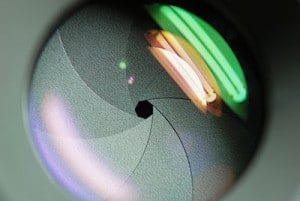
The aperture is a small set of blades in the lens that controls how much light will enter the camera. The blades create a octagonal shape that can be widened (we photogs call it shooting “wide open”), or closed down to a small hole. Obviously, if you shoot with the aperture wide open, then more light is allowed into the camera than if the aperture is closed down to only allow a tiny hole of light to enter the camera.
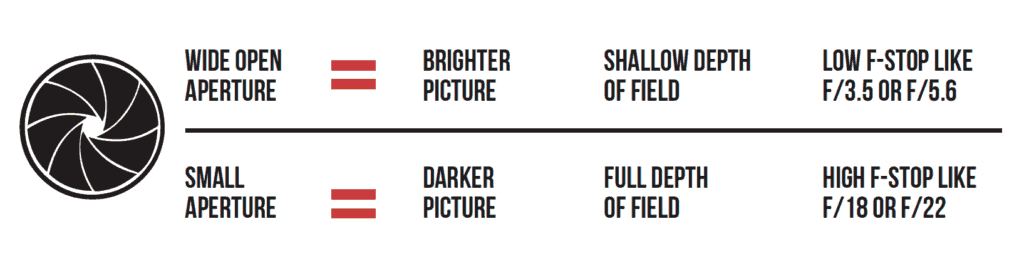
So suppose you take a picture that is too bright. How do you fix it? Simply choose a smaller aperture. Simple! Aperture sizes are measured by f-stops. A high f-stop like f-22 means that the aperture hole is quite small, and a low f-stop like f/3.5 means that the aperture is wide open.
Let’s test your knowledge to make sure you have it down. If you take a picture and it’s too dark at f/5.6, would you choose a lower f-stop number or a higher one? Yep! You’d choose a lower f-stop number, which opens up the aperture to let in more light. The size of the aperture controls more than the brightness or darkness of the picture, though.
The aperture also controls the depth-of-field. Depth-of-field is how much of the picture is sharp, and how much is blurry. If you want to take a picture of a person with a blurry background, you’d use shallow depth of field. If you want to take a picture of a sweeping mountain vista, you’d want to use a small aperture size (high f-stop number) so that the entire scene is in sharp focus. If you, like me, are more of a visual learner, then I think this graphic will help solidify the information about aperture. Take a minute and make sure you understand this info before moving on.
Shutter Speed
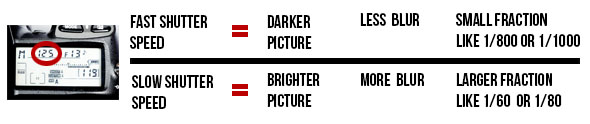
The shutter is a small “curtain” in the camera that quickly rolls over the image sensor (the digital version of film) and allows light to shine onto the imaging sensor for a fraction of a second. The longer the shutter allows light to shine onto the image sensor, the brighter the picture since more light is gathered. A darker picture is produced when the shutter moves very quickly and only allows light to touch the imaging sensor for a tiny fraction of a second. The duration that the shutter allows light onto the image sensor is called the shutter speed, and is measured in fractions of a second. So a shutter speed of 1/2 of a second will allow more light to touch the image sensor and will produce a brighter picture than a shutter speed of 1/200 of a second. So if you’re taking a picture and it is too dark, you could use a slower shutter speed to allow the camera to gather more light.
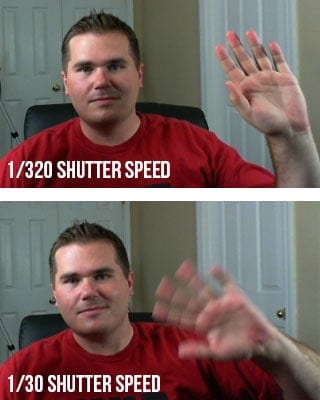
Just as the aperture affects the exposure as well as the depth-of field, the shutter affects more than just the exposure. The shutter speed is also principally responsible for controlling the amount of blur in a picture. If you think about it, it makes sense that the shutter speed controls how much blur is in the picture.
Imagine me sitting here at my computer desk waving to you (you don’t have to imagine very hard if you just look at the picture on the right). If you take a picture of me with a shutter speed of 1/30th of a second, then my hand will have moved in the time that the camera is recording the picture. To get rid of the blur, you need to increase the shutter speed to around 1/320th of a second. At this speed, my hand is still moving, but the camera takes the picture so fast that my hand travels only such a small distance that it is not noticeable in the picture.
The next question that most people ask is, how slow of a shutter speed can you use and still get a sharp picture? My blog post on Minimum Shutter Speeds will answer your question!
ISO
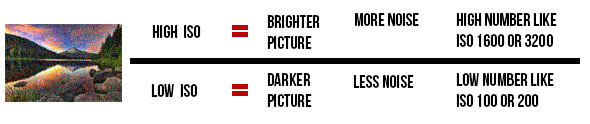
The funny thing about ISO is that it is an acronym, but nobody really knows what it stands for. It is always just called ISO even though it really stands for International Organization for Standardization. Every once in a while, you’ll hear an older photographer pronounce it “I-so”, but almost everyone pronounces it “I.S.O.” The ISO controls the exposure by using software in the camera to make it extra sensitive to light.
A high ISO such as ISO 1,600 will produce a brighter picture than a lower ISO such as ISO 100. The drawback to increasing the ISO is that it makes the picture noisier. Digital noise is apparent when a photo looks grainy. Have you ever taken a picture at night with your cell phone or your pocket camera, and noticed that it looks really grainy? That is because the camera tried to compensate for the dark scene by choosing a high ISO, which causes more grain.
What constitutes a “high” ISO is constantly changing. Camera companies are constantly improving the ability of cameras to use high ISOs without as much grain. A few years ago, only the highest-end pro DSLR cameras could achieve 2,000 ISO, and now even entry-level DSLR cameras can shoot at this level. Since each camera is different, you would do well to do a few tests with your camera to see how high of an ISO you can shoot at without making the image overly grainy.
Right now, you will commonly find new DSLRs that advertise expandable ISO ranges.
Putting It All Together
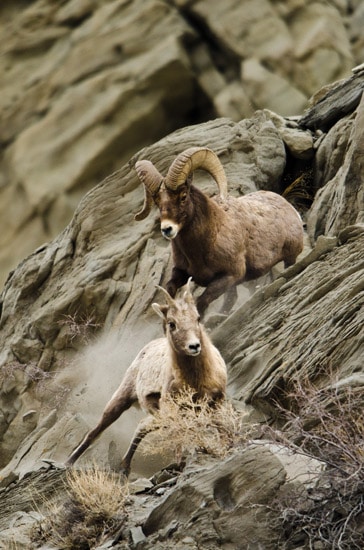
I know exactly what you’re thinking. “Why do I need three tools to control the exposure? Wouldn’t one suffice?” The answer is no, and I’ll explain why with an example. In January, I took a trip to my favorite place on the planet to take pictures–Yellowstone National Park. My guide informed us that the bighorn sheep in the park were dying off very quickly due to whooping cough, so I worked hard that week to capture pictures of the last few sheep in that area of the park.
Around 9AM on a cloudy day, I found a small group of bighorn sheep and started photographing them with a long 600mm lens. The early hour and clouded sky made the situation quite dark for shooting.
Let me help you out. The lens I was working with cost around $12,000, but don’t worry. You can get really good results with a much more affordable 600mm lens. I’m considering selling my expensive lens.
Anyway, it had a maximum aperture size of f/4. So I set my aperture at f/4 to gather as much light as possible. This also impacted the depth-of field to blur out the rocks behind the bighorn sheep. Next, I set my shutter speed. I wanted to capture action in the photo, so I set my camera to 1/1000th of a second shutter speed. I knew that this fast of a shutter speed would prevent any motion blur from the sheep running on the mountain side. Then, I took a picture. WAAAY too dark! I couldn’t compromise my shutter speed or aperture, so I knew I needed to use the third player in the exposure triangle–the ISO.
I played around with my ISO and found that if I increased it to ISO 640, it made the picture bright enough to take the picture without making it overly grainy. This combination of shutter speed, aperture, and ISO worked out perfectly. It feels so good to hone in the camera settings!
Now can you see why you need to know how to shutter, aperture, AND ISO, and know how to set them independently on your camera!
If you’re a visual learner and want to really learn your camera, then be sure to check out my Photography Start Course. Just a reminder, it’s a series of 22 videos where I take you on location to shoot waterfalls, landscapes, people, kids, and macro photos. You can look over my shoulder and see exactly how I set up my camera to take professional photos.

Now, you need to learn how to apply these settings on your camera to take advantage of your new-found nuggets of knowledge.
Your method of explaining the whole thing in this article is truly nice,
every one be capable of simply understand it, Thanks a lot.
You lost me, friend. I mean, I suppose I get what youre indicating. I realize what you are saying, but you just seem to have overlooked that there are some other individuals inside the world who look at this matter for what it definitely is and might not agree with you. You may be turning away a lot of folks who may have been supporters of your web site.
Hey there, You’ve done an excellent job. I?ll definitely digg it and personally recommend to my friends. I am confident they’ll be benefited from this site.
Hãy nhanh tay tham gia ngay để được nhận những phần thưởng hấp dẫn tại yo88 .com!
You made some decent points there. I looked over the internet for any issue and located most people goes in addition to together with your web site.
Very nice article. I absolutely love this website.
Keep writing!
Good – I should certainly say I’m impressed with your site. I had no trouble navigating through all the tabs and related info. The site ended up being truly easy to access. Good job… finding insurance
Đây là đặc biệt để đăng ký và nhận ngay những quà tặng hấp dẫn tại yo88 .com!
The very heart of your writing whilst sounding agreeable initially, did not sit very well with me personally after some time. Somewhere within the sentences you managed to make me a believer but only for a short while. I still have got a problem with your jumps in logic and you would do well to help fill in those gaps. In the event you actually can accomplish that, I could undoubtedly end up being impressed.
That is a very good viewpoint, however isn’t create any kind of sence at all preaching about that will mather. Just about any approach gives thanks and also thought about aim to reveal your current article in to delicius but it surely is apparently an issue using your sites is it possible please recheck this. many thanks once more.
Thank you for some other informative web site.
The place else may I am getting that type of info
written in such an ideal manner? I’ve a challenge that I am just now operating on, and I have been on the look
out for such info.
For most recent information you have to go to see world-wide-web and on world-wide-web I found this site as a
most excellent site for newest updates.
Can I simply say what a reduction to search out someone who actually is aware of what theyre speaking about on the internet. You definitely know easy methods to bring an issue to gentle and make it important. More folks must read this and understand this facet of the story. I cant believe youre not more widespread because you undoubtedly have the gift.
ven still; she loves talking dirty over video chat. If you’re looking for a camgirl that never says no, Daisy delivers the ultimate
The word ‘love’ refers to a particular set of behaviour and emotions including commitment, trust, affection, care, passion, intimacy
I can’t express how much I value the effort the author has put into writing this exceptional piece of content. The clarity of the writing, the depth of analysis, and the wealth of information offered are simply astonishing. His zeal for the subject is apparent, and it has definitely struck a chord with me. Thank you, author, for sharing your wisdom and enriching our lives with this extraordinary article!
It’s really a cool and useful piece of info. I’m glad that you simply shared this useful information with us. Please stay us informed like this. Thank you for sharing.
Hi this is a wonderful article. I’m going to mail this to my pals. I came on this while browsing on aol I’ll be sure to come back. thanks for sharing.
Все вы тут обсуждаете политику, а я между делом выигрываю в PinUp.
Каждый выбирает свой вид отдыха, мой – это PinUp.
Здесь никогда не скучно!
Youre so cool! I dont suppose Ive read anything in this way prior to. So nice to get somebody by incorporating original thoughts on this subject. realy i appreciate you for starting this up. this excellent website is one thing that is needed on the web, a person with some originality. valuable task for bringing new stuff for the world wide web!