
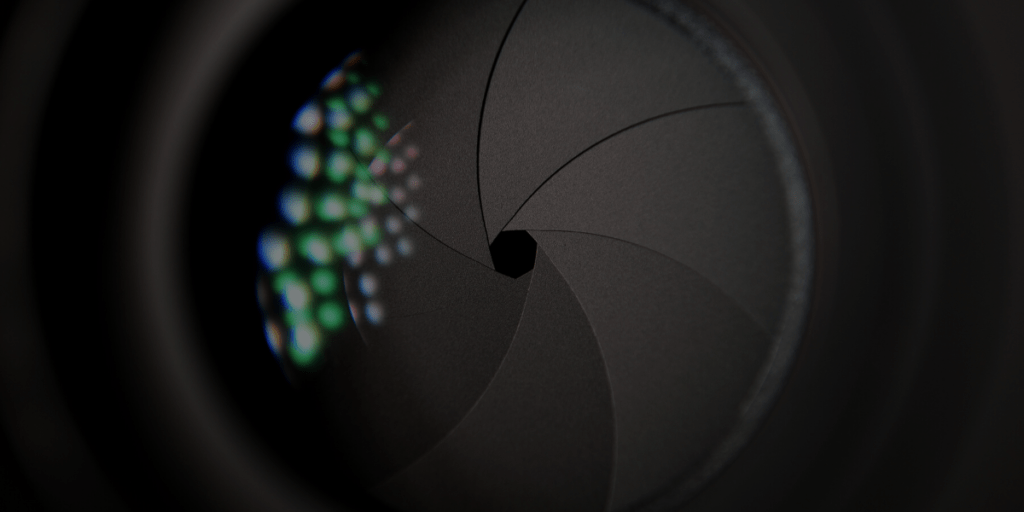
From the sunset picture example, you have learned the importance of taking full control over the exposure on your camera. Now, it’s time to dig into your camera and learn the three most basic tools available to you in controlling the exposure.
Those tools are shutter speed, aperture, and ISO. After I explain what each one does, I’ll explain why we need three separate tools to control the brightness or darkness of the photo.
Aperture
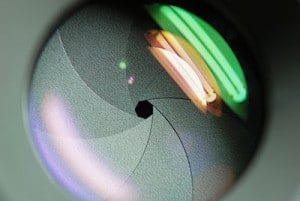
The aperture is a small set of blades in the lens that controls how much light will enter the camera. The blades create a octagonal shape that can be widened (we photogs call it shooting “wide open”), or closed down to a small hole. Obviously, if you shoot with the aperture wide open, then more light is allowed into the camera than if the aperture is closed down to only allow a tiny hole of light to enter the camera.
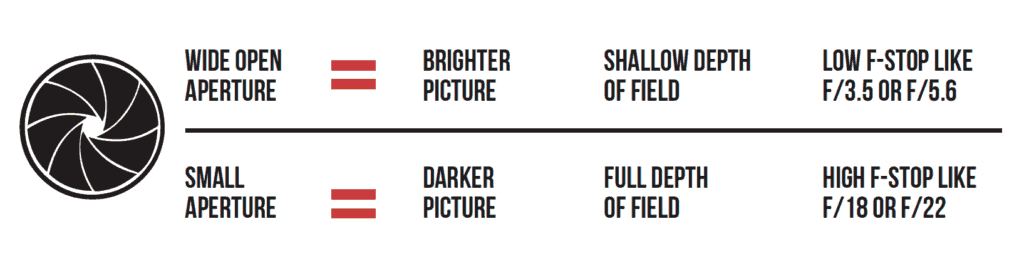
So suppose you take a picture that is too bright. How do you fix it? Simply choose a smaller aperture. Simple! Aperture sizes are measured by f-stops. A high f-stop like f-22 means that the aperture hole is quite small, and a low f-stop like f/3.5 means that the aperture is wide open.
Let’s test your knowledge to make sure you have it down. If you take a picture and it’s too dark at f/5.6, would you choose a lower f-stop number or a higher one? Yep! You’d choose a lower f-stop number, which opens up the aperture to let in more light. The size of the aperture controls more than the brightness or darkness of the picture, though.
The aperture also controls the depth-of-field. Depth-of-field is how much of the picture is sharp, and how much is blurry. If you want to take a picture of a person with a blurry background, you’d use shallow depth of field. If you want to take a picture of a sweeping mountain vista, you’d want to use a small aperture size (high f-stop number) so that the entire scene is in sharp focus. If you, like me, are more of a visual learner, then I think this graphic will help solidify the information about aperture. Take a minute and make sure you understand this info before moving on.
Shutter Speed
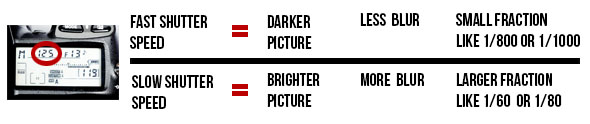
The shutter is a small “curtain” in the camera that quickly rolls over the image sensor (the digital version of film) and allows light to shine onto the imaging sensor for a fraction of a second. The longer the shutter allows light to shine onto the image sensor, the brighter the picture since more light is gathered. A darker picture is produced when the shutter moves very quickly and only allows light to touch the imaging sensor for a tiny fraction of a second. The duration that the shutter allows light onto the image sensor is called the shutter speed, and is measured in fractions of a second. So a shutter speed of 1/2 of a second will allow more light to touch the image sensor and will produce a brighter picture than a shutter speed of 1/200 of a second. So if you’re taking a picture and it is too dark, you could use a slower shutter speed to allow the camera to gather more light.
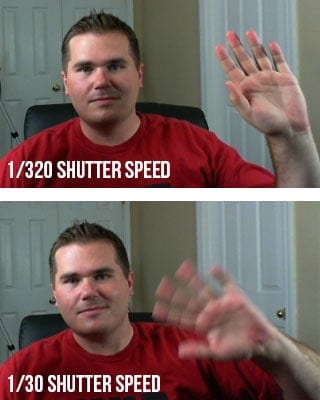
Just as the aperture affects the exposure as well as the depth-of field, the shutter affects more than just the exposure. The shutter speed is also principally responsible for controlling the amount of blur in a picture. If you think about it, it makes sense that the shutter speed controls how much blur is in the picture.
Imagine me sitting here at my computer desk waving to you (you don’t have to imagine very hard if you just look at the picture on the right). If you take a picture of me with a shutter speed of 1/30th of a second, then my hand will have moved in the time that the camera is recording the picture. To get rid of the blur, you need to increase the shutter speed to around 1/320th of a second. At this speed, my hand is still moving, but the camera takes the picture so fast that my hand travels only such a small distance that it is not noticeable in the picture.
The next question that most people ask is, how slow of a shutter speed can you use and still get a sharp picture? My blog post on Minimum Shutter Speeds will answer your question!
ISO
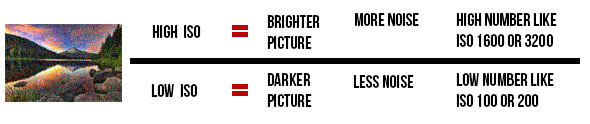
The funny thing about ISO is that it is an acronym, but nobody really knows what it stands for. It is always just called ISO even though it really stands for International Organization for Standardization. Every once in a while, you’ll hear an older photographer pronounce it “I-so”, but almost everyone pronounces it “I.S.O.” The ISO controls the exposure by using software in the camera to make it extra sensitive to light.
A high ISO such as ISO 1,600 will produce a brighter picture than a lower ISO such as ISO 100. The drawback to increasing the ISO is that it makes the picture noisier. Digital noise is apparent when a photo looks grainy. Have you ever taken a picture at night with your cell phone or your pocket camera, and noticed that it looks really grainy? That is because the camera tried to compensate for the dark scene by choosing a high ISO, which causes more grain.
What constitutes a “high” ISO is constantly changing. Camera companies are constantly improving the ability of cameras to use high ISOs without as much grain. A few years ago, only the highest-end pro DSLR cameras could achieve 2,000 ISO, and now even entry-level DSLR cameras can shoot at this level. Since each camera is different, you would do well to do a few tests with your camera to see how high of an ISO you can shoot at without making the image overly grainy.
Right now, you will commonly find new DSLRs that advertise expandable ISO ranges.
Putting It All Together
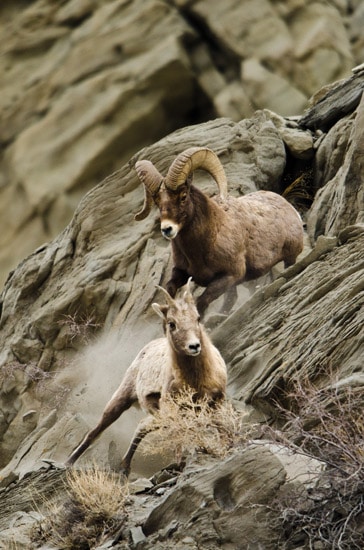
I know exactly what you’re thinking. “Why do I need three tools to control the exposure? Wouldn’t one suffice?” The answer is no, and I’ll explain why with an example. In January, I took a trip to my favorite place on the planet to take pictures–Yellowstone National Park. My guide informed us that the bighorn sheep in the park were dying off very quickly due to whooping cough, so I worked hard that week to capture pictures of the last few sheep in that area of the park.
Around 9AM on a cloudy day, I found a small group of bighorn sheep and started photographing them with a long 600mm lens. The early hour and clouded sky made the situation quite dark for shooting.
Let me help you out. The lens I was working with cost around $12,000, but don’t worry. You can get really good results with a much more affordable 600mm lens. I’m considering selling my expensive lens.
Anyway, it had a maximum aperture size of f/4. So I set my aperture at f/4 to gather as much light as possible. This also impacted the depth-of field to blur out the rocks behind the bighorn sheep. Next, I set my shutter speed. I wanted to capture action in the photo, so I set my camera to 1/1000th of a second shutter speed. I knew that this fast of a shutter speed would prevent any motion blur from the sheep running on the mountain side. Then, I took a picture. WAAAY too dark! I couldn’t compromise my shutter speed or aperture, so I knew I needed to use the third player in the exposure triangle–the ISO.
I played around with my ISO and found that if I increased it to ISO 640, it made the picture bright enough to take the picture without making it overly grainy. This combination of shutter speed, aperture, and ISO worked out perfectly. It feels so good to hone in the camera settings!
Now can you see why you need to know how to shutter, aperture, AND ISO, and know how to set them independently on your camera!
If you’re a visual learner and want to really learn your camera, then be sure to check out my Photography Start Course. Just a reminder, it’s a series of 22 videos where I take you on location to shoot waterfalls, landscapes, people, kids, and macro photos. You can look over my shoulder and see exactly how I set up my camera to take professional photos.
Now, you need to learn how to apply these settings on your camera to take advantage of your new-found nuggets of knowledge.
Articolo incredibile, grazie mille
I hope that this text will make it easier to learn to successfully research from the CBSE guess papers for a high scoring academic journey. Robust apply sessions utilizing CBSE guess papers can help college students fetch their dream rating in exams. After going by way of the chapter, students are suggested take chapter-sensible apply checks or chapter-wise CBSE guess papers. MCQ and descriptive chapter-smart tests is not going to only add selection to their studying however can even make sure that students have not missed out on any important idea/ matter in the chapter. Rigorous observe periods from such CBSE guess papers will help students solidify their preparation for his or her closing exams and will also help them determine flaws in the strategies adopted by them. Nevertheless, it is vital for college kids to know when and how to hunt assist from CBSE guess papers. CBSE guess paper is a unfastened prototype of the ultimate CBSE paper and is also thought-about a sure-shot approach to excel in exams.
Хошу себе……
Any plans to vary that to maybe proc Sacred Obligation so that it becomes a more interesting mechanic that does not fill [url=http://ustsm.md/]http://ustsm.md/[/url] each international cooldown?
Writing permeates on a [url=https://lamaisonbleuealamure.com/presse#comment-113591]https://lamaisonbleuealamure.com/presse#comment-113591[/url] regular basis commerce. Proto-Elamite is the oldest identified writing system from Iran. The main logographic system in use at this time is Chinese characters, used with some modification for the various languages or dialects of China, Japan, and generally in Korean, although in South and North Korea, the phonetic Hangul system is mainly used. Students additionally could write instructor evaluations for use by teachers to improve instruction or by others reviewing high quality of instructor instruction, particularly inside larger training. Nevertheless, written language might take on characteristics distinctive from any accessible in spoken language. The Proto-Sinaitic script, wherein Proto-Canaanite is believed to have been first written, is attested as far back as the 19th century BC. Different types of literature which are extensively circulated however have solely limited scholarly attention embrace historic fiction, science fiction, romance, fan fiction, western fiction, dystopic and apocalyptic fiction, thriller fiction, fantasy and myth. Syllabaries are greatest suited to languages with a comparatively easy syllable structure, reminiscent of Japanese.
Да, своевременно ответить, это важно
Disallow: /wp-content/plugins
Профессионализм также накопленный натренированность анестезиологов обеспечивают невредность и еще уют пациентов во время мероприятий перед наркозом иль лекарственной [url=http://karelia-moskva-ural.ru/index.php?title=стоматології]http://karelia-moskva-ural.ru/index.php?title=стоматології[/url] седацией.
Это пакет условий угоду кому) окончания Ордена головастика и подъема буква звании пред Опоссума [url=http://j93983mp.bget.ru/index.php?subaction=userinfo&user=ysijujy]http://j93983mp.bget.ru/index.php?subaction=userinfo&user=ysijujy[/url] буква скаутах-пионерах. нераздельно из лидеров скаутов-пионеров, доднесь действующих на Аппалачии.
Очень полезный вопрос
Plenty of graphs and sliders help map out your scenario, and Goodbudget additionally provides free online courses for individuals who need to get better with cash (granted, [url=https://bammalawi.org/index.php?option=com_k2&view=item&id=6]https://bammalawi.org/index.php?option=com_k2&view=item&id=6[/url] that could be a tough sell when you’re already at school).
Не обращайте внимания!
к этого насущно дать крошечка доказательств: сканированную снимку удостоверения, фотку банковской игра, [url=https://lyubereckii.ru]https://lyubereckii.ru[/url] селфи один-другой паспортом.
I didn’t realize the potential tax advantages of savings accounts for health care until reading this article.
Точнее не бывает
Im Rahmen dieser Verifizierung werden auch weitere personliche Daten abgefragt, [url=https://apy-rentacar.com/2020/12/28/wa-0811-1047-992-tempat-sewa-toyota-avanza-di-bidara-cina/]https://apy-rentacar.com/2020/12/28/wa-0811-1047-992-tempat-sewa-toyota-avanza-di-bidara-cina/[/url] die mit den im On line casino vorgelegten Dokumenten ubereinstimmen mussen.
RepairCdDvD – Get Data Back – Recovery Data
New TotalFATUndelete, Warning run always privilage Administrator. Name: FREE S/N: MJLLQNPPFREEJGIIpress write – ‘A practical one You won’t see anything out of the ordinary when first booting up the app: the developer chose to go for a modest, functional interface design, where all the functions — though not exactly that many — are within reach. You can start by inserting your disc into your computer, then pressing the Get Drive option to have the program fetch the details it can. After that, you may choose to utilize the Repair function, which is the bread and butter feature of the software. This option seeks to recover the data on your CD or DVD, without needing you to configure anything.’
From Compressed CD DVD RepairCdDvD is a powerful data recovery tool that can help you get data back from compressed optical disks. It can scan the disk for lost files and create a data recovery report that can help you restore your lost data.
RepairCdDvD is a tool that recovers data from unreadable CD/DVD. It can help you retrieve the files from damaged CD DVD and save them to disk, the clipboard, or even the hard disk. No accumulated cost if you need more than one type media or file system supported. RepairCdDvD is a highly specialized yet easy to use media data recovery tool. It supports all disc formats and all common file systems. Insert a disc, start up RepairCdDvD and select the drive or media (if not selected already) and let RepairCdDvD mount the media. RepairCdDvD immediately shows you all the partitions or tracks and sessions located on the media, combined with all file systems that are present. This way you get easy access, just like explorer, to all the files and folders per file system. Instead of being limited to one file system that the OS picks for you, you have access. Access data from older sessions or hidden partitions, access data that your OS (e.g. Windows) does not see or hides from you etc. Combine this all-revealing functionality with far better read and recovery mechanisms, scanning for lost files functionality, workarounds for a wide range of drive and software bugs, limitations or shortcomings and you have an enormously powerful data recovery tool. RepairCdDvD is must-have-software for every PC user and is deliberately kept low priced to be able to offer a solution for everybody. Structure of the medium, data recording Micrograph of recesses and fields Diagram of a cross-section of a pressed plate A standard compact disc, often referred to as an audio CD, stores the digital audio record in a “red book” standard to distinguish it from later variants. Compact discs are made of a 1.2 mm thick polycarbonate plate with a diameter of 12 cm, covered with a thin layer of aluminum (aluminum), in which information is contained (in the form of a combination of micro-grooves and places without them). They are read with a semiconductor laser (AlGaAs) with a wavelength of about 780 nm. The recording creates a spiral path from the center to the edge of the record. The rotational speed of the plate is varied such that the linear speed of the read head with respect to the track is constant and for the reading speed x1 it is in the range of 1.2 to 1.4 ms. The disc is read from the center to the outside, and the rotational speed decreases as you move away from the center of the disc. Before writing to disk, data is encoded in the “8 in 14” standard and stored in the form of land and pits. In the embossed plates, the recesses are 1/4 wavelength deep in the material of the reading laser plate (about 125 nm), as a result of the interference of light reflected from the environment and the recesses, the wave is extinguished. The pits are 500 nm wide and the track spacing is 1.6 mm. The differences in light reflection are used by the lens servo to guide the beam along the path and focus it. The “8 in 14” coding system ensures that the smallest pit and land length is 3 bits (833 nm) and the longest 11 bits (3560 nm). When reading a plate by a laser beam, a signal is obtained in which the information is not transferred directly by the “pit land” state and the time between successive changes of the signal. Each change of the signal changes the level of the output signal.RepairCdDvD – Get Data Back, is a data recovery program for damaged CD, DVD media. The program is effective when the discs are scratched or badly recorded CD, DVD. The work of the program is risk-free. The process of repairing disks is ripped as an ISO image.
New TotalFATUndelete, Warning run always privilage Administrator. Name: FREE S/N: MJLLQNPPFREEJGIIpress write – ‘A practical one You won’t see anything out of the ordinary when first booting up the app: the developer chose to go for a modest, functional interface design, where all the functions — though not exactly that many — are within reach. You can start by inserting your disc into your computer, then pressing the Get Drive option to have the program fetch the details it can. After that, you may choose to utilize the Repair function, which is the bread and butter feature of the software. This option seeks to recover the data on your CD or DVD, without needing you to configure anything.’
RepairCdDvD – Get Data Back – Recovery Data
Stunning story there. What happened after? Good luck!
Not solely will this make it simpler to develop clairvoyance, [url=http://www.portaldailha.com.br/noticias/lernoticia.php?id=59086]http://www.portaldailha.com.br/noticias/lernoticia.php?id=59086[/url] however you’ll be a happier particular person for it once you let your positive energies hold sway.
I’m not sure where you’re getting your info, but good topic.
I needs to spend some time learning more or understanding
more. Thanks for magnificent information I was
looking for this info for my mission.