
From the sunset picture example, you have learned the importance of taking full control over the exposure on your camera. Now, it’s time to dig into your camera and learn the three most basic tools available to you in controlling the exposure.
Those tools are shutter speed, aperture, and ISO. After I explain what each one does, I’ll explain why we need three separate tools to control the brightness or darkness of the photo.
Aperture
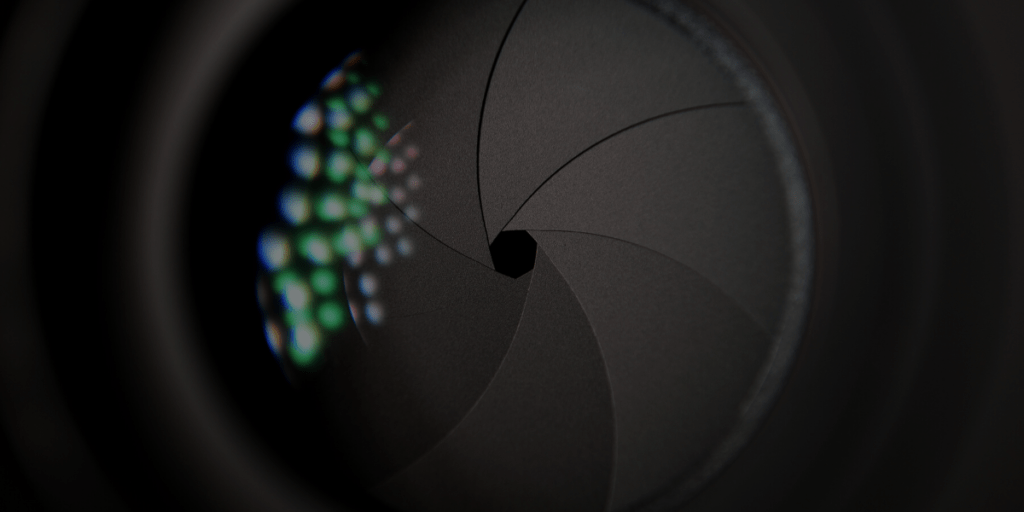
The aperture is a small set of blades in the lens that controls how much light will enter the camera. The blades create a octagonal shape that can be widened (we photogs call it shooting “wide open”), or closed down to a small hole. Obviously, if you shoot with the aperture wide open, then more light is allowed into the camera than if the aperture is closed down to only allow a tiny hole of light to enter the camera.
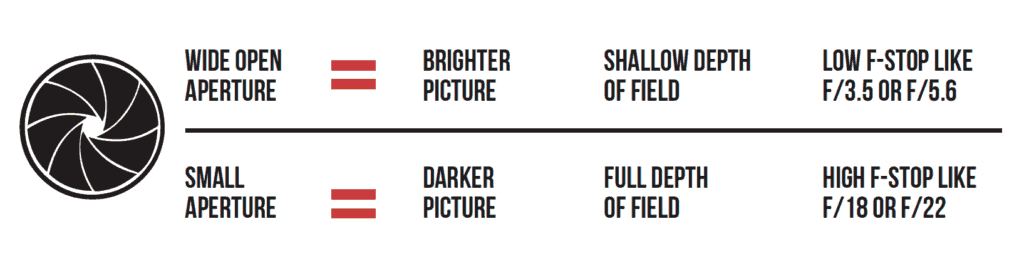
So suppose you take a picture that is too bright. How do you fix it? Simply choose a smaller aperture. Simple! Aperture sizes are measured by f-stops. A high f-stop like f-22 means that the aperture hole is quite small, and a low f-stop like f/3.5 means that the aperture is wide open.
Let’s test your knowledge to make sure you have it down. If you take a picture and it’s too dark at f/5.6, would you choose a lower f-stop number or a higher one? Yep! You’d choose a lower f-stop number, which opens up the aperture to let in more light. The size of the aperture controls more than the brightness or darkness of the picture, though.
The aperture also controls the depth-of-field. Depth-of-field is how much of the picture is sharp, and how much is blurry. If you want to take a picture of a person with a blurry background, you’d use shallow depth of field. If you want to take a picture of a sweeping mountain vista, you’d want to use a small aperture size (high f-stop number) so that the entire scene is in sharp focus. If you, like me, are more of a visual learner, then I think this graphic will help solidify the information about aperture. Take a minute and make sure you understand this info before moving on.
Shutter Speed
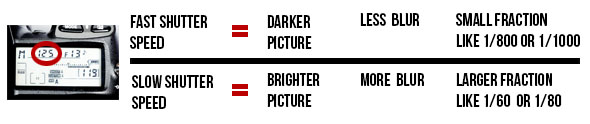
The shutter is a small “curtain” in the camera that quickly rolls over the image sensor (the digital version of film) and allows light to shine onto the imaging sensor for a fraction of a second. The longer the shutter allows light to shine onto the image sensor, the brighter the picture since more light is gathered. A darker picture is produced when the shutter moves very quickly and only allows light to touch the imaging sensor for a tiny fraction of a second. The duration that the shutter allows light onto the image sensor is called the shutter speed, and is measured in fractions of a second. So a shutter speed of 1/2 of a second will allow more light to touch the image sensor and will produce a brighter picture than a shutter speed of 1/200 of a second. So if you’re taking a picture and it is too dark, you could use a slower shutter speed to allow the camera to gather more light.
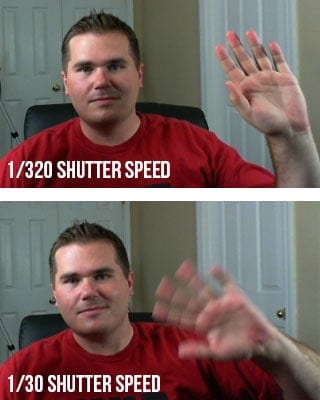
Just as the aperture affects the exposure as well as the depth-of field, the shutter affects more than just the exposure. The shutter speed is also principally responsible for controlling the amount of blur in a picture. If you think about it, it makes sense that the shutter speed controls how much blur is in the picture.
Imagine me sitting here at my computer desk waving to you (you don’t have to imagine very hard if you just look at the picture on the right). If you take a picture of me with a shutter speed of 1/30th of a second, then my hand will have moved in the time that the camera is recording the picture. To get rid of the blur, you need to increase the shutter speed to around 1/320th of a second. At this speed, my hand is still moving, but the camera takes the picture so fast that my hand travels only such a small distance that it is not noticeable in the picture.
The next question that most people ask is, how slow of a shutter speed can you use and still get a sharp picture? My blog post on Minimum Shutter Speeds will answer your question!
ISO
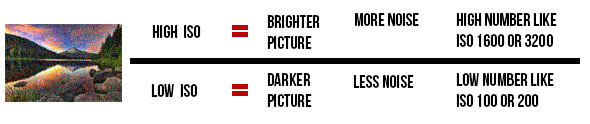
The funny thing about ISO is that it is an acronym, but nobody really knows what it stands for. It is always just called ISO even though it really stands for International Organization for Standardization. Every once in a while, you’ll hear an older photographer pronounce it “I-so”, but almost everyone pronounces it “I.S.O.” The ISO controls the exposure by using software in the camera to make it extra sensitive to light.
A high ISO such as ISO 1,600 will produce a brighter picture than a lower ISO such as ISO 100. The drawback to increasing the ISO is that it makes the picture noisier. Digital noise is apparent when a photo looks grainy. Have you ever taken a picture at night with your cell phone or your pocket camera, and noticed that it looks really grainy? That is because the camera tried to compensate for the dark scene by choosing a high ISO, which causes more grain.
What constitutes a “high” ISO is constantly changing. Camera companies are constantly improving the ability of cameras to use high ISOs without as much grain. A few years ago, only the highest-end pro DSLR cameras could achieve 2,000 ISO, and now even entry-level DSLR cameras can shoot at this level. Since each camera is different, you would do well to do a few tests with your camera to see how high of an ISO you can shoot at without making the image overly grainy.
Right now, you will commonly find new DSLRs that advertise expandable ISO ranges.
Putting It All Together
I know exactly what you’re thinking. “Why do I need three tools to control the exposure? Wouldn’t one suffice?” The answer is no, and I’ll explain why with an example. In January, I took a trip to my favorite place on the planet to take pictures–Yellowstone National Park. My guide informed us that the bighorn sheep in the park were dying off very quickly due to whooping cough, so I worked hard that week to capture pictures of the last few sheep in that area of the park.
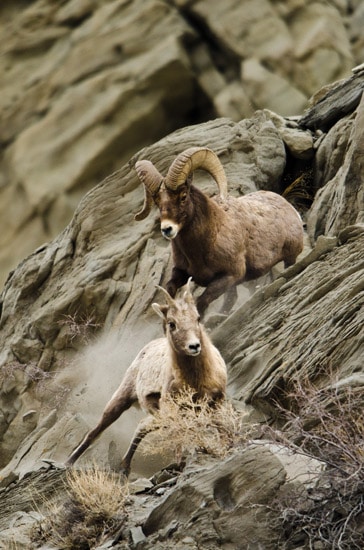
Around 9AM on a cloudy day, I found a small group of bighorn sheep and started photographing them with a long 600mm lens. The early hour and clouded sky made the situation quite dark for shooting.
Let me help you out. The lens I was working with cost around $12,000, but don’t worry. You can get really good results with a much more affordable 600mm lens. I’m considering selling my expensive lens.
Anyway, it had a maximum aperture size of f/4. So I set my aperture at f/4 to gather as much light as possible. This also impacted the depth-of field to blur out the rocks behind the bighorn sheep. Next, I set my shutter speed. I wanted to capture action in the photo, so I set my camera to 1/1000th of a second shutter speed. I knew that this fast of a shutter speed would prevent any motion blur from the sheep running on the mountain side. Then, I took a picture. WAAAY too dark! I couldn’t compromise my shutter speed or aperture, so I knew I needed to use the third player in the exposure triangle–the ISO.
I played around with my ISO and found that if I increased it to ISO 640, it made the picture bright enough to take the picture without making it overly grainy. This combination of shutter speed, aperture, and ISO worked out perfectly. It feels so good to hone in the camera settings!
Now can you see why you need to know how to shutter, aperture, AND ISO, and know how to set them independently on your camera!
If you’re a visual learner and want to really learn your camera, then be sure to check out my Photography Start Course. Just a reminder, it’s a series of 22 videos where I take you on location to shoot waterfalls, landscapes, people, kids, and macro photos. You can look over my shoulder and see exactly how I set up my camera to take professional photos.

Now, you need to learn how to apply these settings on your camera to take advantage of your new-found nuggets of knowledge.
Thank you, I’ve recently been looking for information about this subject for ages and yours is the best I’ve discovered so far.
This really answered my downside, thank you!
I get pleasure from, result in I found just what I was taking a look for. You have ended my four day long hunt! God Bless you man. Have a nice day. Bye
I think this is one of the most vital info for me. And i am glad reading your article. But should remark on few general things, The web site style is perfect, the articles is really great : D. Good job, cheers
I was wondering if you ever thought of changing the page layout of your website? Its very well written; I love what youve got to say. But maybe you could a little more in the way of content so people could connect with it better. Youve got an awful lot of text for only having one or 2 pictures. Maybe you could space it out better?
Spot on with this write-up, I actually assume this web site needs far more consideration. I?ll in all probability be again to learn way more, thanks for that info.
Heya i?m for the first time here. I found this board and I find It truly useful & it helped me out much. I hope to give something back and help others like you helped me.
hi!,I like your writing so so much! percentage we keep in touch more approximately your article on AOL? I need an expert in this house to solve my problem. Maybe that is you! Having a look ahead to look you.
Thanks for these tips. One thing I additionally believe is always that credit cards offering a 0 monthly interest often entice consumers together with zero rate, instant approval and easy on-line balance transfers, nevertheless beware of the number one factor that is going to void your current 0 easy street annual percentage rate and as well as throw one out into the poor house quick.
It?s actually a great and helpful piece of info. I am glad that you shared this useful information with us. Please keep us informed like this. Thanks for sharing.
One more thing. I believe that there are many travel insurance web-sites of reputable companies that permit you to enter your vacation details and have you the prices. You can also purchase this international travel insurance policy on-line by using your current credit card. All you have to do is usually to enter your current travel specifics and you can understand the plans side-by-side. Simply find the system that suits your finances and needs and use your credit card to buy the item. Travel insurance on the web is a good way to check for a reputable company pertaining to international travel insurance. Thanks for expressing your ideas.
Thanks for giving your ideas. I’d also like to say that video games have been at any time evolving. Modern tools and enhancements have made it easier to create authentic and interactive games. These entertainment video games were not actually sensible when the concept was first of all being experimented with. Just like other kinds of technological know-how, video games as well have had to grow through many many years. This itself is testimony on the fast progression of video games.
Excellent web site. A lot of useful information here. I am sending it to some friends ans also sharing in delicious. And naturally, thanks for your sweat!
It?s really a cool and helpful piece of info. I?m happy that you simply shared this helpful information with us. Please keep us informed like this. Thank you for sharing.
Fantastic site you have here but I was wanting to know if you knew of any discussion boards that cover the same topics talked about here? I’d really like to be a part of community where I can get advice from other knowledgeable people that share the same interest. If you have any recommendations, please let me know. Thanks a lot!
Thanks for your write-up. Another element is that being a photographer entails not only issues in recording award-winning photographs and also hardships in establishing the best digicam suited to your needs and most especially situations in maintaining the grade of your camera. This really is very real and apparent for those photography fans that are in capturing the particular nature’s engaging scenes : the mountains, the particular forests, the particular wild or maybe the seas. Visiting these daring places certainly requires a dslr camera that can live up to the wild’s severe natural environment.
I have seen many useful issues on your site about pc’s. However, I’ve got the impression that lap tops are still not quite powerful sufficiently to be a good choice if you normally do jobs that require loads of power, like video modifying. But for world-wide-web surfing, statement processing, and majority of other common computer work they are just great, provided you never mind the tiny screen size. Appreciate sharing your notions.
Thanks for the thoughts you have discussed here. Furthermore, I believe usually there are some factors that really keep your car insurance premium down. One is, to take into consideration buying autos that are within the good listing of car insurance organizations. Cars which are expensive are more at risk of being lost. Aside from that insurance coverage is also using the value of your automobile, so the costlier it is, then the higher your premium you spend.
A different issue is that video gaming became one of the all-time most significant forms of recreation for people spanning various ages. Kids engage in video games, plus adults do, too. The particular XBox 360 is probably the favorite games systems for those who love to have a lot of games available to them, plus who like to relax and play live with some others all over the world. Thanks for sharing your ideas.
You can definitely see your expertise in the work you write. The world hopes for even more passionate writers such as you who aren’t afraid to say how they believe. Always go after your heart.