
From the sunset picture example, you have learned the importance of taking full control over the exposure on your camera. Now, it’s time to dig into your camera and learn the three most basic tools available to you in controlling the exposure.
Those tools are shutter speed, aperture, and ISO. After I explain what each one does, I’ll explain why we need three separate tools to control the brightness or darkness of the photo.
Aperture

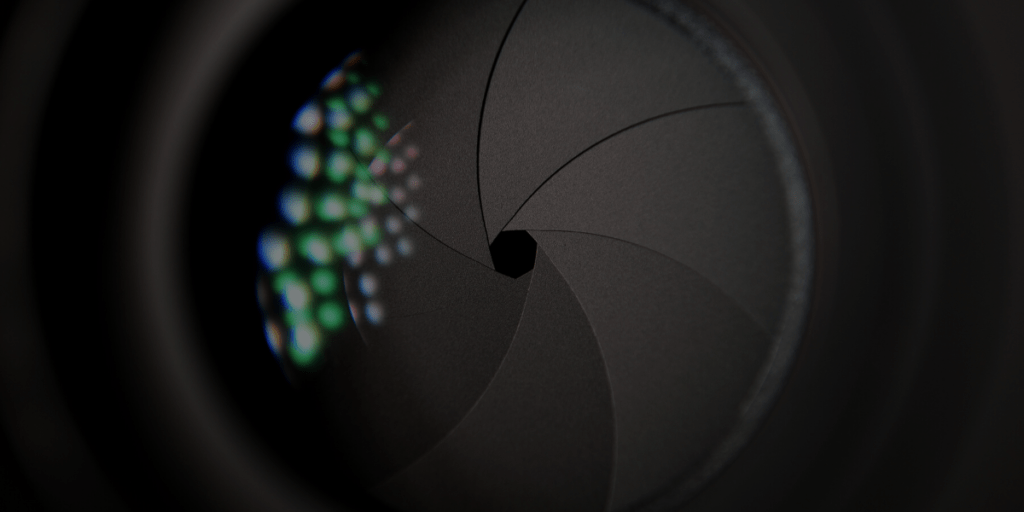
The aperture is a small set of blades in the lens that controls how much light will enter the camera. The blades create a octagonal shape that can be widened (we photogs call it shooting “wide open”), or closed down to a small hole. Obviously, if you shoot with the aperture wide open, then more light is allowed into the camera than if the aperture is closed down to only allow a tiny hole of light to enter the camera.
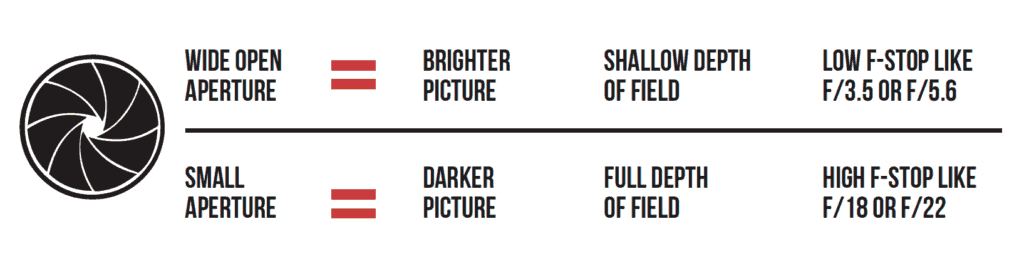
So suppose you take a picture that is too bright. How do you fix it? Simply choose a smaller aperture. Simple! Aperture sizes are measured by f-stops. A high f-stop like f-22 means that the aperture hole is quite small, and a low f-stop like f/3.5 means that the aperture is wide open.
Let’s test your knowledge to make sure you have it down. If you take a picture and it’s too dark at f/5.6, would you choose a lower f-stop number or a higher one? Yep! You’d choose a lower f-stop number, which opens up the aperture to let in more light. The size of the aperture controls more than the brightness or darkness of the picture, though.
The aperture also controls the depth-of-field. Depth-of-field is how much of the picture is sharp, and how much is blurry. If you want to take a picture of a person with a blurry background, you’d use shallow depth of field. If you want to take a picture of a sweeping mountain vista, you’d want to use a small aperture size (high f-stop number) so that the entire scene is in sharp focus. If you, like me, are more of a visual learner, then I think this graphic will help solidify the information about aperture. Take a minute and make sure you understand this info before moving on.
Shutter Speed
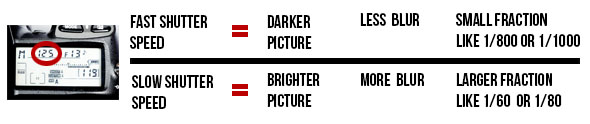
The shutter is a small “curtain” in the camera that quickly rolls over the image sensor (the digital version of film) and allows light to shine onto the imaging sensor for a fraction of a second. The longer the shutter allows light to shine onto the image sensor, the brighter the picture since more light is gathered. A darker picture is produced when the shutter moves very quickly and only allows light to touch the imaging sensor for a tiny fraction of a second. The duration that the shutter allows light onto the image sensor is called the shutter speed, and is measured in fractions of a second. So a shutter speed of 1/2 of a second will allow more light to touch the image sensor and will produce a brighter picture than a shutter speed of 1/200 of a second. So if you’re taking a picture and it is too dark, you could use a slower shutter speed to allow the camera to gather more light.
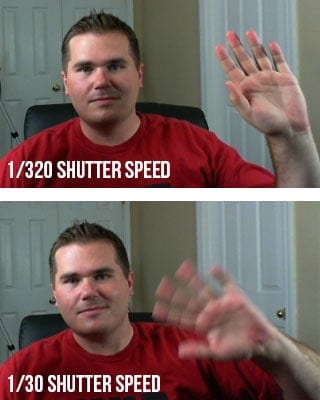
Just as the aperture affects the exposure as well as the depth-of field, the shutter affects more than just the exposure. The shutter speed is also principally responsible for controlling the amount of blur in a picture. If you think about it, it makes sense that the shutter speed controls how much blur is in the picture.
Imagine me sitting here at my computer desk waving to you (you don’t have to imagine very hard if you just look at the picture on the right). If you take a picture of me with a shutter speed of 1/30th of a second, then my hand will have moved in the time that the camera is recording the picture. To get rid of the blur, you need to increase the shutter speed to around 1/320th of a second. At this speed, my hand is still moving, but the camera takes the picture so fast that my hand travels only such a small distance that it is not noticeable in the picture.
The next question that most people ask is, how slow of a shutter speed can you use and still get a sharp picture? My blog post on Minimum Shutter Speeds will answer your question!
ISO
The funny thing about ISO is that it is an acronym, but nobody really knows what it stands for. It is always just called ISO even though it really stands for International Organization for Standardization. Every once in a while, you’ll hear an older photographer pronounce it “I-so”, but almost everyone pronounces it “I.S.O.” The ISO controls the exposure by using software in the camera to make it extra sensitive to light.
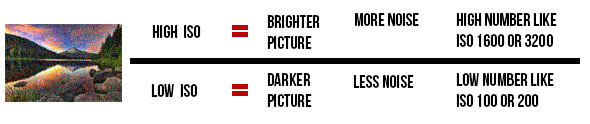
A high ISO such as ISO 1,600 will produce a brighter picture than a lower ISO such as ISO 100. The drawback to increasing the ISO is that it makes the picture noisier. Digital noise is apparent when a photo looks grainy. Have you ever taken a picture at night with your cell phone or your pocket camera, and noticed that it looks really grainy? That is because the camera tried to compensate for the dark scene by choosing a high ISO, which causes more grain.
What constitutes a “high” ISO is constantly changing. Camera companies are constantly improving the ability of cameras to use high ISOs without as much grain. A few years ago, only the highest-end pro DSLR cameras could achieve 2,000 ISO, and now even entry-level DSLR cameras can shoot at this level. Since each camera is different, you would do well to do a few tests with your camera to see how high of an ISO you can shoot at without making the image overly grainy.
Right now, you will commonly find new DSLRs that advertise expandable ISO ranges.
Putting It All Together
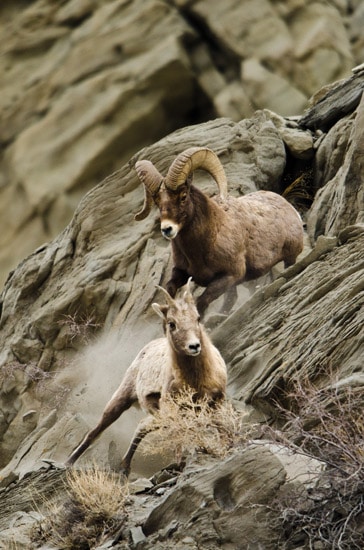
I know exactly what you’re thinking. “Why do I need three tools to control the exposure? Wouldn’t one suffice?” The answer is no, and I’ll explain why with an example. In January, I took a trip to my favorite place on the planet to take pictures–Yellowstone National Park. My guide informed us that the bighorn sheep in the park were dying off very quickly due to whooping cough, so I worked hard that week to capture pictures of the last few sheep in that area of the park.
Around 9AM on a cloudy day, I found a small group of bighorn sheep and started photographing them with a long 600mm lens. The early hour and clouded sky made the situation quite dark for shooting.
Let me help you out. The lens I was working with cost around $12,000, but don’t worry. You can get really good results with a much more affordable 600mm lens. I’m considering selling my expensive lens.
Anyway, it had a maximum aperture size of f/4. So I set my aperture at f/4 to gather as much light as possible. This also impacted the depth-of field to blur out the rocks behind the bighorn sheep. Next, I set my shutter speed. I wanted to capture action in the photo, so I set my camera to 1/1000th of a second shutter speed. I knew that this fast of a shutter speed would prevent any motion blur from the sheep running on the mountain side. Then, I took a picture. WAAAY too dark! I couldn’t compromise my shutter speed or aperture, so I knew I needed to use the third player in the exposure triangle–the ISO.
I played around with my ISO and found that if I increased it to ISO 640, it made the picture bright enough to take the picture without making it overly grainy. This combination of shutter speed, aperture, and ISO worked out perfectly. It feels so good to hone in the camera settings!
Now can you see why you need to know how to shutter, aperture, AND ISO, and know how to set them independently on your camera!
If you’re a visual learner and want to really learn your camera, then be sure to check out my Photography Start Course. Just a reminder, it’s a series of 22 videos where I take you on location to shoot waterfalls, landscapes, people, kids, and macro photos. You can look over my shoulder and see exactly how I set up my camera to take professional photos.

Now, you need to learn how to apply these settings on your camera to take advantage of your new-found nuggets of knowledge.
You could certainly see your skills in the work you write. The world hopes for even more passionate writers like you who are not afraid to say how they believe. Always follow your heart.
Thanks for the ideas you have discussed here. Moreover, I believe there are some factors which keep your car insurance policy premium straight down. One is, to take into consideration buying vehicles that are inside good set of car insurance companies. Cars which are expensive are usually more at risk of being stolen. Aside from that insurance coverage is also in line with the value of the car, so the more expensive it is, then the higher your premium you make payment for.
This is undoubtedly one of the best articles I’ve read on this topic! The author’s comprehensive knowledge and enthusiasm for the subject are apparent in every paragraph. I’m so appreciative for stumbling upon this piece as it has enriched my understanding and sparked my curiosity even further. Thank you, author, for investing the time to produce such a remarkable article!
I would also love to add that in case you do not currently have an insurance policy otherwise you do not remain in any group insurance, you may well gain from seeking assistance from a health agent. Self-employed or people having medical conditions normally seek the help of one health insurance broker. Thanks for your article.
I love your wordpress web template, wherever would you obtain it through?
It?s actually a nice and helpful piece of info. I am satisfied that you just shared this useful info with us. Please stay us informed like this. Thank you for sharing.
Yet another thing I would like to talk about is that in place of trying to match all your online degree lessons on days of the week that you end work (since most people are fatigued when they come home), try to receive most of your classes on the saturdays and sundays and only a couple of courses for weekdays, even if it means taking some time away from your end of the week. This is really good because on the weekends, you will be far more rested and also concentrated on school work. Thanks alot : ) for the different suggestions I have acquired from your site.
very good put up, i actually love this web site, keep on it
Thanks for discussing your ideas. I’d personally also like to convey that video games have been ever evolving. Modern tools and innovations have made it simpler to create practical and active games. These kinds of entertainment video games were not really sensible when the concept was first of all being experimented with. Just like other styles of technological innovation, video games as well have had to grow by many generations. This is testimony towards the fast growth of video games.
Hey there, You have done an excellent job. I?ll certainly digg it and personally suggest to my friends. I am confident they will be benefited from this web site.
Yet another issue is that video games are generally serious naturally with the main focus on knowing things rather than entertainment. Although, there is an entertainment element to keep children engaged, each and every game is normally designed to improve a specific skill set or curriculum, such as instructional math or scientific research. Thanks for your publication.
It?s really a great and helpful piece of info. I?m glad that you shared this helpful info with us. Please keep us informed like this. Thanks for sharing.
Hey there! Do you know if they make any plugins to protect against hackers? I’m kinda paranoid about losing everything I’ve worked hard on. Any recommendations?
I think other web-site proprietors should take this website as an model, very clean and excellent user friendly style and design, let alone the content. You’re an expert in this topic!
you are actually a good webmaster. The site loading pace is amazing. It kind of feels that you are doing any distinctive trick. Also, The contents are masterwork. you have done a magnificent activity on this subject!
Thanks for the helpful content. It is also my opinion that mesothelioma cancer has an particularly long latency time, which means that indication of the disease may not emerge until 30 to 50 years after the first exposure to asbestos. Pleural mesothelioma, that’s the most common form and impacts the area round the lungs, might result in shortness of breath, chest pains, and also a persistent coughing, which may result in coughing up maintain.
Nice read, I just passed this onto a colleague who was doing some research on that. And he just bought me lunch since I found it for him smile Therefore let me rephrase that: Thank you for lunch!
I do like the manner in which you have framed this specific problem and it does indeed supply us a lot of fodder for consideration. On the other hand, through what I have personally seen, I simply just wish when the feed-back pack on that people remain on point and not start on a soap box of some other news of the day. All the same, thank you for this outstanding piece and although I do not concur with the idea in totality, I regard the point of view.
There may be noticeably a bundle to learn about this. I assume you made certain nice factors in features also.
Thanks for the something totally new you have uncovered in your article. One thing I would really like to discuss is that FSBO human relationships are built with time. By presenting yourself to owners the first weekend their FSBO can be announced, ahead of the masses start out calling on Wednesday, you produce a good interconnection. By sending them tools, educational products, free records, and forms, you become an ally. By subtracting a personal fascination with them and their predicament, you build a solid network that, many times, pays off in the event the owners opt with a realtor they know plus trust – preferably you.