
From the sunset picture example, you have learned the importance of taking full control over the exposure on your camera. Now, it’s time to dig into your camera and learn the three most basic tools available to you in controlling the exposure.
Those tools are shutter speed, aperture, and ISO. After I explain what each one does, I’ll explain why we need three separate tools to control the brightness or darkness of the photo.
Aperture
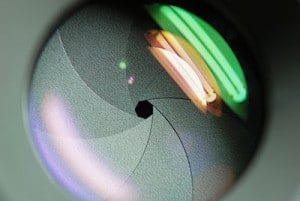
The aperture is a small set of blades in the lens that controls how much light will enter the camera. The blades create a octagonal shape that can be widened (we photogs call it shooting “wide open”), or closed down to a small hole. Obviously, if you shoot with the aperture wide open, then more light is allowed into the camera than if the aperture is closed down to only allow a tiny hole of light to enter the camera.
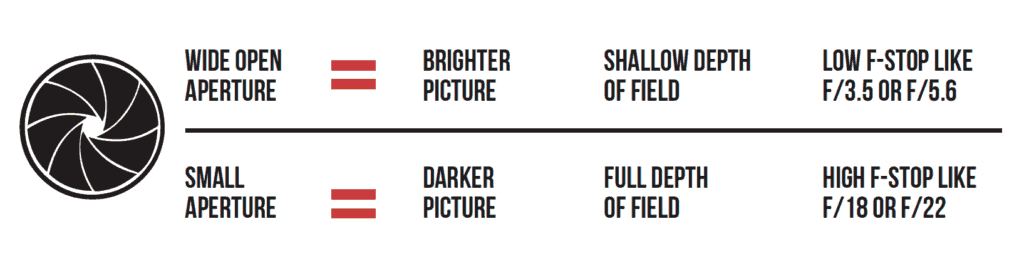
So suppose you take a picture that is too bright. How do you fix it? Simply choose a smaller aperture. Simple! Aperture sizes are measured by f-stops. A high f-stop like f-22 means that the aperture hole is quite small, and a low f-stop like f/3.5 means that the aperture is wide open.
Let’s test your knowledge to make sure you have it down. If you take a picture and it’s too dark at f/5.6, would you choose a lower f-stop number or a higher one? Yep! You’d choose a lower f-stop number, which opens up the aperture to let in more light. The size of the aperture controls more than the brightness or darkness of the picture, though.
The aperture also controls the depth-of-field. Depth-of-field is how much of the picture is sharp, and how much is blurry. If you want to take a picture of a person with a blurry background, you’d use shallow depth of field. If you want to take a picture of a sweeping mountain vista, you’d want to use a small aperture size (high f-stop number) so that the entire scene is in sharp focus. If you, like me, are more of a visual learner, then I think this graphic will help solidify the information about aperture. Take a minute and make sure you understand this info before moving on.
Shutter Speed
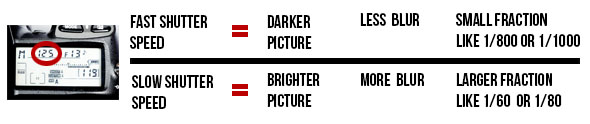
The shutter is a small “curtain” in the camera that quickly rolls over the image sensor (the digital version of film) and allows light to shine onto the imaging sensor for a fraction of a second. The longer the shutter allows light to shine onto the image sensor, the brighter the picture since more light is gathered. A darker picture is produced when the shutter moves very quickly and only allows light to touch the imaging sensor for a tiny fraction of a second. The duration that the shutter allows light onto the image sensor is called the shutter speed, and is measured in fractions of a second. So a shutter speed of 1/2 of a second will allow more light to touch the image sensor and will produce a brighter picture than a shutter speed of 1/200 of a second. So if you’re taking a picture and it is too dark, you could use a slower shutter speed to allow the camera to gather more light.
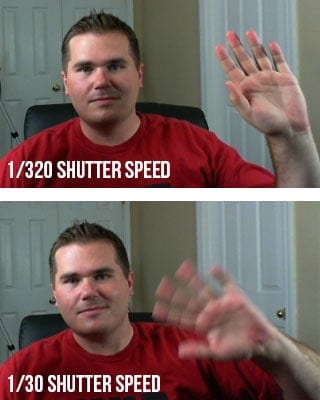
Just as the aperture affects the exposure as well as the depth-of field, the shutter affects more than just the exposure. The shutter speed is also principally responsible for controlling the amount of blur in a picture. If you think about it, it makes sense that the shutter speed controls how much blur is in the picture.
Imagine me sitting here at my computer desk waving to you (you don’t have to imagine very hard if you just look at the picture on the right). If you take a picture of me with a shutter speed of 1/30th of a second, then my hand will have moved in the time that the camera is recording the picture. To get rid of the blur, you need to increase the shutter speed to around 1/320th of a second. At this speed, my hand is still moving, but the camera takes the picture so fast that my hand travels only such a small distance that it is not noticeable in the picture.
The next question that most people ask is, how slow of a shutter speed can you use and still get a sharp picture? My blog post on Minimum Shutter Speeds will answer your question!
ISO
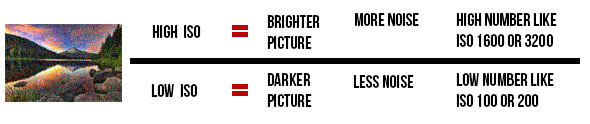
The funny thing about ISO is that it is an acronym, but nobody really knows what it stands for. It is always just called ISO even though it really stands for International Organization for Standardization. Every once in a while, you’ll hear an older photographer pronounce it “I-so”, but almost everyone pronounces it “I.S.O.” The ISO controls the exposure by using software in the camera to make it extra sensitive to light.
A high ISO such as ISO 1,600 will produce a brighter picture than a lower ISO such as ISO 100. The drawback to increasing the ISO is that it makes the picture noisier. Digital noise is apparent when a photo looks grainy. Have you ever taken a picture at night with your cell phone or your pocket camera, and noticed that it looks really grainy? That is because the camera tried to compensate for the dark scene by choosing a high ISO, which causes more grain.
What constitutes a “high” ISO is constantly changing. Camera companies are constantly improving the ability of cameras to use high ISOs without as much grain. A few years ago, only the highest-end pro DSLR cameras could achieve 2,000 ISO, and now even entry-level DSLR cameras can shoot at this level. Since each camera is different, you would do well to do a few tests with your camera to see how high of an ISO you can shoot at without making the image overly grainy.
Right now, you will commonly find new DSLRs that advertise expandable ISO ranges.
Putting It All Together
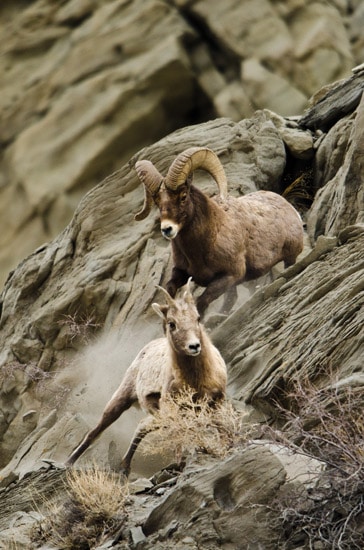
I know exactly what you’re thinking. “Why do I need three tools to control the exposure? Wouldn’t one suffice?” The answer is no, and I’ll explain why with an example. In January, I took a trip to my favorite place on the planet to take pictures–Yellowstone National Park. My guide informed us that the bighorn sheep in the park were dying off very quickly due to whooping cough, so I worked hard that week to capture pictures of the last few sheep in that area of the park.
Around 9AM on a cloudy day, I found a small group of bighorn sheep and started photographing them with a long 600mm lens. The early hour and clouded sky made the situation quite dark for shooting.
Let me help you out. The lens I was working with cost around $12,000, but don’t worry. You can get really good results with a much more affordable 600mm lens. I’m considering selling my expensive lens.
Anyway, it had a maximum aperture size of f/4. So I set my aperture at f/4 to gather as much light as possible. This also impacted the depth-of field to blur out the rocks behind the bighorn sheep. Next, I set my shutter speed. I wanted to capture action in the photo, so I set my camera to 1/1000th of a second shutter speed. I knew that this fast of a shutter speed would prevent any motion blur from the sheep running on the mountain side. Then, I took a picture. WAAAY too dark! I couldn’t compromise my shutter speed or aperture, so I knew I needed to use the third player in the exposure triangle–the ISO.
I played around with my ISO and found that if I increased it to ISO 640, it made the picture bright enough to take the picture without making it overly grainy. This combination of shutter speed, aperture, and ISO worked out perfectly. It feels so good to hone in the camera settings!
Now can you see why you need to know how to shutter, aperture, AND ISO, and know how to set them independently on your camera!
If you’re a visual learner and want to really learn your camera, then be sure to check out my Photography Start Course. Just a reminder, it’s a series of 22 videos where I take you on location to shoot waterfalls, landscapes, people, kids, and macro photos. You can look over my shoulder and see exactly how I set up my camera to take professional photos.
Now, you need to learn how to apply these settings on your camera to take advantage of your new-found nuggets of knowledge.
I really love your site.. Excellent colors & theme.
Did you build this amazing site yourself? Please reply back as I’m wanting to create my very
own site and want to find out where you got this from or just what the theme is called.
Kudos!
Исследуйте новые порно-сайты с новыми видео. Наслаждайтесь приватным просмотром.Посещайте последние платформы для взрослых с оперативным воспроизведением и высоким разрешением. Выберите из широкого ассортимента.Найдите новые порно-сайты с геурированными коллекциями для адаптированного развлечения.
Посещайте сайт для взрослых с премиум-контентом. Наслаждайтесь приватным просмотром.Найдите сайт для взрослых с оперативным воспроизведением и высоким разрешением. Выберите из множества категорий.Просматривайте сайт для взрослых с эксклюзивным контентом для адаптированного развлечения.
Откройте лучшие порно-сайты с премиум-видео. Наслаждайтесь безопасной трансляцией.Посещайте ведущие xxx сайты с быстрой загрузкой и HD-качеством. Выберите из множества жанров.Найдите топовые xxx платформы с геурированными коллекциями для индивидуального просмотра.
Узнайте, где смотреть порно на надежных платформах. Наслаждайтесь высококачественными видео с дискретным доступом.Исследуйте где найти xxx видео на ведущих сайтах с высоким разрешением. Выберите из множества категорий.Исследуйте где наслаждаться контентом для взрослых на безопасных платформах с разнообразными библиотеками.
Найдите топовые xxx платформы с эксклюзивными клипами. Наслаждайтесь безопасной трансляцией.Исследуйте лучшие порно-сайты с быстрой загрузкой и четкими видео. Выберите из множества жанров.Найдите топовые xxx платформы с разнообразными библиотеками для персонализированного опыта.
Исследуйте новые xxx сайты с свежими видео. Наслаждайтесь дискретной трансляцией.Исследуйте новые xxx сайты с оперативным воспроизведением и высоким разрешением. Выберите из множества жанров.Откройте новые xxx сайты с разнообразными библиотеками для индивидуального просмотра.
We are a group of volunteers and starting a new scheme in our community. Your site offered us with helpful information to paintings on. You have performed a formidable task and our entire community will be grateful to you.
Читайте мангу на бесплатных платформах. Погрузитесь в интересные повествования с качественными изображениями.
I?m now not positive where you are getting your information, but great topic. I must spend some time studying more or figuring out more. Thanks for great information I used to be in search of this info for my mission.
I’m impressed by the quality of this content! The author has undoubtedly put a huge amount of effort into exploring and arranging the information. It’s inspiring to come across an article that not only provides valuable information but also keeps the readers hooked from start to finish. Hats off to him for making such a remarkable piece!
I was curious if you ever considered changing the structure of your website? Its very well written; I love what youve got to say. But maybe you could a little more in the way of content so people could connect with it better. Youve got an awful lot of text for only having 1 or two pictures. Maybe you could space it out better?
This is without a doubt one of the greatest articles I’ve read on this topic! The author’s thorough knowledge and enthusiasm for the subject shine through in every paragraph. I’m so appreciative for coming across this piece as it has enhanced my knowledge and sparked my curiosity even further. Thank you, author, for dedicating the time to create such a outstanding article!
Heya i am for the first time here. I came across this board and I find It really useful
Thanks for the concepts you are discussing on this site. Another thing I’d really like to say is the fact that getting hold of copies of your credit rating in order to scrutinize accuracy of each and every detail is the first motion you have to conduct in credit repair. You are looking to clean your credit file from destructive details mistakes that ruin your credit score.
One more thing I would like to talk about is that instead of trying to fit all your online degree courses on days and nights that you finish work (since most people are fatigued when they return home), try to arrange most of your lessons on the saturdays and sundays and only one or two courses in weekdays, even if it means a little time away from your weekend. This is really good because on the weekends, you will be extra rested and concentrated in school work. Many thanks for the different points I have discovered from your site.
Thank you for this article. I would also like to talk about the fact that it can end up being hard while you are in school and simply starting out to establish a long credit score. There are many individuals who are simply just trying to survive and have long or beneficial credit history can sometimes be a difficult thing to have.
There is noticeably a lot to realize about this. I consider you made some good points in features also.
Thank you for sharing these kind of wonderful discussions. In addition, an excellent travel and medical insurance strategy can often ease those fears that come with traveling abroad. Your medical emergency can shortly become extremely expensive and that’s absolute to quickly slam a financial burden on the family finances. Having in place the perfect travel insurance deal prior to leaving is definitely worth the time and effort. Thanks
Buy OnlyFans Creator Account