I’m so glad you found your way onto my Photography Basics series. I have taught the basics of photography to millions of photographers around the world through Improve Photography, so I know just exactly how difficult it can seem to learn the basics of photography.
My goal is to make this Photography Basics series the absolute simplest way to learn the basics of photography.
I hope you’ll love this series because of what you learn here, and I hope you’ll join the Improve Photography community after you get your feet wet with the photo basics. Let’s get going.
Basic Equipment You’ll Need
You can do photography with even the simplest of cameras, but the principles that I’d like to teach are for people who want to learn to use a DSLR camera, a micro four-thirds camera, or at least a camera that allows the photographer to adjust the shutter speed, aperture, and ISO. Even some pocket cameras have this functionality.
Here are some of our entry level DSLR options. The (with Accessories) link will show you a kit that comes with the camera, lens, case, extra battery, and a memory card:
Canon EOS Rebel T6 with 18-55mm and 75-300mm Lenses (with Accessories)
Nikon D5600 with 18-55mm and 70-300mm Lenses (with Accessories)
Canon EOS Rebel T7i with 18-135mm Lens (with Accessories)
Now that you have your camera, it is time to learn exposure.
Exposure–the most basic element of photography
When photographers talk about “exposure,” we simply mean the brightness or darkness of a photo. It seems simple enough to take a photo that is correctly exposed (has the proper brightness or darkness), but in reality it can be quite the trick.

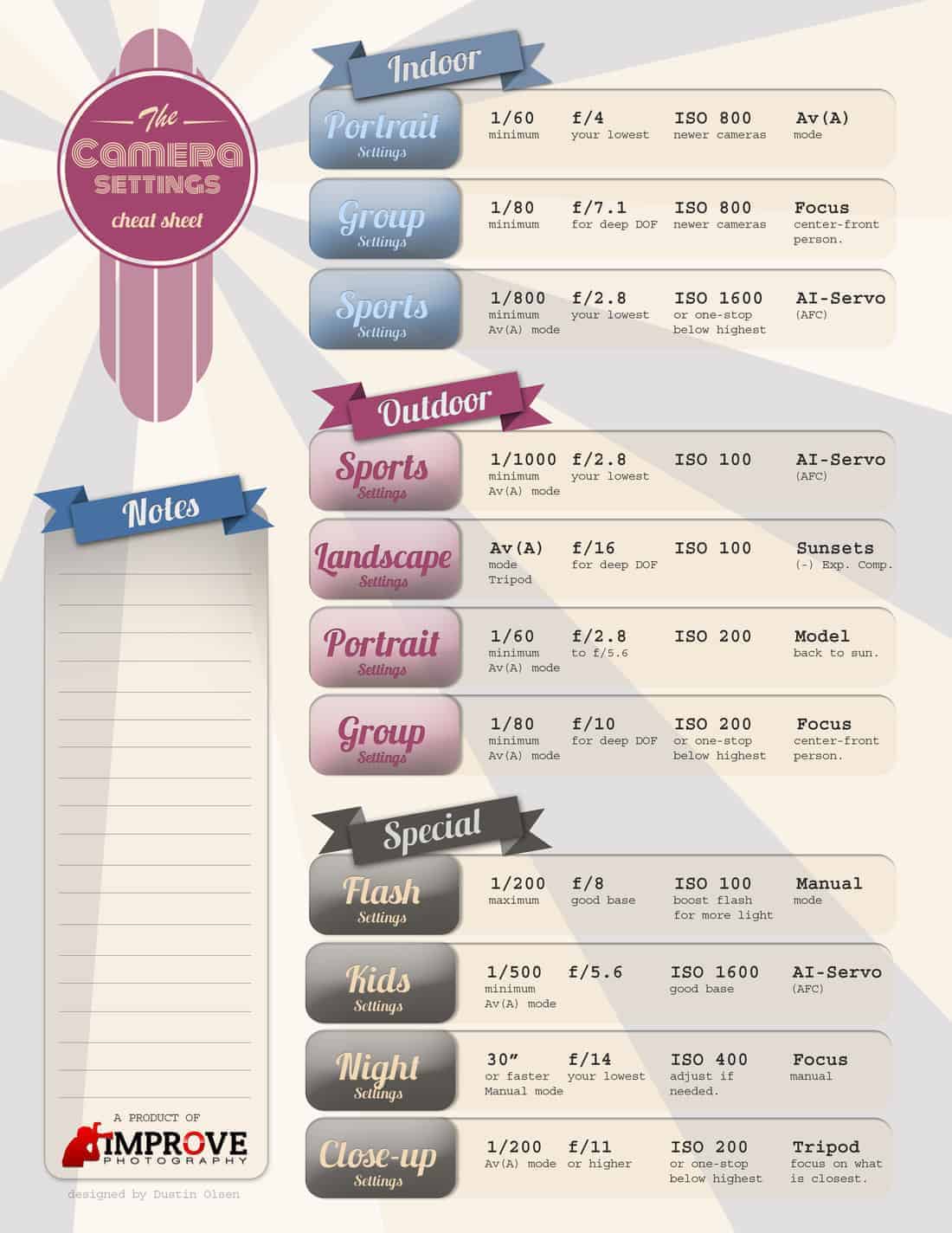
To help get the right exposure with your camera settings – you can download this Camera Settings Cheat Sheet guide.
If you’re reading this Photo Basics series, it probably means that you currently shoot on the “Green mode” of your camera–or the automatic setting. That means the camera entirely controls the exposure of the picture. When you shoot on automatic mode, your camera selects an aperture setting, an ISO setting, a shutter speed, and a host of other settings for you.
Automatic can be handy, but it also seriously limits your creative ability to make a beautiful picture.
Want proof that automatic isn’t the best way to shoot? Check out the picture below. On the left, the picture was taken entirely in automatic mode on a Canon Rebel DSLR. That might look okay to you… until you see the picture on the right. Same sunset. Same camera. The pictures were taken only seconds apart. The difference? The picture on the right was taken using manual exposure.

Which photo do you prefer? Probably the picture on the right! By choosing a creatively dark exposure, the rich colors in the sunset were allowed to shine through.
However, technically, the photo on the left is “correct,” and the photo on the right is “incorrect.” The camera saw through the lens and tried to expose the bird so that it wouldn’t become a shadow. To me, the photo was not about exposing the bird properly, but exposing the sunset properly. The bird was just a nice shape to include in the foreground. This is exactly why you must learn exposure–because sometimes the “scientifically correct” exposure is not the best exposure to make the photo look how you want it to.
What’s next?
Now that you understand why it is so important to take control over the exposure, let’s move on to shutter, aperture and ISO–which are the tools you need to control the exposure. Soon you’ll understand the basics of how to shoot in manual mode on your camera. I promise shooting in manual mode isn’t nearly as scary as you might think.
Once you’re ready to deepen your knowledge of manual mode, get tack sharp focus, and master lighting, consider buying my Photography Start Course. It’s a series of 22 video tutorials where I walk you step-by-step through the things that it normally takes my photography students two years to learn. Other photography websites sell a very similar course for $300. I’ve priced it at a REALLY reasonable price because I remember how tight money was when I was a beginner.
Great introduction to exposure! I appreciate the clear explanations and practical tips. Can’t wait to try out the suggestions in my next shoot!
Ok win Game is India’s premium online gaming platform. Get extra bonus and reward when registering for the first time on Ok Win.
I’m blown away by the quality of this content! The author has obviously put a great amount of effort into exploring and arranging the information. It’s inspiring to come across an article that not only offers helpful information but also keeps the readers captivated from start to finish. Hats off to him for making such a brilliant work!
My relatives always say that I am killing my time here at net,
but I know I am getting familiarity daily by reading such
good articles or reviews.
What’s up colleagues, how is the whole thing, and what you
would like to say about this article, in my view its truly remarkable for
me.
Audio started playing when I opened up this web site, so annoying!
Become a Data Scientist with 360DigiTMG’s expert-led training in Nagpur. Learn AI, ML & Python. Enroll now!
Fantastic intro to the essentials of camera exposure—aperture, shutter speed, and ISO explained in plain English.
Great for beginners facing the learning curve of manual settings.
Improve Photography
Photography Life
This guide makes the exposure triangle feel approachable.
Learnt quickly how these three work together to control brightness.
Really demystifies photography basics.
Love how this lesson breaks exposure into easy chunks instead of jargon.
It shows how each setting directly affects exposure and image qualities like blur and noise.
Photography Life
Perfect for DSLR or mirrorless newbies.
It gives you real confidence over auto mode.
Simple yet insightful.
This exposure intro is a gem for new photographers—clean, clear, and actionable.
Explains that aperture, shutter, and ISO form the “exposure triangle” you need to master.
Photography Life
Who knew manual mode could make so much sense?
Makes learning camera control exciting.
Definitely worth diving into.
Brilliant basic tutorial—no fluff, just how exposure works and why it matters.
Highlights how aperture, shutter speed, and ISO can shape your photo’s look and feel.
Easy for beginners to follow.
Empowers you to shoot with intention, not autopilot.
Clear, helpful, rewarding.
This lesson is perfect for demystifying the exposure triangle—so simple yet so powerful.
Taught me exactly how adjusting one element needs compensating with another.
Finally feel ready to experiment on manual mode.
This paced introduction builds solid understanding.
Exactly what every beginning photographer needs.
Such a clean breakdown of exposure basics—no magic, just how aperture, shutter, and ISO interact.
Great reminder: mastering exposure is about making choices, not just clicking.
Loved how beginner-focused it is.
Makes camera settings feel approachable.
Inspiring way to start learning photography.
This intro to exposure is exactly what newbie photographers need—simple, solid, smart.
Focuses on building understanding instead of memorizing numbers.
Highlights how each setting affects brightness and style.
Encourages hands-on learning.
So well done.
Thank you for sharing with us, I believe this website truly stands out : D.
this made things so much clearer. Grateful for content like this!”
This is a fantastic introduction to photography basics! I really appreciated the clear explanations on exposure and how it impacts photo quality. Looking forward to applying these tips to my own photography. Keep up the great work!
Great introduction to the basics of exposure! I appreciate how clearly you explained the relationship between aperture, shutter speed, and ISO. Can’t wait to try out the tips in my next shoot!
honxtnzvqfufzptxxjedsmdtrirysx
Very nice info