I’m so glad you found your way onto my Photography Basics series. I have taught the basics of photography to millions of photographers around the world through Improve Photography, so I know just exactly how difficult it can seem to learn the basics of photography.
My goal is to make this Photography Basics series the absolute simplest way to learn the basics of photography.
I hope you’ll love this series because of what you learn here, and I hope you’ll join the Improve Photography community after you get your feet wet with the photo basics. Let’s get going.
Basic Equipment You’ll Need
You can do photography with even the simplest of cameras, but the principles that I’d like to teach are for people who want to learn to use a DSLR camera, a micro four-thirds camera, or at least a camera that allows the photographer to adjust the shutter speed, aperture, and ISO. Even some pocket cameras have this functionality.
Here are some of our entry level DSLR options. The (with Accessories) link will show you a kit that comes with the camera, lens, case, extra battery, and a memory card:
Canon EOS Rebel T6 with 18-55mm and 75-300mm Lenses (with Accessories)
Nikon D5600 with 18-55mm and 70-300mm Lenses (with Accessories)
Canon EOS Rebel T7i with 18-135mm Lens (with Accessories)
Now that you have your camera, it is time to learn exposure.
Exposure–the most basic element of photography
When photographers talk about “exposure,” we simply mean the brightness or darkness of a photo. It seems simple enough to take a photo that is correctly exposed (has the proper brightness or darkness), but in reality it can be quite the trick.
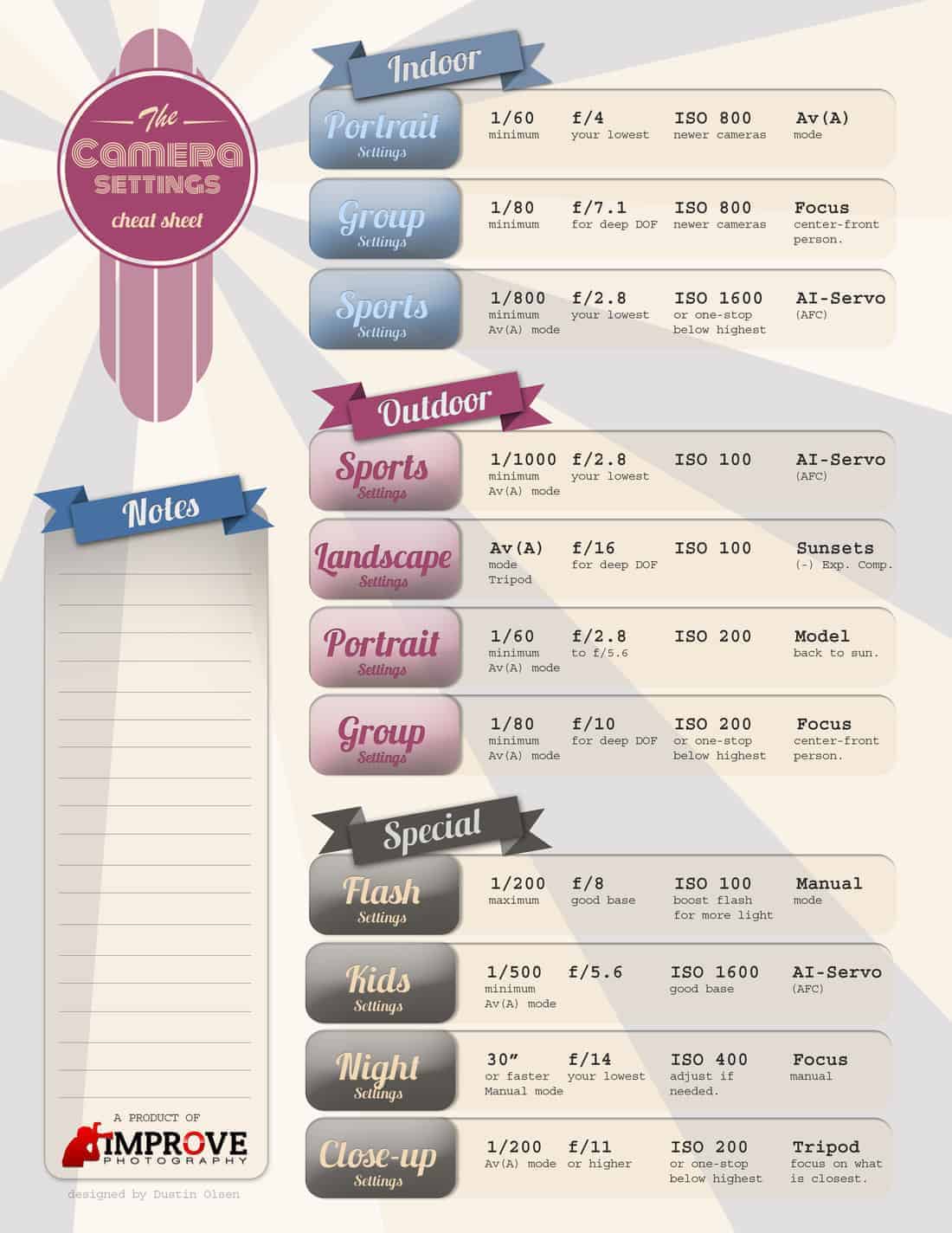
To help get the right exposure with your camera settings – you can download this Camera Settings Cheat Sheet guide.
If you’re reading this Photo Basics series, it probably means that you currently shoot on the “Green mode” of your camera–or the automatic setting. That means the camera entirely controls the exposure of the picture. When you shoot on automatic mode, your camera selects an aperture setting, an ISO setting, a shutter speed, and a host of other settings for you.
Automatic can be handy, but it also seriously limits your creative ability to make a beautiful picture.
Want proof that automatic isn’t the best way to shoot? Check out the picture below. On the left, the picture was taken entirely in automatic mode on a Canon Rebel DSLR. That might look okay to you… until you see the picture on the right. Same sunset. Same camera. The pictures were taken only seconds apart. The difference? The picture on the right was taken using manual exposure.

Which photo do you prefer? Probably the picture on the right! By choosing a creatively dark exposure, the rich colors in the sunset were allowed to shine through.
However, technically, the photo on the left is “correct,” and the photo on the right is “incorrect.” The camera saw through the lens and tried to expose the bird so that it wouldn’t become a shadow. To me, the photo was not about exposing the bird properly, but exposing the sunset properly. The bird was just a nice shape to include in the foreground. This is exactly why you must learn exposure–because sometimes the “scientifically correct” exposure is not the best exposure to make the photo look how you want it to.
What’s next?
Now that you understand why it is so important to take control over the exposure, let’s move on to shutter, aperture and ISO–which are the tools you need to control the exposure. Soon you’ll understand the basics of how to shoot in manual mode on your camera. I promise shooting in manual mode isn’t nearly as scary as you might think.
Once you’re ready to deepen your knowledge of manual mode, get tack sharp focus, and master lighting, consider buying my Photography Start Course. It’s a series of 22 video tutorials where I walk you step-by-step through the things that it normally takes my photography students two years to learn. Other photography websites sell a very similar course for $300. I’ve priced it at a REALLY reasonable price because I remember how tight money was when I was a beginner.
Thank you for sharing your info. I truly appreciate your efforts and I will be waiting for your further write ups thanks once again.
I am impressed with this site, very I am a fan.
I have seen lots of useful things on your internet site about computer systems. However, I have got the view that notebook computers are still less than powerful sufficiently to be a option if you often do things that require plenty of power, such as video touch-ups. But for website surfing, statement processing, and many other prevalent computer functions they are okay, provided you do not mind the small screen size. Many thanks for sharing your opinions.
This was a great read! I really appreciate the insights and perspective you shared. Looking forward to more of your content!
Would like to tell to steam of words.
Thank you for the auspicious writeup. It in fact
was once a enjoyment account it. Glance advanced to more brought
agreeable from you! By the way, how can we communicate?
I feel this is among the most vital information for me.
And i am satisfied studying your article. But want to statement
on few common things, The web site style is great, the articles is truly great : D.
Good task, cheers
Hi there to all, the contents present at this web page are actually remarkable for people knowledge, well, keep up the
nice work fellows.
This was a great read! I really appreciate the insights and perspective you shared. Looking forward to more of your content!
I’m amazed by the quality of this content! The author has clearly put a huge amount of effort into exploring and organizing the information. It’s refreshing to come across an article that not only offers valuable information but also keeps the readers captivated from start to finish. Hats off to her for making such a remarkable piece!
Solutions for Various Situations: Roadside assistance is not just for vehicle breakdowns. It also covers scenarios like accidents, getting stuck, running out of fuel, or flat tires. Each situation requires specialized equipment and expertise.
Thanks for every other informative web site. Where else could I am getting that kind of info written in such an ideal method? I’ve a mission that I am simply now working on, and I’ve been on the glance out for such info.
Psychological Support for Drivers: Roadside assistance doesn’t only offer physical help. It also provides psychological support for drivers who may be stressed, especially in difficult or remote situations.
Thanks for your short article. I would like to say that the health insurance agent also works for the benefit of the particular coordinators of your group insurance policy. The health insurance broker is given a long list of benefits needed by individuals or a group coordinator. Such a broker does is look for individuals and also coordinators which best go with those desires. Then he shows his tips and if all parties agree, this broker formulates an agreement between the 2 parties.
What?s Going down i am new to this, I stumbled upon this I have discovered It positively useful and it has aided me out loads. I’m hoping to give a contribution & aid other users like its aided me. Great job.
Psychological Support for Drivers: Roadside assistance doesn’t only offer physical help. It also provides psychological support for drivers who may be stressed, especially in difficult or remote situations.
fantastic issues altogether, you just won a new reader. What could you recommend about your submit that you just made some days ago? Any positive?
What’s up to every single one, it’s in fact a fastidious for
me to go to see this site, it includes precious
Information.
You are a very bright person!
Thanks for the diverse tips shared on this web site. I have noticed that many insurers offer buyers generous savings if they favor to insure a few cars with them. A significant quantity of households have got several motor vehicles these days, specifically those with old teenage children still dwelling at home, as well as savings with policies could soon mount up. So it makes sense to look for a good deal.