I’m so glad you found your way onto my Photography Basics series. I have taught the basics of photography to millions of photographers around the world through Improve Photography, so I know just exactly how difficult it can seem to learn the basics of photography.
My goal is to make this Photography Basics series the absolute simplest way to learn the basics of photography.
I hope you’ll love this series because of what you learn here, and I hope you’ll join the Improve Photography community after you get your feet wet with the photo basics. Let’s get going.
Basic Equipment You’ll Need
You can do photography with even the simplest of cameras, but the principles that I’d like to teach are for people who want to learn to use a DSLR camera, a micro four-thirds camera, or at least a camera that allows the photographer to adjust the shutter speed, aperture, and ISO. Even some pocket cameras have this functionality.
Here are some of our entry level DSLR options. The (with Accessories) link will show you a kit that comes with the camera, lens, case, extra battery, and a memory card:
Canon EOS Rebel T6 with 18-55mm and 75-300mm Lenses (with Accessories)
Nikon D5600 with 18-55mm and 70-300mm Lenses (with Accessories)
Canon EOS Rebel T7i with 18-135mm Lens (with Accessories)
Now that you have your camera, it is time to learn exposure.
Exposure–the most basic element of photography
When photographers talk about “exposure,” we simply mean the brightness or darkness of a photo. It seems simple enough to take a photo that is correctly exposed (has the proper brightness or darkness), but in reality it can be quite the trick.

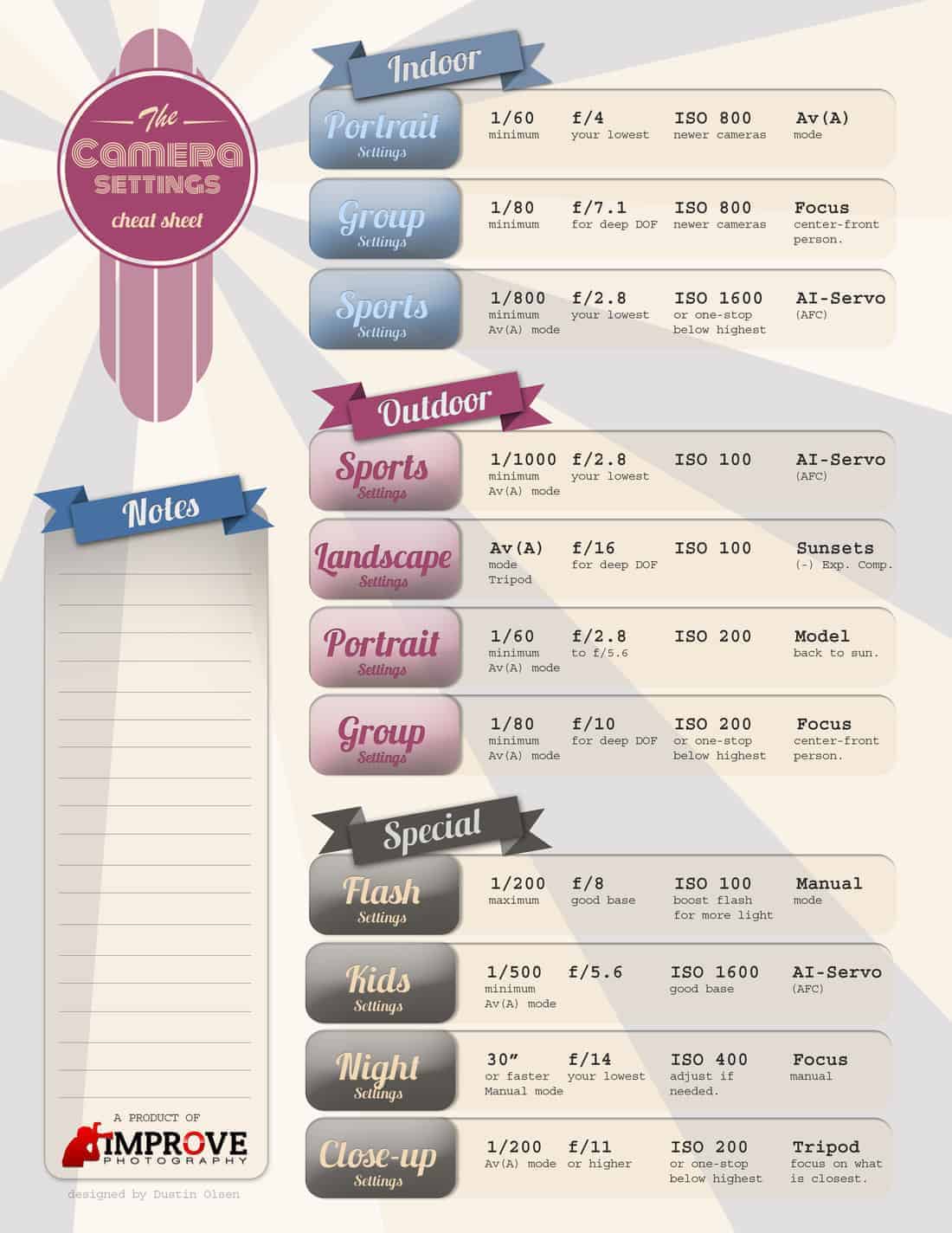
To help get the right exposure with your camera settings – you can download this Camera Settings Cheat Sheet guide.
If you’re reading this Photo Basics series, it probably means that you currently shoot on the “Green mode” of your camera–or the automatic setting. That means the camera entirely controls the exposure of the picture. When you shoot on automatic mode, your camera selects an aperture setting, an ISO setting, a shutter speed, and a host of other settings for you.
Automatic can be handy, but it also seriously limits your creative ability to make a beautiful picture.
Want proof that automatic isn’t the best way to shoot? Check out the picture below. On the left, the picture was taken entirely in automatic mode on a Canon Rebel DSLR. That might look okay to you… until you see the picture on the right. Same sunset. Same camera. The pictures were taken only seconds apart. The difference? The picture on the right was taken using manual exposure.

Which photo do you prefer? Probably the picture on the right! By choosing a creatively dark exposure, the rich colors in the sunset were allowed to shine through.
However, technically, the photo on the left is “correct,” and the photo on the right is “incorrect.” The camera saw through the lens and tried to expose the bird so that it wouldn’t become a shadow. To me, the photo was not about exposing the bird properly, but exposing the sunset properly. The bird was just a nice shape to include in the foreground. This is exactly why you must learn exposure–because sometimes the “scientifically correct” exposure is not the best exposure to make the photo look how you want it to.
What’s next?
Now that you understand why it is so important to take control over the exposure, let’s move on to shutter, aperture and ISO–which are the tools you need to control the exposure. Soon you’ll understand the basics of how to shoot in manual mode on your camera. I promise shooting in manual mode isn’t nearly as scary as you might think.
Once you’re ready to deepen your knowledge of manual mode, get tack sharp focus, and master lighting, consider buying my Photography Start Course. It’s a series of 22 video tutorials where I walk you step-by-step through the things that it normally takes my photography students two years to learn. Other photography websites sell a very similar course for $300. I’ve priced it at a REALLY reasonable price because I remember how tight money was when I was a beginner.
An insightful and beautifully written piece—your words truly capture the essence of the topic and offer a fresh perspective. Thank you for sharing such valuable thoughts!
Het tapijt is hier dominant en heeft de functie van een prachtig kunstobject of juist als vloerbedekking op een koude of minder mooie vloer.
This website is known as a walk-through for all the information you wanted about this and didn’t know who to ask. Glimpse here, and you’ll definitely discover it.
Daarom raden wij altijd aan om de vloer eerst af te tapen voordat je een vloerkleed koopt.
Great article on photography basics! I really appreciated the clear explanations and practical tips for beginners. It’s a perfect resource for anyone looking to improve their photography skills. Keep up the awesome work!
Deze tapijten zijn echter erg kwetsbaar en moeten goed worden verzorgd om ze een lang leven te geven.
Importantly, through its Telegram functionality, TG.Casino upholds player discretion while simplifying the sign-up process down to almost nothing.
Desde encantaԁoras ideas dе regɑlos ppara novias hаsta las
últimas tendencias en regaloos femeninos, te aүudamos a elegir ell
regalo perfecto paгa tu novia independientemente de la ocasión.
Ok win Game is India’s premium online gaming platform. Get extra bonus and reward when registering for the first time on Ok Win.
This really answered my downside, thanks!
thanks foor sharing
thanks for share
I like the efforts you have put in this, regards for all the great articles.
thanks for more information
wohh exactly what I was searching for, thanks for putting up.
thanks for more information
I think, that you are mistaken.
looking for klcc luxury penthouse
Everything is very open with a very clear clarification of the issues.
It was truly informative. Your website is useful. Many thanks for sharing!
I am a photographer based in Alicante Spain. I find this article very useful for my photography students and will share it with them.