

In part 2 of this photography basics series, we learned about aperture, ISO, and shutter speed. Now, you need to learn how to apply these settings on your camera to take advantage of your new-found knowledge.
The Great Flaw of Shooting “Icon Modes” on Your Camera
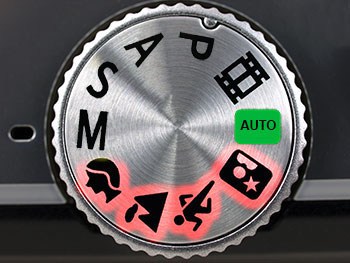
Whenever I teach shooting modes, I always get the same question from members of my class. “Why do I need to learn how to set my camera’s settings manually when my camera already has built-in modes for sports, portraits, landscapes, etc?” By the way, these are referred to by photographers as the icon modes because they have icons of the shooting situation on the mode dial.
This example will help to explain why these icon modes won’t work for those who want to become a “real” photographer.
With your new photography skills and your new fancy camera, your family members nominate you the official photographer at your family reunion. It comes time to take the giant group picture with over 60 people in it. What mode do you set the camera to? The little portrait icon, because it’s a portrait, right?
There is a problem with that; a really big problem. The portrait mode on your camera automatically makes the aperture really low, because it thinks you want shallow depth-of-field in your portrait. But in this instance, it’s such a large group of people that you need full depth-of-field so that the people in the back aren’t out of focus. The camera doesn’t know your intentions with this portrait, so half of the group looks blurry.
And thus we see why the little automatic icon modes (the landscape, portrait, sports modes, etc), simply will not work for photographers who want to learn to take professional-quality photos.
What are Creative Modes?

The Creative Modes on your camera are Program, Aperture Priority, Shutter Priority, and Manual Mode. On most cameras, they are marked “P, A, S, M.” These stand for “Program Mode, Aperture priority, Shutter Priority, and Manual Mode.”
If you use a Canon DSLR, then you’ll see that your camera company likes to feel “special” by changing up those names. Canon cameras will show “P, Av, Tv, M” for the same exact modes. “Av” is Canon’s version of Aperture Priority, and “Tv” is Canon’s version of Shutter Priority.
It may feel a little bit intimidating to move to these creative modes on your camera, but I’ll walk you step-by-step through each of the creative modes, how to use them, and what they do.
Program Mode (P)
Just trust me on this one–you don’t want to use it–ever.
But just in case you’re curious, program mode usually (it is slightly different on each camera model) sets the aperture and the shutter speed for you, and allows the photographer to set the white balance, ISO, and flash.
This mode is not a great choice for serious photographers because you can’t set the shutter speed to make sure the picture isn’t blurry. Also, you can’t set the aperture to control the depth-of-field.
Aperture Priority Mode
(“A” on most cameras, “Av” on Canon)
I’d love to see you use aperture priority for 95% of your shooting for the next several months. It is the mode that most hobbyist photographers and even many pro photographers shoot in most of the time.
When you shoot aperture priority mode, you set the aperture (the f-stop) and also the ISO. The camera will then set a shutter speed for you so that the picture is properly exposed.
Aperture priority mode is powerful because it is amazingly simple to use, and still allows the photographer a lot of creative choice. In fact, most competent photographers use aperture priority mode every single day.
Suppose you’re shooting friends and family at a party. The background is really busy with people and things around the house, so you decide you want a blurry background in the photo (shallow depth-of-field). To achieve this, you set the camera to f/3.5 which is a low aperture and which will blur out the background.
The first picture you take is of a person sitting on the couch next to a lamp. The lamp is bright, so you want a fast shutter speed to get the correct exposure since your aperture is wide open. Using aperture priority mode, the camera would automatically set that shutter speed for you. Then, you want to take a picture of someone in a darker corner of the room. You wouldn’t have to fiddle with camera settings at all, because the camera will automatically see that it is dark and choose a slower shutter speed. All the while, you’re able to keep the aperture set to use creative depth-of-field.
If I could only teach you one thing in this photography basics series, it would be to set your camera in aperture priority for the next six months.
When you want full depth-of-field, choose a high f-stop (aperture). When you want shallow depth of field, choose a lower f-stop. Your pictures will DRAMATICALLY improve when you learn to control the depth-of-field.
Shutter Priority Mode
(“S” on most cameras, or “Tv” on Canon cameras)
Shutter priority mode sounds very useful, but the truth is that I have never found a professional photographer who uses it. It is a bit difficult to explain why that is.
At first blush, it sounds convenient to have a mode where you could choose the shutter speed and ISO and let the camera choose the aperture for you. For example, when shooting a school basketball game, you might think you’d want shutter priority mode because you could set the shutter speed fast enough for the quick-moving sports situation.
However, you might be surprised to learn that nearly all professional sports photographers I’ve worked with shoot in aperture priority mode. Why? Because the depth-of-field is key. We want to control depth-of-field in our sports pictures and we just keep an eye on the shutter speed to make sure the camera isn’t picking one that is too low. If it does, then we boost the ISO so that the camera will choose a faster shutter speed.
Manual Mode (“M”)
When I was 16 and drove a car for the first time, my teacher took me to a large parking lot. He asked me to floor it as fast as I possibly could across the parking lot. This was my first time driving! So, I went for it. I felt like I was FLYING! Then, he told me half way across the parking lot to look at the speedometer. I was only going 10 miles per hour (16 kilometers)! The point is, the first time you try anything, it feels intimidating and like you’re out of control.
The first time any of my students use a camera in manual mode, I can see them terrified to try it out. However, shooting in manual mode really isn’t as difficult as it may seem.
To understand manual mode, the example below will be helpful.
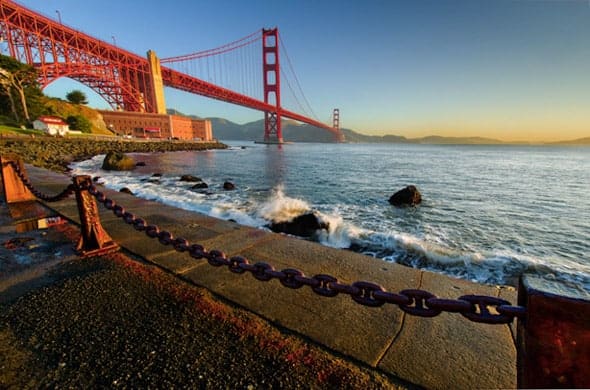
I took the picture above while at a photography conference in San Francisco. In a situation like this, the bridge isn’t going anywhere, the bay isn’t going anywhere, the chain in front of me wasn’t going anywhere. I had a captive audience to say the least.
In situations like this, I always use manual mode. I then set my shutter speed to 1/100. I set my ISO to 100 because I wanted no noise in the picture and I knew if I needed more light, I could just slow down the shutter speed.
After taking the picture with the settings above, I realized that the picture came out a bit too dark with 1/100 shutter speed. So, I slowed it down to 1/60 and it looked just how I wanted.
The point is that, eventually, you’ll find yourself wanting to shoot in manual mode for situations where you aren’t rushed to get the shot. If you’re shooting sports, outdoor portraits, or other things, then aperture priority is simpler and faster than shooting in manual mode.
But since you’re still learning, the best option for the next few months is to get comfortable shooting in aperture priority mode 100% of the time.
In the next lesson in this series, you’re going to learn how you can dramatically improve your pictures by using creative compositions. We’re past most of the technical stuff for now.
Next, I’m going to teach you how to develop strong compositions in your photos.
Great insights on shooting modes! I always found the options a bit overwhelming, but your explanations make it much clearer. I can’t wait to experiment with Manual and Aperture Priority modes. Thank you for breaking it down!
Most of the things you say happens to be supprisingly legitimate and it makes me ponder the reason why I had not looked at this with this light previously. This piece really did switch the light on for me as far as this particular subject matter goes. But there is one issue I am not necessarily too comfortable with so while I attempt to reconcile that with the actual main idea of your issue, allow me see just what all the rest of the visitors have to point out.Nicely done.
Your writing style makes complex topics seem simple. Thanks!
Good write-up, I?¦m normal visitor of one?¦s web site, maintain up the nice operate, and It is going to be a regular visitor for a lengthy time.
Thank you, I have just been searching for information about this subject for ages and yours is the greatest I’ve discovered so far. But, what about the bottom line? Are you sure about the source?
Thank you for this article. I’d personally also like to express that it can often be hard if you find yourself in school and starting out to initiate a long credit history. There are many students who are merely trying to pull through and have a long or beneficial credit history can often be a difficult point to have.
Thanks for the new things you have revealed in your text. One thing I would really like to touch upon is that FSBO associations are built eventually. By releasing yourself to the owners the first saturday their FSBO can be announced, ahead of the masses begin calling on Friday, you produce a good link. By giving them methods, educational supplies, free records, and forms, you become a good ally. If you take a personal curiosity about them along with their predicament, you build a solid relationship that, most of the time, pays off if the owners opt with a real estate agent they know as well as trust – preferably you.
Rattling good visual appeal on this web site, I’d rate it 10 10.
We are a group of volunteers and starting a new scheme in our community. Your web site offered us with valuable information to work on. You’ve done a formidable job and our entire community will be grateful to you.
I have realized that over the course of building a relationship with real estate owners, you’ll be able to come to understand that, in every real estate transaction, a percentage is paid. Eventually, FSBO sellers do not “save” the fee. Rather, they fight to win the commission by means of doing a strong agent’s job. In accomplishing this, they expend their money and also time to execute, as best they could, the assignments of an agent. Those assignments include getting known the home through marketing, introducing the home to prospective buyers, developing a sense of buyer desperation in order to induce an offer, booking home inspections, handling qualification investigations with the financial institution, supervising repairs, and aiding the closing.
I have noticed that online degree is getting common because accomplishing your degree online has turned into a popular selection for many people. A large number of people have not had a possibility to attend a normal college or university nonetheless seek the improved earning potential and a better job that a Bachelor’s Degree grants. Still other folks might have a qualification in one discipline but wish to pursue something they now possess an interest in.
Almost all of the things you say is astonishingly appropriate and that makes me wonder the reason why I hadn’t looked at this with this light previously. This article really did switch the light on for me as far as this subject goes. Nevertheless at this time there is 1 position I am not too comfortable with so whilst I try to reconcile that with the core theme of your issue, permit me see just what the rest of the readers have to say.Well done.
Thankyou for all your efforts that you have put in this. very interesting info .
Some truly nice stuff on this website , I like it.
I conceive this internet site contains some real good info for everyone : D.
Your place is valueble for me. Thanks!?
I have noticed that over the course of building a relationship with real estate owners, you’ll be able to get them to understand that, in each and every real estate contract, a commission rate is paid. Eventually, FSBO sellers do not “save” the fee. Rather, they struggle to earn the commission by way of doing the agent’s occupation. In doing this, they invest their money as well as time to conduct, as best they can, the obligations of an adviser. Those responsibilities include uncovering the home by marketing, delivering the home to willing buyers, making a sense of buyer emergency in order to trigger an offer, making arrangement for home inspections, dealing with qualification checks with the lender, supervising repairs, and assisting the closing.
As soon as I discovered this web site I went on reddit to share some of the love with them.
I take pleasure in, cause I discovered exactly what I used to be having a look for. You have ended my four day long hunt! God Bless you man. Have a nice day. Bye
As I website possessor I believe the content material here is rattling wonderful , appreciate it for your hard work. You should keep it up forever! Good Luck.