I'm so glad you found your way onto my Photography Basics series. I have taught the basics of photography to millions of photographers around the world through Improve Photography, so I know just exactly how difficult it can seem to learn the basics of photography.
My goal is to make this Photography Basics series the absolute simplest way to learn the basics of photography.
I hope you'll love this series because of what you learn here, and I hope you'll join the Improve Photography community after you get your feet wet with the photo basics. Let's get going.
Basic Equipment You'll Need
You can do photography with even the simplest of cameras, but the principles that I'd like to teach are for people who want to learn to use a DSLR camera, a micro four-thirds camera, or at least a camera that allows the photographer to adjust the shutter speed, aperture, and ISO. Even some pocket cameras have this functionality.
Here are some of our entry level DSLR options. The (with Accessories) link will show you a kit that comes with the camera, lens, case, extra battery, and a memory card:
Canon EOS Rebel T6 with 18-55mm and 75-300mm Lenses (with Accessories)
Nikon D5600 with 18-55mm and 70-300mm Lenses (with Accessories)
Canon EOS Rebel T7i with 18-135mm Lens (with Accessories)
Now that you have your camera, it is time to learn exposure.
Exposure–the most basic element of photography
When photographers talk about “exposure,” we simply mean the brightness or darkness of a photo. It seems simple enough to take a photo that is correctly exposed (has the proper brightness or darkness), but in reality it can be quite the trick.

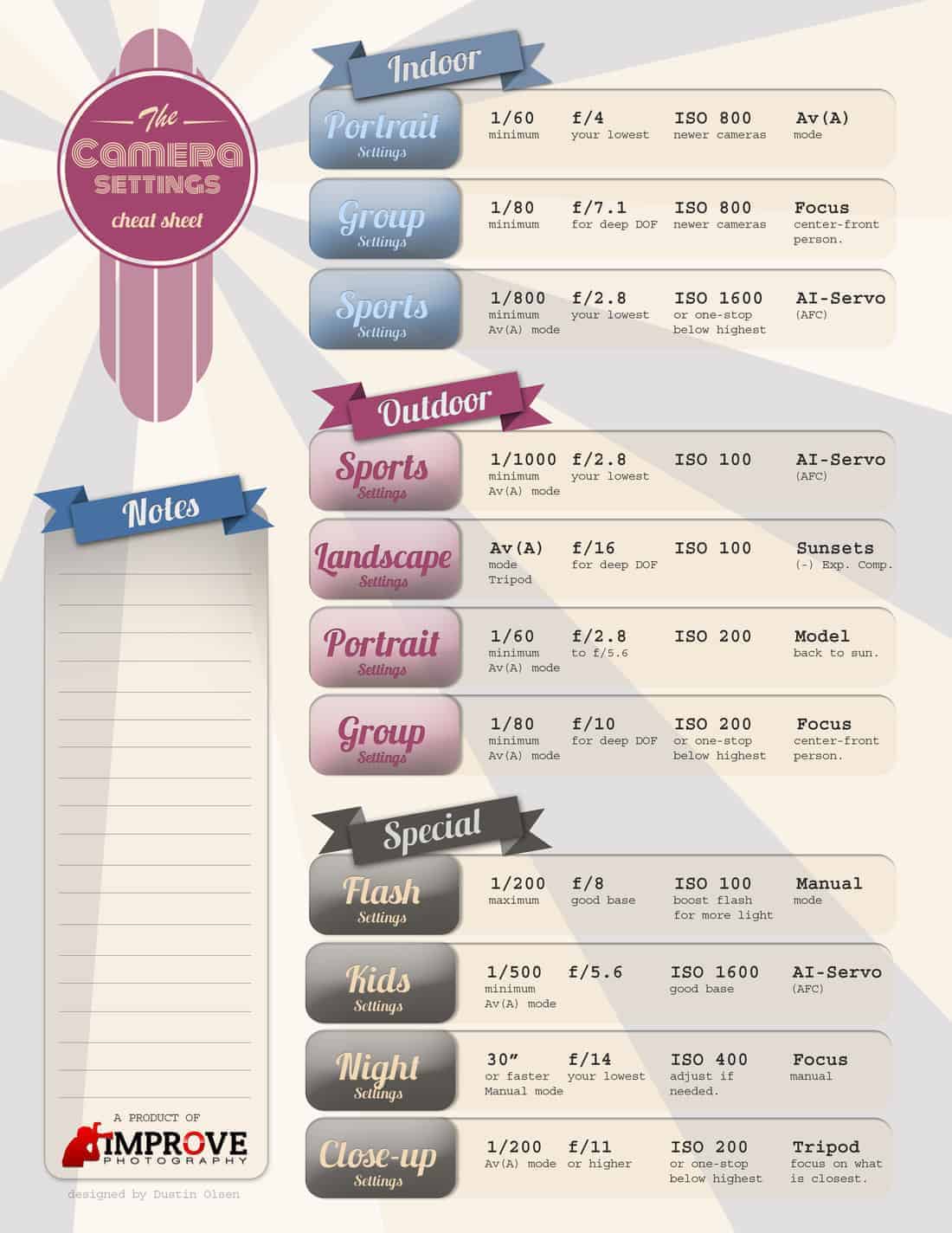
To help get the right exposure with your camera settings – you can download this Camera Settings Cheat Sheet guide.
If you're reading this Photo Basics series, it probably means that you currently shoot on the “Green mode” of your camera–or the automatic setting. That means the camera entirely controls the exposure of the picture. When you shoot on automatic mode, your camera selects an aperture setting, an ISO setting, a shutter speed, and a host of other settings for you.
Automatic can be handy, but it also seriously limits your creative ability to make a beautiful picture.
Want proof that automatic isn't the best way to shoot? Check out the picture below. On the left, the picture was taken entirely in automatic mode on a Canon Rebel DSLR. That might look okay to you… until you see the picture on the right. Same sunset. Same camera. The pictures were taken only seconds apart. The difference? The picture on the right was taken using manual exposure.

Which photo do you prefer? Probably the picture on the right! By choosing a creatively dark exposure, the rich colors in the sunset were allowed to shine through.
However, technically, the photo on the left is “correct,” and the photo on the right is “incorrect.” The camera saw through the lens and tried to expose the bird so that it wouldn't become a shadow. To me, the photo was not about exposing the bird properly, but exposing the sunset properly. The bird was just a nice shape to include in the foreground. This is exactly why you must learn exposure–because sometimes the “scientifically correct” exposure is not the best exposure to make the photo look how you want it to.
What's next?
Now that you understand why it is so important to take control over the exposure, let's move on to shutter, aperture and ISO–which are the tools you need to control the exposure. Soon you'll understand the basics of how to shoot in manual mode on your camera. I promise shooting in manual mode isn't nearly as scary as you might think.
Once you're ready to deepen your knowledge of manual mode, get tack sharp focus, and master lighting, consider buying my Photography Start Course. It's a series of 22 video tutorials where I walk you step-by-step through the things that it normally takes my photography students two years to learn. Other photography websites sell a very similar course for $300. I've priced it at a REALLY reasonable price because I remember how tight money was when I was a beginner.
миг кредит вход
Thanks for sharing such a great article
I got this web page from my friend who told me on the
topic of this web site and now this time I am
visiting this site and reading very informative articles or reviews at this time.
Get High Quality Chemistry Lab Equipment at best prices from manufacturer, supplier and exporter in India. We will provide you with high quality 1st class products at affordable prices.
Inspiring story there. What happened after? Good luck!
I am actually thankful to the holder of this web site who has
shared this fantastic paragraph at at this time.
Wow many of useful data.
This site was… how do I say it? Relevant!! Finally I’ve found something
that helped me. Thank you!
I constantly spent my half an hour to read this webpage’s articles everyday along with a cup
of coffee.
We’re a group of volunteers and opening a brand new scheme in our community.
Your site provided us with valuable info to work
on. You have done an impressive process and our entire community shall be grateful to
you.
It’s very trouble-free to find out any matter on net as compared to textbooks, as I found this article at this site.
En outre, la chose la plus importante à retenir est de limiter au most le contact avec la zone du piercing.
Il est recommandé de faire appel à un réparateur volet roulant Hauts-de-Seine,
ayant à la fois l’expérience et le matériel pour réparer votre
matériel.
Fotograf Gondermek istiyorum nasıl ulaşıcam
Its not my first time to pay a visit this web page, i am
visiting this website dailly and obtain good data from here daily.
Thank you for this insightful introduction to your Photography Basics series! As a beginner in photography, I’ve often found the world of camera settings and exposure a bit overwhelming. Your explanation of exposure as the fundamental element of photography really resonated with me. The example you provided, comparing the automatic and manual exposures of the same sunset shot, was an eye-opener. It’s amazing how a creatively dark exposure can bring out such vibrant colors and mood in a photo.
I appreciate how you’ve emphasized the importance of taking control over exposure and moving away from the ‘scientifically correct’ approach to capture the photo as you envision it. This makes me excited to learn more about the tools like shutter speed, aperture, and ISO that enable photographers to have this creative control. Your promise that shooting in manual mode isn’t as intimidating as it might seem is quite reassuring!
I’m definitely looking forward to diving into the rest of your series and gaining a deeper understanding of manual mode, sharp focus, and lighting. Your Photography Start Course also sounds like a fantastic resource to continue building my skills. The fact that you’ve priced it reasonably shows your commitment to helping beginners like me on our photography journey.
Once again, thank you for providing such clear and relatable explanations. I’m excited to learn and grow through your series!
I want to send my photos
For most recent information you have to pay a
quick visit world wide web and on internet I found this website as
a most excellent site for hottest updates.
Thank you for the good writeup. It in fact was
a amusement account it. Look advanced to more added agreeable from you!
By the way, how can we communicate?
Every weekend i used to pay a quick visit this site, because i want enjoyment,
as this this web page conations in fact pleasant funny stuff too.