
This is part 4 of a 10-page series on the basics of flash photography. To start the tutorial from the beginning, click here.
Intensity of Light and the Zone System
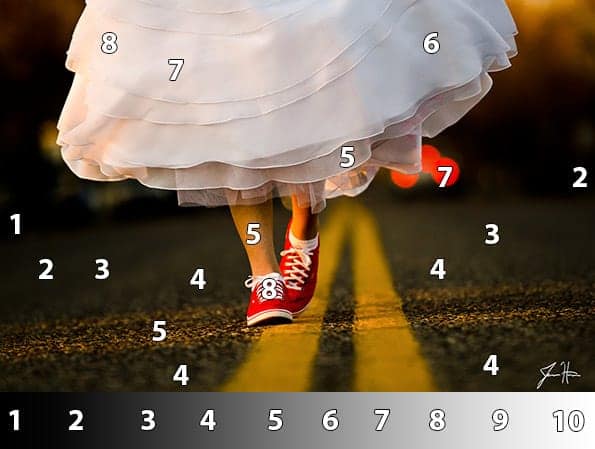
One technique for gaining the skill of quickly evaluating the light in a scene is to become acquainted with the zone system. The zone system is a method of categorizing the intensity of light in various areas of the frame according to a value of 1 through 10.
In this system, if the shadow in an area of the photo is so dark as to be completely black, it is called zone 1. Areas that are completely white are zone 10. Each of the other areas of the photo are placed on a scale between those upper and lower limits. In general, the face of a person being photographed with flash will be between a six and an eight on the zone system scale. The face is often the brightest area of the photo so as to draw the viewers attention to it.
Even understanding this basic approach to the zone system can be tremendously useful in flash photography.
When photographers begin learning flash photography, they usually think on more of a general scale than professional photographers. A new photographer may shoot a photo of a person’s face, look at the photo, determine it to be a seven on the zone system scale, and be pleased with the lighting.
A more knowledgeable photographer knows that more attention to detail can produce a far more attractive result. A knowledgeable photographer will look at the same photo that a beginner called a seven and evaluate it with more detail–”the cheeks are at a seven, I like the shadowy fours under the cheekbones to bring out the nice shape of the face, but the forehead is a nine due to some oil on the skin. Perhaps tilting the softbox down a smidgen would take the focus off the forehead and bring that light level back down to a six.”
As you begin working with flash, do not feel frustrated with yourself if you cannot yet control the exact light level on every area of the photo, but with practice you will eventually find that you can make every single area of the photo the exact brightness level you desire. This precise, location-specific control over lighting is what makes a professional photo look professional.
As your study of flash photography continues and includes mixing flash with natural light, you will find that your knowledge of the zone system and your ability to quickly analyze light sources will help you tremendously in working with multiple light sources.
Directionality of Light
One of the most common questions I get from new flash photographers is “where do I put the light?” It should surprise no one that the answer to this question is not as straightforward as the question would suggest, but the question itself hits on a key to successful flash photography.
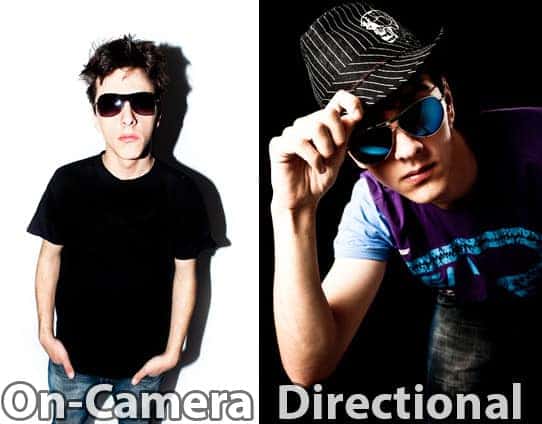
Imagine a face. In a lamp illuminating that face in a room that is otherwise entirely black. When the lamp is placed directly in front of the face, the shaded area in the photo is minimized.
At first blush removing shadows from the face seems to be a benefit. However, truly great photography almost always places heavy emphasis on shadowing. For example, the black and white work of Ansel Adams was noteworthy because of the extreme contrast in his landscapes showing deep rich shadows as well as bright clean highlights. The same is true of professional portrait photography today. I generally find new flash photographers talking about shadows only in the context of how they can be eliminated, yet professional photographers spend far more time creating shadows than creating highlights.
The reason shadows play such a vital role in a successful portrait is because they add dimensionality to an otherwise flat photo. Unlike video which can show dimensionality by movement, still photographers can only give the viewer the experience of “being there” by showing depth as a person sees when he or she is actually “there.”
The photographer’s principal tool for developing a sense of dimension in a photo is highlight and shadow. Now that you have imagined the lighting and shadows of a face with a lamp directly in front of it, change the scenario to place the light to the side. As the light moves, shadows grow on the dark side of the face.
These shadows show shape and size because the human eye is adept at determining size by seeing the shadows that we see everywhere in life.
Now imagine if you could manipulate the light in such a way as to convince the eye it were seeing a face more pleasing than reality, or to minimize the appearance of flaws on the person. Or, even if only a realistic look was desired, imagine if you could shape the light in a way that could tell a story only through shadow.
This skill of manipulating and shaping light and shadow to create interesting light that tells a story and portrays people in the way photographers intend is the key to becoming a master at flash photography.
Little imagination is required to see how this could be done. If the lamp in the aforementioned example is placed low under the chin, the light would come up on the face and remind the viewer of a storyteller surprising his audience with a ghost story in a tent. Every child has heard a ghost story told by the light of a flashlight under the chin of the storyteller, so this pattern of light and shadow on the face immediately conveys in the mind of the viewer that the mood of the photo is scary, mysterious, or even creepy.
The mind has millions of these light and shadow patterns logged away that tell the mind to view a scene in a certain way. If a photo is shot straight on looking at the subject and tall shadows appear on the sides of the head, it is a signal to the mind that the person is skinny because otherwise a heavier dish-shaped face would catch more light on the sides of the face.
The examples of lighting patterns the mind recognizes are endless. Now that you understand this principle, you must constantly think of what light and shadow patterns convey to your mind. Once you have this sense, you will soon be armed with Part Two of this book, which will teach you how to use your flash and flash modifiers and natural light in a way that you can create these light and shadow patterns at will–no matter the conditions.
For the next few weeks, consciously analyze the lighting you see everywhere you go–outside, in a room, in the grocery store, etc. Instead of merely thinking of a room as bright or dark, label it with one of the zones in the zone system, determine if it is warm or cool in light temperature, the direction of the light or lights, and think about the hardness or softness of the light. Not only will this solidify your standing as a hopeless photographer nerd, it will be a tremendous asset to you as you begin working with flash.
An additional issue is that video gaming has become one of the all-time most important forms of entertainment for people of nearly every age. Kids enjoy video games, plus adults do, too. The XBox 360 is amongst the favorite video games systems for individuals that love to have a huge variety of activities available to them, as well as who like to experiment with live with others all over the world. Many thanks for sharing your thinking.
You explained the topic with impressive clarity; the clear organization made every point easy to absorb. It made me curious to explore the topic further. I am glad I took the time to read this.
I really enjoyed the perspective you shared here; the practical examples gave the ideas real-world meaning. I came away with a much better understanding of the topic. This deserves to reach a wide audience.
You explained the topic with impressive clarity; your friendly writing style made the subject feel approachable. It made me curious to explore the topic further. I hope you continue exploring topics like this.
An additional issue is that video gaming has become one of the all-time biggest forms of fun for people of various age groups. Kids play video games, and also adults do, too. The actual XBox 360 is one of the favorite games systems for folks who love to have a lot of video games available to them, along with who like to play live with other people all over the world. Many thanks for sharing your ideas.
This was a genuinely enjoyable read; the useful takeaways made this especially worthwhile. It left me with a clear and memorable takeaway. The quality of the writing elevated the entire piece!
I have figured out some new points from your internet site about personal computers. Another thing I have always assumed is that computer systems have become a specific thing that each home must have for most reasons. They provide convenient ways to organize homes, pay bills, search for information, study, pay attention to music and even watch tv programs. An innovative way to complete most of these tasks is with a computer. These computers are mobile, small, potent and mobile.
You turned a complex idea into an accessible read; the concise explanations respected the reader’s time. It provided exactly the context I needed. This article was a refreshing find.
This was both informative and refreshingly easy to follow; the clear organization made every point easy to absorb. It made me curious to explore the topic further. Thank you for sharing such useful work!
You turned a complex idea into an accessible read; your friendly writing style made the subject feel approachable. I came away with a much better understanding of the topic. I look forward to reading more from you.
I really enjoyed the perspective you shared here; the clear organization made every point easy to absorb. It clarified several points that are often overlooked. This deserves to reach a wide audience.
Hola! I’ve been reading your website for a while now and finally got the bravery to go ahead and give you a shout out from Austin Tx! Just wanted to mention keep up the great work!
The core of your writing while appearing agreeable originally, did not really sit properly with me personally after some time. Somewhere throughout the paragraphs you actually managed to make me a believer unfortunately only for a very short while. I however have a problem with your leaps in logic and one might do well to fill in those breaks. If you actually can accomplish that, I would definitely be amazed.
Great article. It is extremely unfortunate that over the last several years, the travel industry has already been able to to handle terrorism, SARS, tsunamis, flu virus, swine flu, as well as first ever real global downturn. Through it all the industry has really proven to be solid, resilient in addition to dynamic, getting new methods to deal with adversity. There are generally fresh challenges and opportunities to which the industry must just as before adapt and react.
I have observed that online diploma is getting well-known because attaining your degree online has developed into a popular selection for many people. Many people have never had an opportunity to attend an established college or university however seek the raised earning possibilities and a better job that a Bachelor Degree gives. Still some others might have a college degree in one training but would choose to pursue one thing they now develop an interest in.
Hi there! Do you know if they make any plugins to safeguard against hackers? I’m kinda paranoid about losing everything I’ve worked hard on. Any tips?
Thanks for this wonderful article. One other thing is that the majority of digital cameras arrive equipped with some sort of zoom lens that permits more or less of any scene to be included through ‘zooming’ in and out. These kind of changes in {focus|focusing|concentration|target|the a**** length are generally reflected inside viewfinder and on substantial display screen right on the back of this camera.
You could definitely see your skills within the work you write. The world hopes for more passionate writers like you who aren’t afraid to say how they believe. At all times go after your heart.
Thanks for your article. One other thing is that if you are advertising your property by yourself, one of the troubles you need to be aware of upfront is just how to deal with house inspection accounts. As a FSBO home owner, the key towards successfully transferring your property and saving money about real estate agent income is knowledge. The more you already know, the softer your property sales effort will probably be. One area exactly where this is particularly essential is home inspections.
I beloved up to you’ll obtain carried out proper here. The comic strip is tasteful, your authored subject matter stylish. nonetheless, you command get bought an shakiness over that you wish be handing over the following. in poor health indisputably come more previously once more as precisely the similar just about very continuously inside of case you defend this increase.