
This is part 4 of a 10-page series on the basics of flash photography. To start the tutorial from the beginning, click here.
Intensity of Light and the Zone System
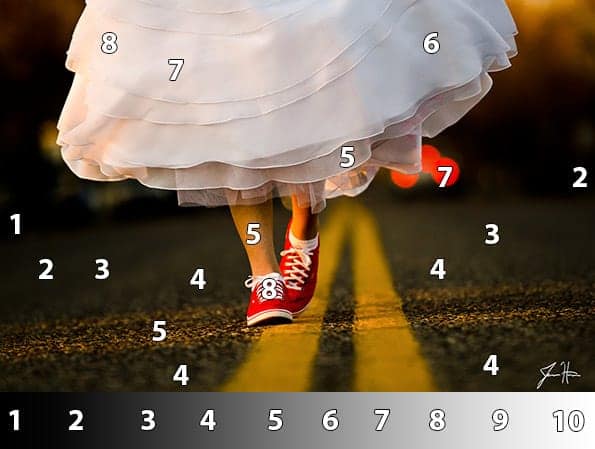
One technique for gaining the skill of quickly evaluating the light in a scene is to become acquainted with the zone system. The zone system is a method of categorizing the intensity of light in various areas of the frame according to a value of 1 through 10.
In this system, if the shadow in an area of the photo is so dark as to be completely black, it is called zone 1. Areas that are completely white are zone 10. Each of the other areas of the photo are placed on a scale between those upper and lower limits. In general, the face of a person being photographed with flash will be between a six and an eight on the zone system scale. The face is often the brightest area of the photo so as to draw the viewers attention to it.
Even understanding this basic approach to the zone system can be tremendously useful in flash photography.
When photographers begin learning flash photography, they usually think on more of a general scale than professional photographers. A new photographer may shoot a photo of a person’s face, look at the photo, determine it to be a seven on the zone system scale, and be pleased with the lighting.
A more knowledgeable photographer knows that more attention to detail can produce a far more attractive result. A knowledgeable photographer will look at the same photo that a beginner called a seven and evaluate it with more detail–”the cheeks are at a seven, I like the shadowy fours under the cheekbones to bring out the nice shape of the face, but the forehead is a nine due to some oil on the skin. Perhaps tilting the softbox down a smidgen would take the focus off the forehead and bring that light level back down to a six.”
As you begin working with flash, do not feel frustrated with yourself if you cannot yet control the exact light level on every area of the photo, but with practice you will eventually find that you can make every single area of the photo the exact brightness level you desire. This precise, location-specific control over lighting is what makes a professional photo look professional.
As your study of flash photography continues and includes mixing flash with natural light, you will find that your knowledge of the zone system and your ability to quickly analyze light sources will help you tremendously in working with multiple light sources.
Directionality of Light
One of the most common questions I get from new flash photographers is “where do I put the light?” It should surprise no one that the answer to this question is not as straightforward as the question would suggest, but the question itself hits on a key to successful flash photography.
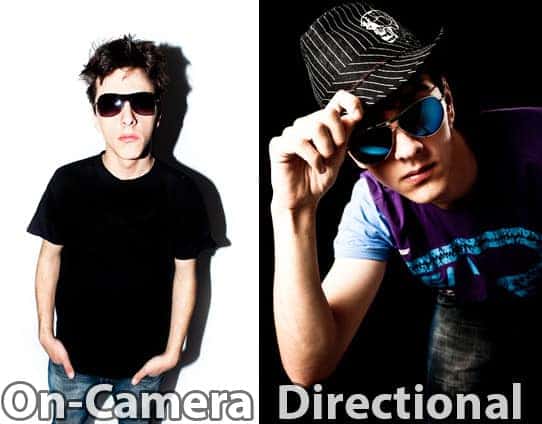
Imagine a face. In a lamp illuminating that face in a room that is otherwise entirely black. When the lamp is placed directly in front of the face, the shaded area in the photo is minimized.
At first blush removing shadows from the face seems to be a benefit. However, truly great photography almost always places heavy emphasis on shadowing. For example, the black and white work of Ansel Adams was noteworthy because of the extreme contrast in his landscapes showing deep rich shadows as well as bright clean highlights. The same is true of professional portrait photography today. I generally find new flash photographers talking about shadows only in the context of how they can be eliminated, yet professional photographers spend far more time creating shadows than creating highlights.
The reason shadows play such a vital role in a successful portrait is because they add dimensionality to an otherwise flat photo. Unlike video which can show dimensionality by movement, still photographers can only give the viewer the experience of “being there” by showing depth as a person sees when he or she is actually “there.”
The photographer’s principal tool for developing a sense of dimension in a photo is highlight and shadow. Now that you have imagined the lighting and shadows of a face with a lamp directly in front of it, change the scenario to place the light to the side. As the light moves, shadows grow on the dark side of the face.
These shadows show shape and size because the human eye is adept at determining size by seeing the shadows that we see everywhere in life.
Now imagine if you could manipulate the light in such a way as to convince the eye it were seeing a face more pleasing than reality, or to minimize the appearance of flaws on the person. Or, even if only a realistic look was desired, imagine if you could shape the light in a way that could tell a story only through shadow.
This skill of manipulating and shaping light and shadow to create interesting light that tells a story and portrays people in the way photographers intend is the key to becoming a master at flash photography.
Little imagination is required to see how this could be done. If the lamp in the aforementioned example is placed low under the chin, the light would come up on the face and remind the viewer of a storyteller surprising his audience with a ghost story in a tent. Every child has heard a ghost story told by the light of a flashlight under the chin of the storyteller, so this pattern of light and shadow on the face immediately conveys in the mind of the viewer that the mood of the photo is scary, mysterious, or even creepy.
The mind has millions of these light and shadow patterns logged away that tell the mind to view a scene in a certain way. If a photo is shot straight on looking at the subject and tall shadows appear on the sides of the head, it is a signal to the mind that the person is skinny because otherwise a heavier dish-shaped face would catch more light on the sides of the face.
The examples of lighting patterns the mind recognizes are endless. Now that you understand this principle, you must constantly think of what light and shadow patterns convey to your mind. Once you have this sense, you will soon be armed with Part Two of this book, which will teach you how to use your flash and flash modifiers and natural light in a way that you can create these light and shadow patterns at will–no matter the conditions.
For the next few weeks, consciously analyze the lighting you see everywhere you go–outside, in a room, in the grocery store, etc. Instead of merely thinking of a room as bright or dark, label it with one of the zones in the zone system, determine if it is warm or cool in light temperature, the direction of the light or lights, and think about the hardness or softness of the light. Not only will this solidify your standing as a hopeless photographer nerd, it will be a tremendous asset to you as you begin working with flash.
I think other website proprietors should take this website as an model, very clean and wonderful user genial style and design, let alone the content. You’re an expert in this topic!
Thanks for the concepts you have contributed here. Also, I believe there are a few factors that keep your insurance premium straight down. One is, to think about buying autos that are inside the good report on car insurance firms. Cars which can be expensive are usually more at risk of being snatched. Aside from that insurance policies are also in line with the value of your truck, so the costlier it is, then higher the premium you have to pay.
I have learned some new elements from your web site about personal computers. Another thing I have always considered is that computer systems have become an item that each home must have for some reasons. They supply you with convenient ways to organize homes, pay bills, go shopping, study, hear music and also watch tv programs. An innovative strategy to complete all of these tasks is by using a computer. These personal computers are mobile ones, small, powerful and easily transportable.
In the awesome design of things you’ll secure a B- with regard to effort. Exactly where you lost me personally was on the details. You know, they say, the devil is in the details… And that couldn’t be much more correct in this article. Having said that, let me say to you just what did deliver the results. The text is definitely really engaging which is possibly why I am making an effort in order to opine. I do not make it a regular habit of doing that. 2nd, although I can easily notice the jumps in reason you come up with, I am not sure of how you appear to unite your details which in turn make your final result. For right now I will, no doubt yield to your issue but wish in the foreseeable future you actually link your facts better.
compelling, beautifully expressed, and genuinely inspiring to read.
Fantastic goods from you, man. I’ve understand your stuff previous to and you are just extremely magnificent. I really like what you have acquired here, certainly like what you’re stating and the way in which you say it. You make it enjoyable and you still take care of to keep it smart. I can’t wait to read far more from you. This is actually a tremendous web site.
Things i have observed in terms of computer system memory is there are specifications such as SDRAM, DDR and many others, that must match up the technical specs of the motherboard. If the personal computer’s motherboard is rather current while there are no computer OS issues, improving the memory space literally normally takes under a couple of hours. It’s among the list of easiest laptop or computer upgrade types of procedures one can visualize. Thanks for discussing your ideas.
I’ve come across that currently, more and more people are attracted to cameras and the field of digital photography. However, to be a photographer, you have to first invest so much time period deciding which model of camera to buy in addition to moving out of store to store just so you could potentially buy the most inexpensive camera of the trademark you have decided to decide on. But it would not end right now there. You also have to consider whether you should buy a digital camera extended warranty. Thanks for the good guidelines I gained from your site.
insight. The clarity, flow, and passion in your writing make the entire
insight. The clarity, flow, and passion in your writing make the entire
Yesterday, while I was at work, my sister stole my apple ipad and tested to see if it can survive a twenty five foot drop, just so she can be a youtube sensation. My apple ipad is now destroyed and she has 83 views. I know this is totally off topic but I had to share it with someone!
It?s actually a cool and useful piece of info. I?m glad that you shared this helpful info with us. Please keep us informed like this. Thanks for sharing.
Thanks for this glorious article. Yet another thing to mention is that the majority of digital cameras can come equipped with the zoom lens that permits more or less of the scene for being included by way of ‘zooming’ in and out. These kinds of changes in {focus|focusing|concentration|target|the a**** length tend to be reflected from the viewfinder and on substantial display screen on the back of the actual camera.
I appreciate your wordpress template, where would you obtain it from?
I know of the fact that today, more and more people are being attracted to video cameras and the subject of picture taking. However, as a photographer, it’s important to first devote so much time frame deciding which model of digicam to buy plus moving out of store to store just so you could possibly buy the cheapest camera of the brand you have decided to pick. But it does not end there. You also have to take into consideration whether you should buy a digital digicam extended warranty. Thx for the good guidelines I received from your site.
Discover the best MMO private servers and MMORPG private servers in 2026. Explore top private server games, Android private servers, active communities, rankings, and the best servers to play.
Discover the best MMO private servers and MMORPG private servers in 2026. Explore top private server games, Android private servers, active communities, rankings, and the best servers to play.
Discover the best MMO private servers and MMORPG private servers in 2026. Explore top private server games, Android private servers, active communities, rankings, and the best servers to play.
I have observed that over the course of building a relationship with real estate entrepreneurs, you’ll be able to come to understand that, in every single real estate financial transaction, a fee is paid. All things considered, FSBO sellers don’t “save” the fee. Rather, they struggle to win the commission simply by doing a agent’s task. In accomplishing this, they spend their money along with time to conduct, as best they could, the duties of an adviser. Those responsibilities include uncovering the home through marketing, introducing the home to all buyers, creating a sense of buyer urgency in order to induce an offer, scheduling home inspections, controlling qualification investigations with the mortgage lender, supervising maintenance tasks, and aiding the closing.
You made some respectable points there. I looked on the internet for the problem and found most people will go along with together with your website.