This is part 4 of a 10-page series on the basics of flash photography. To start the tutorial from the beginning, click here.
Intensity of Light and the Zone System
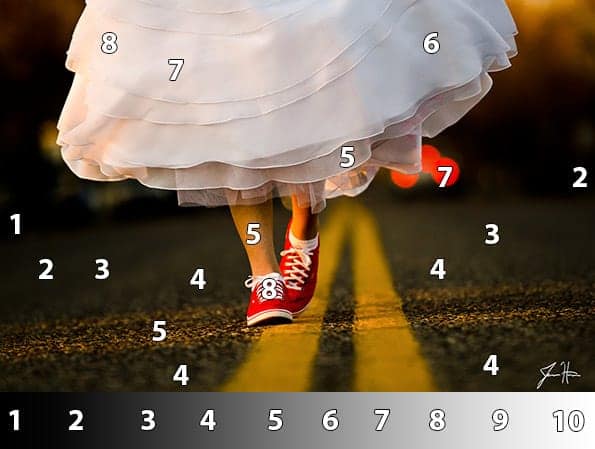
One technique for gaining the skill of quickly evaluating the light in a scene is to become acquainted with the zone system. The zone system is a method of categorizing the intensity of light in various areas of the frame according to a value of 1 through 10.
In this system, if the shadow in an area of the photo is so dark as to be completely black, it is called zone 1. Areas that are completely white are zone 10. Each of the other areas of the photo are placed on a scale between those upper and lower limits. In general, the face of a person being photographed with flash will be between a six and an eight on the zone system scale. The face is often the brightest area of the photo so as to draw the viewers attention to it.
Even understanding this basic approach to the zone system can be tremendously useful in flash photography.
When photographers begin learning flash photography, they usually think on more of a general scale than professional photographers. A new photographer may shoot a photo of a person’s face, look at the photo, determine it to be a seven on the zone system scale, and be pleased with the lighting.
A more knowledgeable photographer knows that more attention to detail can produce a far more attractive result. A knowledgeable photographer will look at the same photo that a beginner called a seven and evaluate it with more detail–”the cheeks are at a seven, I like the shadowy fours under the cheekbones to bring out the nice shape of the face, but the forehead is a nine due to some oil on the skin. Perhaps tilting the softbox down a smidgen would take the focus off the forehead and bring that light level back down to a six.”
As you begin working with flash, do not feel frustrated with yourself if you cannot yet control the exact light level on every area of the photo, but with practice you will eventually find that you can make every single area of the photo the exact brightness level you desire. This precise, location-specific control over lighting is what makes a professional photo look professional.
As your study of flash photography continues and includes mixing flash with natural light, you will find that your knowledge of the zone system and your ability to quickly analyze light sources will help you tremendously in working with multiple light sources.
Directionality of Light
One of the most common questions I get from new flash photographers is “where do I put the light?” It should surprise no one that the answer to this question is not as straightforward as the question would suggest, but the question itself hits on a key to successful flash photography.
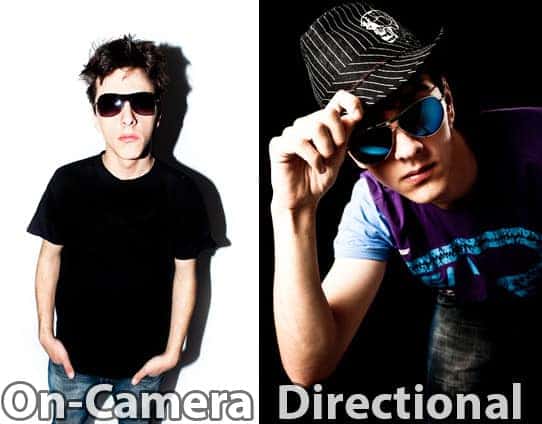
Imagine a face. In a lamp illuminating that face in a room that is otherwise entirely black. When the lamp is placed directly in front of the face, the shaded area in the photo is minimized.
At first blush removing shadows from the face seems to be a benefit. However, truly great photography almost always places heavy emphasis on shadowing. For example, the black and white work of Ansel Adams was noteworthy because of the extreme contrast in his landscapes showing deep rich shadows as well as bright clean highlights. The same is true of professional portrait photography today. I generally find new flash photographers talking about shadows only in the context of how they can be eliminated, yet professional photographers spend far more time creating shadows than creating highlights.
The reason shadows play such a vital role in a successful portrait is because they add dimensionality to an otherwise flat photo. Unlike video which can show dimensionality by movement, still photographers can only give the viewer the experience of “being there” by showing depth as a person sees when he or she is actually “there.”
The photographer’s principal tool for developing a sense of dimension in a photo is highlight and shadow. Now that you have imagined the lighting and shadows of a face with a lamp directly in front of it, change the scenario to place the light to the side. As the light moves, shadows grow on the dark side of the face.
These shadows show shape and size because the human eye is adept at determining size by seeing the shadows that we see everywhere in life.
Now imagine if you could manipulate the light in such a way as to convince the eye it were seeing a face more pleasing than reality, or to minimize the appearance of flaws on the person. Or, even if only a realistic look was desired, imagine if you could shape the light in a way that could tell a story only through shadow.
This skill of manipulating and shaping light and shadow to create interesting light that tells a story and portrays people in the way photographers intend is the key to becoming a master at flash photography.
Little imagination is required to see how this could be done. If the lamp in the aforementioned example is placed low under the chin, the light would come up on the face and remind the viewer of a storyteller surprising his audience with a ghost story in a tent. Every child has heard a ghost story told by the light of a flashlight under the chin of the storyteller, so this pattern of light and shadow on the face immediately conveys in the mind of the viewer that the mood of the photo is scary, mysterious, or even creepy.
The mind has millions of these light and shadow patterns logged away that tell the mind to view a scene in a certain way. If a photo is shot straight on looking at the subject and tall shadows appear on the sides of the head, it is a signal to the mind that the person is skinny because otherwise a heavier dish-shaped face would catch more light on the sides of the face.
The examples of lighting patterns the mind recognizes are endless. Now that you understand this principle, you must constantly think of what light and shadow patterns convey to your mind. Once you have this sense, you will soon be armed with Part Two of this book, which will teach you how to use your flash and flash modifiers and natural light in a way that you can create these light and shadow patterns at will–no matter the conditions.
For the next few weeks, consciously analyze the lighting you see everywhere you go–outside, in a room, in the grocery store, etc. Instead of merely thinking of a room as bright or dark, label it with one of the zones in the zone system, determine if it is warm or cool in light temperature, the direction of the light or lights, and think about the hardness or softness of the light. Not only will this solidify your standing as a hopeless photographer nerd, it will be a tremendous asset to you as you begin working with flash.
Yesterday, while I was at work, my sister stole my apple ipad and tested to see if it can survive a thirty foot drop, just so she can be a youtube sensation. My apple ipad is now destroyed and she has 83 views. I know this is completely off topic but I had to share it with someone!
Hi just wanted to give you a brief heads up and let you know a few of the images aren’t loading correctly. I’m not sure why but I think its a linking issue. I’ve tried it in two different web browsers and both show the same results.
Another issue is that video gaming became one of the all-time main forms of entertainment for people of various age groups. Kids play video games, and also adults do, too. The actual XBox 360 is just about the favorite gaming systems for folks who love to have hundreds of video games available to them, plus who like to relax and play live with other people all over the world. Many thanks for sharing your ideas.
Статья ясно описывает факты и события, связанные с обсуждаемой темой.
Good ? I should definitely pronounce, impressed with your web site. I had no trouble navigating through all tabs and related info ended up being truly easy to do to access. I recently found what I hoped for before you know it at all. Reasonably unusual. Is likely to appreciate it for those who add forums or anything, site theme . a tones way for your client to communicate. Excellent task..
I’ve noticed that credit improvement activity needs to be conducted with tactics. If not, you are going to find yourself causing harm to your rank. In order to grow into success fixing your credit ranking you have to always make sure that from this moment you pay any monthly fees promptly before their appointed date. It really is significant on the grounds that by not really accomplishing so, all other steps that you will decide on to improve your credit position will not be successful. Thanks for giving your strategies.
I am really thankful to the holder of this website who has shared this enormous paragraph at at this place.
Thanks for your publication. I would also love to say that the first thing you will need to carry out is determine if you really need credit repair. To do that you will need to get your hands on a duplicate of your credit report. That should really not be difficult, because government makes it necessary that you are allowed to have one free of charge copy of your actual credit report annually. You just have to inquire the right persons. You can either find out from the website with the Federal Trade Commission as well as contact one of the major credit agencies instantly.
I think the admin of this web page is truly working hard in support of his web site, for the reason that here every stuff is quality based stuff.
Heya i am for the first time here. I found this board and I find It really useful & it helped me out much. I hope to give something back and aid others like you helped me.
I additionally believe that mesothelioma cancer is a extraordinary form of cancer malignancy that is generally found in individuals previously exposed to asbestos. Cancerous tissue form inside the mesothelium, which is a defensive lining which covers a lot of the body’s bodily organs. These cells commonly form inside lining on the lungs, tummy, or the sac that encircles the heart. Thanks for revealing your ideas.
An outstanding share! I’ve just forwarded this onto a colleague who had been conducting a little homework on this. And he actually bought me breakfast due to the fact that I stumbled upon it for him… lol. So allow me to reword this…. Thank YOU for the meal!! But yeah, thanks for spending the time to discuss this subject here on your site.
Thank you, I have recently been searching for info approximately this subject for a while and yours is the best I’ve found out so far. But, what in regards to the bottom line? Are you certain about the source?
I appreciate, cause I found just what I was looking for. You’ve ended my four day long hunt! God Bless you man. Have a nice day. Bye
hi!,I like your writing so much! share we communicate more about your article on AOL? I require an expert on this area to solve my problem. Maybe that’s you! Looking forward to see you.
I believe this is one of the so much significant information for me. And i am happy studying your article. However wanna observation on some normal issues, The web site taste is wonderful, the articles is really excellent : D. Excellent activity, cheers
Thanks for your suggestions. One thing I’ve noticed is that often banks in addition to financial institutions know the spending routines of consumers plus understand that many people max outside their credit cards around the breaks. They prudently take advantage of this fact and commence flooding the inbox and also snail-mail box along with hundreds of no-interest APR card offers shortly when the holiday season finishes. Knowing that if you are like 98 of American public, you’ll get at the chance to consolidate card debt and move balances for 0 annual percentage rates credit cards.
Thank you for every other informative web site. Where else could I am getting that kind of info written in such a perfect method? I have a venture that I am simply now running on, and I’ve been at the look out for such information.
insight. The clarity, flow, and passion in your writing make the entire
Я ценю фактический и информативный характер этой статьи. Она предлагает читателю возможность рассмотреть различные аспекты рассматриваемой проблемы без внушения какого-либо определенного мнения.