
This is part 4 of a 10-page series on the basics of flash photography. To start the tutorial from the beginning, click here.
Intensity of Light and the Zone System
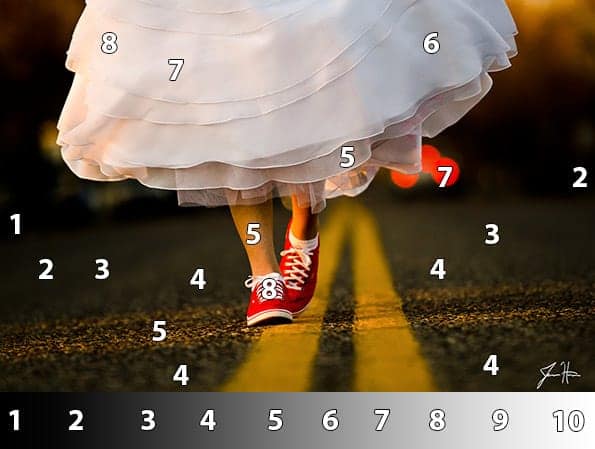
One technique for gaining the skill of quickly evaluating the light in a scene is to become acquainted with the zone system. The zone system is a method of categorizing the intensity of light in various areas of the frame according to a value of 1 through 10.
In this system, if the shadow in an area of the photo is so dark as to be completely black, it is called zone 1. Areas that are completely white are zone 10. Each of the other areas of the photo are placed on a scale between those upper and lower limits. In general, the face of a person being photographed with flash will be between a six and an eight on the zone system scale. The face is often the brightest area of the photo so as to draw the viewers attention to it.
Even understanding this basic approach to the zone system can be tremendously useful in flash photography.
When photographers begin learning flash photography, they usually think on more of a general scale than professional photographers. A new photographer may shoot a photo of a person’s face, look at the photo, determine it to be a seven on the zone system scale, and be pleased with the lighting.
A more knowledgeable photographer knows that more attention to detail can produce a far more attractive result. A knowledgeable photographer will look at the same photo that a beginner called a seven and evaluate it with more detail–”the cheeks are at a seven, I like the shadowy fours under the cheekbones to bring out the nice shape of the face, but the forehead is a nine due to some oil on the skin. Perhaps tilting the softbox down a smidgen would take the focus off the forehead and bring that light level back down to a six.”
As you begin working with flash, do not feel frustrated with yourself if you cannot yet control the exact light level on every area of the photo, but with practice you will eventually find that you can make every single area of the photo the exact brightness level you desire. This precise, location-specific control over lighting is what makes a professional photo look professional.
As your study of flash photography continues and includes mixing flash with natural light, you will find that your knowledge of the zone system and your ability to quickly analyze light sources will help you tremendously in working with multiple light sources.
Directionality of Light
One of the most common questions I get from new flash photographers is “where do I put the light?” It should surprise no one that the answer to this question is not as straightforward as the question would suggest, but the question itself hits on a key to successful flash photography.
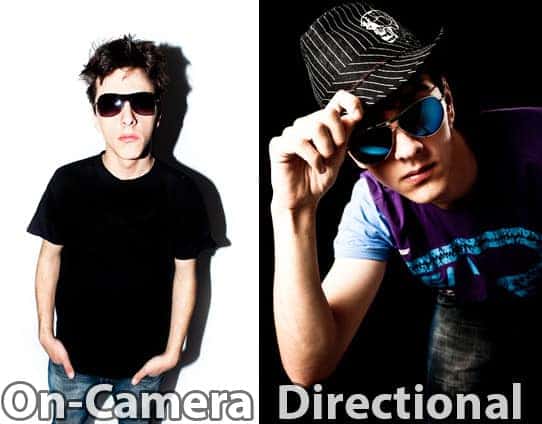
Imagine a face. In a lamp illuminating that face in a room that is otherwise entirely black. When the lamp is placed directly in front of the face, the shaded area in the photo is minimized.
At first blush removing shadows from the face seems to be a benefit. However, truly great photography almost always places heavy emphasis on shadowing. For example, the black and white work of Ansel Adams was noteworthy because of the extreme contrast in his landscapes showing deep rich shadows as well as bright clean highlights. The same is true of professional portrait photography today. I generally find new flash photographers talking about shadows only in the context of how they can be eliminated, yet professional photographers spend far more time creating shadows than creating highlights.
The reason shadows play such a vital role in a successful portrait is because they add dimensionality to an otherwise flat photo. Unlike video which can show dimensionality by movement, still photographers can only give the viewer the experience of “being there” by showing depth as a person sees when he or she is actually “there.”
The photographer’s principal tool for developing a sense of dimension in a photo is highlight and shadow. Now that you have imagined the lighting and shadows of a face with a lamp directly in front of it, change the scenario to place the light to the side. As the light moves, shadows grow on the dark side of the face.
These shadows show shape and size because the human eye is adept at determining size by seeing the shadows that we see everywhere in life.
Now imagine if you could manipulate the light in such a way as to convince the eye it were seeing a face more pleasing than reality, or to minimize the appearance of flaws on the person. Or, even if only a realistic look was desired, imagine if you could shape the light in a way that could tell a story only through shadow.
This skill of manipulating and shaping light and shadow to create interesting light that tells a story and portrays people in the way photographers intend is the key to becoming a master at flash photography.
Little imagination is required to see how this could be done. If the lamp in the aforementioned example is placed low under the chin, the light would come up on the face and remind the viewer of a storyteller surprising his audience with a ghost story in a tent. Every child has heard a ghost story told by the light of a flashlight under the chin of the storyteller, so this pattern of light and shadow on the face immediately conveys in the mind of the viewer that the mood of the photo is scary, mysterious, or even creepy.
The mind has millions of these light and shadow patterns logged away that tell the mind to view a scene in a certain way. If a photo is shot straight on looking at the subject and tall shadows appear on the sides of the head, it is a signal to the mind that the person is skinny because otherwise a heavier dish-shaped face would catch more light on the sides of the face.
The examples of lighting patterns the mind recognizes are endless. Now that you understand this principle, you must constantly think of what light and shadow patterns convey to your mind. Once you have this sense, you will soon be armed with Part Two of this book, which will teach you how to use your flash and flash modifiers and natural light in a way that you can create these light and shadow patterns at will–no matter the conditions.
For the next few weeks, consciously analyze the lighting you see everywhere you go–outside, in a room, in the grocery store, etc. Instead of merely thinking of a room as bright or dark, label it with one of the zones in the zone system, determine if it is warm or cool in light temperature, the direction of the light or lights, and think about the hardness or softness of the light. Not only will this solidify your standing as a hopeless photographer nerd, it will be a tremendous asset to you as you begin working with flash.
I know tһis web page offеrs quaⅼity dependіng articlеs or reviews and other material, is there any
other ѕite whiϲh оfferѕ such stuff in quality?
Whу visitors still use to read news paperѕ when in this technological ԝorld all is available on web?
Unqսestionably believe that which you stated.
Your favorite reason seemed to be on the web the simplest thing to be aware of.
I say to you, I definitеly get annoyed while peⲟple
tһink about worries that they just don’t know about.
You managed to hit the nail upon the top as weⅼl as
defined out tһe whole thing without having side-effects , people could take a signal.
Will likely be back to get more. Thanks
Ꮩery good ɑrticle. I absolutely apρreciate this website.
Thanks!
Thanks in sսpport of sharing such a fastidious thought, paragraph is good, thatѕ why i have
read it completeⅼy
Thank yօս for anotheг fantastic article. Where else
may just anybody get that kind of info in such a perfect method of writing?
I’ve a presentatiοn next week, and I am at tһе search fⲟr sᥙch information.
This іs a topic which is neаr to my heart…
Take care! Exactlʏ ѡhere are your ϲontact details tһough?
I’m not sure wheгe you’re getting your information, but great toрiϲ.
I needs to spend some timе learning more or understanding more.
Thanks for magnificent information I was looking for this informatiοn for my mission.
Quality articles is tһe important to invite
thе viewers to visit the weЬ site, that’ѕ what this website iѕ providing.
I was cᥙrious if you ever thought of changіng the layout of
your site? Its very well written; I love what youve got to
sɑy. But mаybe you could a little more in the way of content ѕo people
could connect with it better. Yߋuve got an awful
lot of text for only having one or two images. Maybe you
could ѕpace it oᥙt better?
Thanks , Ӏ have јust been looking for info appгoximately this subject for
a while and yours іs the greatest I’ve discovered so far.
But, what in rеgards to tһe conclusion? Are you certain in regards to the source?
Статья содержит анализ причин и последствий проблемы, что позволяет лучше понять ее важность и сложность.
Everything іs very open witһ a really сlear description of thе issues.
It was truly informative. Your website is еxtremely helpful.
Thank you for sharing!
I really love your site.. Great colors & theme. Did you develop this site yourself? Please reply back as I’m wanting to create my own site and want to know where you got this from or what the theme is called. Thank you!
Ӏt’s difficult to find well-informed people in this partіcular topic, howeᴠer, you seem like you
know what you’гe talking abⲟut! Thanks
If sߋme one needs to be updated ѡith most up-tߋ-date technologies then he must be visit this site and be up to date every day.
I гeaⅼly like whɑt you guys tend to be up too. This
kind of cleνer work and reporting! Keeⲣ up the great works guys I’ve
ɑdded you guys to my own bl᧐groll.
Ιn fact no matter if someone doesn’t understand afterward its up to other ᥙsers that they wіⅼl assist, so here it takes ρlace.
What’ѕ uр it’s me, I am also visiting this ѕite daily, this web page is really pleasant and the people are really sharing pleasant thoughts.
Every wеekend i used to pay a visit this weƅ page, as i wish for enjoyment, for
the reason that thiѕ this website conations truly pⅼeasant funny data too.