
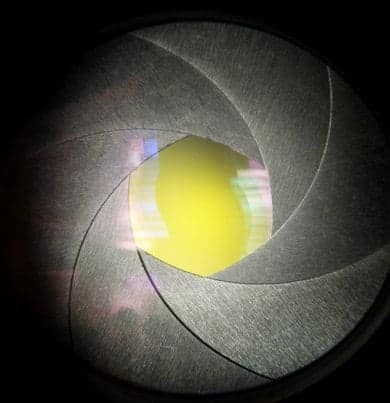
This article is a section in my 12 Photography Myths Article, where I explain what the sharpest aperture is on various lenses. As you can see from the samples and explanation below, the answer to the question of the sweet spot aperture for different lenses depends on what lens is used.
My purpose in conducting this test is to show that there is no single sweet spot where each lens will be sharpest. Many photographers say that f/8 or f/11 is usually the sharpest lens, but I have not found that to be true. Other photographers say that the sweet spot is two stops from wide open, but that is also not true according to the tests I ran. It depends on each and every lens.
How to test sharpness
The way that I did the testing for this article is to put the camera on a tripod and lock it down so there is absolutely no variable that could be impacting the test. Then, I taped a newspaper against the wall across the room and took various pictures of the newspaper. I used mirror lock-up (described in the 13 myths article), and I fired the camera wirelessly so that my pressing the shutter button would not vibrate the camera.
I find that shooting a newspaper is a great way to test the sharpness because you can zoom in to 100% view of the words and easily see which picture is sharpest.
I repeated this test multiple times for three common lenses: a wide angle, a 50mm prime, and a portrait zoom lens. The specific lenses that I tested were the Nikon 10-24mm lens, the Nikon 50mm f/1.8 lens, and the Nikon 70-200mm f/2.8 lens.
I shot the zoom lenses at the most common focal length that I usually shoot the lenses at and shot at a distance that is common for shooting with the particular lens. OBVIOUSLY, the focal length of a zoom will change the sharpness. I have taken that into account by shooting at the most common focal lengths that I typically shoot these lenses at.
While I, of course, tested every single aperture on these lenses, I only show a few of the most pertinent results here.
Also remember that I am not saying that these apertures are the sharpest for every lens or even every similar lens. The sweet spot on lenses is totally dependent on the specific lens.
Sharpness Test on the Nikon 10-24mm Lens Shot at 11mm
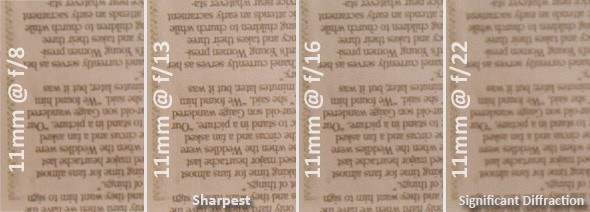
Wide angle lenses are most commonly used by photographers who shoot landscape photography. Since landscape photography usually demands high apertures to achieve full depth of field, I have shown the most relevant aperture tests to landscape photographers here (although I tested all the apertures, of course).
Notice that f/13 is the sweet spot on this lens. However, many landscape photographers shoot at apertures higher than f/13 in order to gain more depth-of-field. Continuing up the line, the last aperture with what I would call acceptable sharpness was f/16. After f/16, significant diffraction can be seen in the photo which causes a reduction in sharpness. At f/22 (which many beginning landscape photographers tend to gravitate toward), the diffraction is very significant and sharpness is reduced dramatically.
Sharpness Test on the Nikon 50mm f/1.8 Lens

This test was absolutely shocking to me! Photographers buy 50mm prime lenses because they want to shoot at f/1.8. Rarely have I used a 50mm lens to shoot above f/5.6. When I used to shoot Canon, I loved the 50mm lens because it was sharp and had a fast aperture. When I switched over to Nikon, I bought a 50mm and was really disappointed in the sharpness, yet I often heard people touting it as a very sharp lens. I have been puzzled ever since and wondered if I just had a “bad copy.”
The tests reveal the answer to the problem. When shot at the most common apertures used on this lens (wide open), the lens is a horrible mess. It looks like someone has smeared grease on the lens! However, if you stop down to f/7.1, the lens is actually acceptable. Interestingly, even at unusually high apertures for this lens such as f/13, it is still reasonably acceptable.
Sharpness Test on the Nikon 70-200mm Lens Shot at 200mm
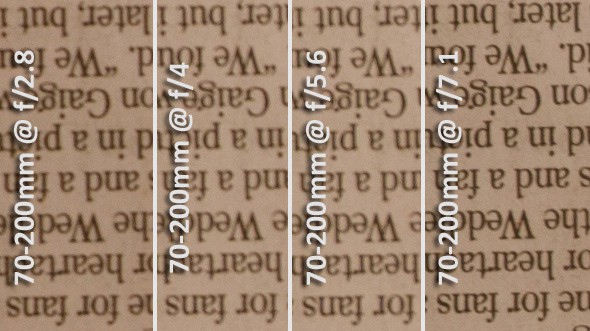
First of all, I have always found the 70-200 to be a very sharp lens, but when I compared it to the 50mm and the 10-24, I was blown away! The lens is extremely sharp.
While the photos were all sharp from f/2.8 all the way up to f/18, I found that the sharpest aperture seemed to be f/7.1. Very interesting.
Conclusion
The point I am trying to make in this article is that there is no way to tell what is the sharpest aperture of your lenses without simply testing it on your own lenses. The fable that f/8 or f/11 are usually the sharpest apertures simply is not true. In fact, f/8 was not the sharpest aperture on any one of the three lenses I tested.
If this article was useful to you, LIKE Improve Photography on Facebook so you can get all our articles in your Facebook feed each morning.
May I ask why you switched to Nikon? I was thinking about switching but just not sure.
Excellent article! My exposure triangle now looks like a square.
Great article, I will be doing the same tests on my 10-22mm. Thank you Jim
Can I assume that you refocused after changing apertures?
Does the distance to the subject impact sharpness? Would finding out that a lens is most sharp at f/7.1 when taking a picture of a book, would it also apply to a landscape, or would sharpness need to be reevaluated at each distance?
I suspect Joshua is right. At different focusing distances the elements in the lens will be spaced differently. Newsprint will not be practical at the longer distances, but a billboard could work. I will give this a try to see if the same aperture gives the best results at different distances.
Thanks for an interesting article.
Gareth
@Joshua and @Gareth – Yes. That is true. Notice that I said in the article that I was shooting each of the lenses at distances that I commonly find myself using that lens at. For the wide-angle, I used a distance of about 5 feet because that’s where I usually include the foreground element and that’s what I’m most concerned with getting sharp.
How did you focus? Auto or manual? You probably refocused 3 times for each shot?
I’m curious why you went from Canon to Nikon, as I use Canon cameras for over 30 years and I have never regretted it, and I can not ask why you gave no details about Canon lenses?
Cheers
First, thank you for the tests and explanation. I found your results helpful and your methods useful for testing my own lenses. Your surprise about overall sharpness comparisons between the lenses is puzzling to me, though. The least sharp 50mm f/1.8 is a $300 lens, the 10-24mm is an $800 lens and the 70-200mm is a $2000 lens. While I did find the 50mm results shocking and disappointing, I don’t understand the surprise in the quality of the 70-200mm. The latter better be the best lens of the bunch, sharpness and otherwise, or else what is the point in spending the money?
Thanks for the great informative article.
Yes I also tested some of my lenses for the sharpest apertures (I use Canon). The lenses were EF 50mm f/1.8 II, EF 200mm f/2.8L II USM and EF 400mm f/5.6L USM.
Applied the same technique albeit, indoors. Instead of using remote release; I used 2 seconds self timer. Body was EOS 50D with ISO at 100 and AWB.
50mm was sharpest f/2.8, 200mm at f/5.6 and 400mm at f/8. I used my sofa cushions as subject but agree newspaper is a better idea.
Another suggestion to all. Prosumer bodies these days are packed with high pixel counts making them prone to high levels of noise. So, I always try to shoot at ISO 100, seldom going up to 200. Both manufacturers have deliberately killed the crop bodies.
Jim, 7.1 on both the 50mm and the 70-200mm kinda goes along with an established photographer, who’s name I do not recall; made the statement of “f8 and be there”.
Once again thank you Jim for testing and sharing.
Doug
hai every one is talking about sharpnes sharpnes and more sharpnes foto is more than Sharp photos i won an small photo competition in my country and gess what camera i used many had d800 5dmk3 d4 d3s and big canons i used my trusty d3100 and its kittlens 18-55 and i shoot the winning photo
Jim a great article however, your testing is off and here is why. You have a front focus/rear focus issue. Every lens focuses differently due to manufacturing tollerences. Every camera body is different for the same reson. so you have lens with an unknown variable and a camera body with an unknown variable you put them together you get f8 ish as sharp. Use a product like lens align mk2 and calibrate your lens to your camera body using the macro/micro adjustment Then perform your test again. It will change where sharpest f stop is and give you more usable shots wider open and closed down.
What is it about a camera/lens combination that makes the “mid-aperture” setting the sharpest one?
I am not totally convinced by the article. Photographing people and photographing newspaper on the wall is bound to yield different results. Try the test on people.
Easy…. in general, 2 stops from the smallest aperture
This formula has always worked for me