
The Basics of On-Camera Flash
The softness of light produced by a flash is controlled by the size of the light source. The larger the light source is, the softer the light. This is why you see photographers shooting a flash through an umbrella. The umbrella spreads out the light and produces a softer quality of light on the model. There are times when umbrellas, softboxes, and the like are too cumbersome. For example, when shooting a wedding reception I generally keep the flash mounted on the camera so I can get some quick shots moving around the event.
However, the light produced by the raw flash pointing directly at the subject is too hard. The light quality is terrible! One solution to this problem is to bounce the light off the ceiling so the ceiling spreads out the light and then reflects down on the person. Unfortunately, this magic technique does not work in every situation. Suppose the wedding reception is outside–where could you bounce the light off now? Or suppose the wedding reception is in a room so large that the ceiling is too far away to bounce the flash off. In these situations, most photographers turn to commercial on-camera flash diffusers such as the Gary Fong Lightsphere or the Adorama Mini Softbox. These miniature flash diffusers slightly enlarge the size of the flash and diffuse the light.
What is the Gary Fong Lightsphere?
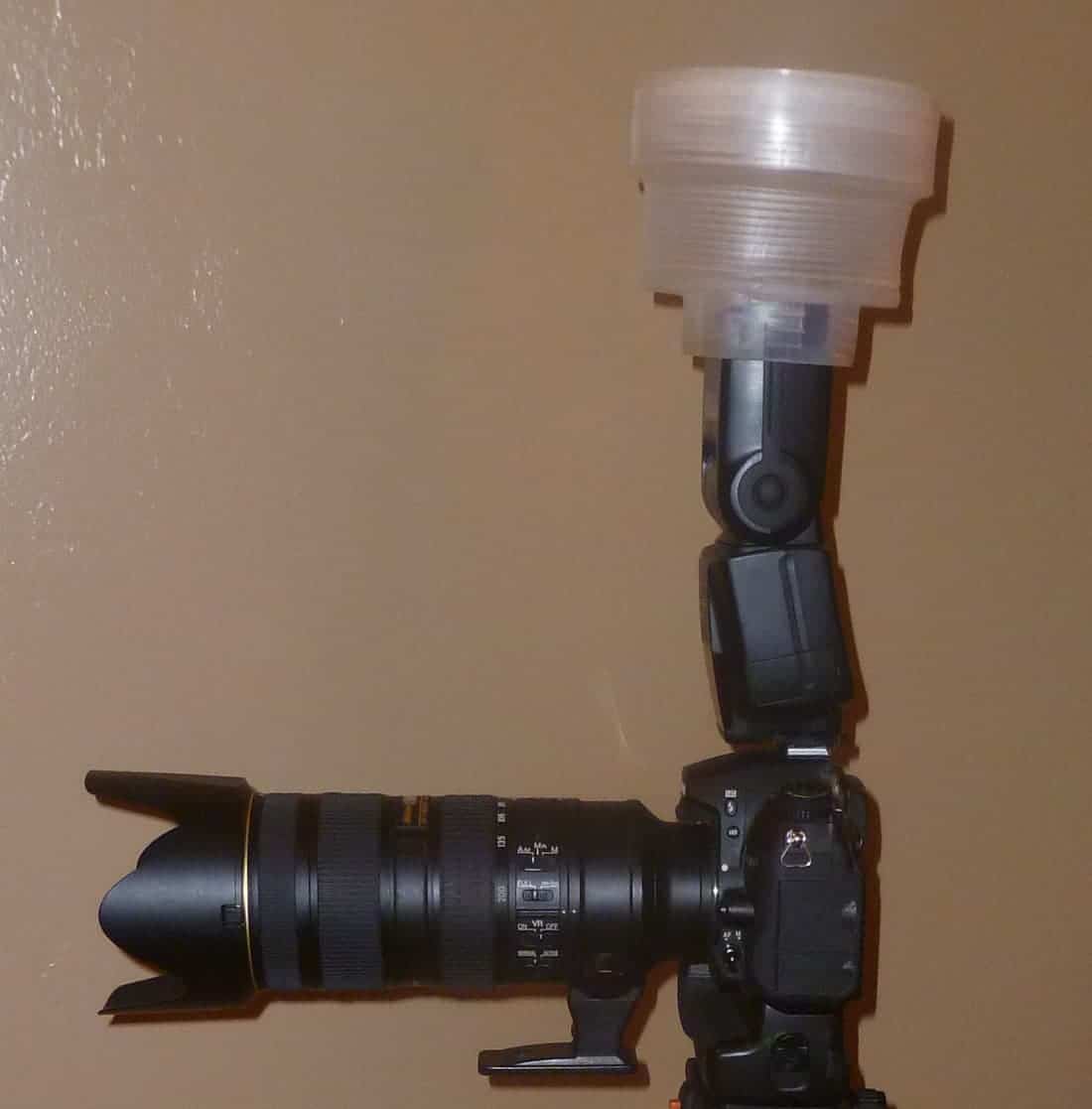
The Gary Fong Lightsphere is a collapsible piece of ribbed and frosted rubber that fits snuggly on top of an on-camera flash and diffuses the light of the bare flash so that it falls more evenly and softly on the model. The product does reasonably well for what it is. It does in fact diffuse the light and produces reasonably pleasing light on the model considering that the picture is taken with on-camera flash.
Why in the world are you comparing this product to tupperware?!?!
The Gary Fong Lightsphere costs $50 (at the time of writing). For a hunk of rubber that produces only marginal improvements over the on-camera flash in my opinion, that is just way too much money. The fact is that the darn thing looks like a piece of tupperware to me. So, I got curious. Was this product doing anything that any other hunk of plastic couldn't do? I tested my hypothesis by taking several pictures with a few different pieces of tupperware to see if I had completely wasted my money on this expensive piece of tupperware called the Lightsphere.
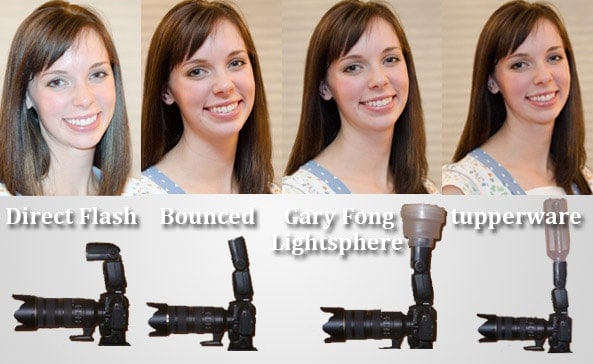
So which one produced the better lighting? The tupperware or the Lightsphere?
After my testing, I found that there was absolutely no significant difference in my opinion in the quality of the light produced by the tupperware in comparison to the quality of light produced by the Lightsphere. In short, save your money. I understand that photographers might be tempted to buy the Lightsphere just because it looks more professional than Tupperware, but have you looked at the Lightsphere? It looks like a UFO landed on your flash! If you still aren't convinced about the tupperware, then you might consider a much cheaper option for on-camera flash such as the Opteka Mini Softbox or even a DIY option.
I purchased the Gary Fong Lightshpere (but the one that doesn’t collapse) and am pretty happy with the results. Yes, it does look awkward – kids have asked me “why do you have a cup on your camera?” but I do love the softer light it produces.
Got to play with the new collapsible Lightsphere at PDN photo plus. I have used the device before, but was surprised to discover a small tweek – a recommendation from the demonstrator – that improves the lighting. Rotate your flash head 90 degrees from how you have it in the shot (so that it’s pointing to your side). This has two benefits: 1) The flash is spread a little bit better, and it seems to do a better job softening the light. 2) If you go to shoot vertical (portrait), you can quickly rotate the lightsphere’s top (round part) pointed at the ceiling. And yes, it should always be pointed up.
Regardless…where I see the advantage of the lightsphere over the tupperware is the catch lights. I think the lightsphere has a more appealing look in the eye than most of the tupperware I’ve used. It also eats far less light (about a half stop) over the tupperware in my experience.
But again…it’s beyond the point of diminishing returns. I don’t see a reason why the lightsphere is necessarily better than tupperware when ROI is taken into consideration. So if money is short…go for tupperware.
PS – My personal favorte flash modifier is the Rougue LightBenders. At PDN, they just introduced a new product (not yet on the webiste) which is a diffuser panel for the Large and Small reflectors. It works pretty well from the demonstrations I’ve seen, and it’s far more portable than even the Fong collapsible. Check it out.
Great to see a real tupperware comparison!
I’ve been using fong diffusers for years (love them) and have always referred to them as tupperware. Alway gets a smile (or quizzical look at least) from subjects.
You are right, they’re probably no better than a good DIY solution, but when I bought mine, a $50 was a small investment to make to get good results without having to mess around perfecting a DIY design.
My fongs have been on and off a couple of flashes a hundred times and have lasted well.
Which piece of tupperware? or did you try several with consistent results? Did you line the back of the tupperware with aluminum foil?
I tried two pieces of tupperware and both gave the same result.
I’d love to see your comparison with an actual vertical shot, instead of a cropped horizontal. Plus, it’d help to know the exposure settings and perhaps shoot in a dark room.
Good observation. Can you be specific about what Tupperware you used on the flash.
Thanks
I use the bottom of a plastic rubbing alcohol bottle. I added little strips of foam rubber for a snug fit on my flash.
Tupperware? Genius!
Love this blog. Nothing better than someone with a sense of humor AND good ideas!
First time here and I really enjoyed reading.
While brilliant in concept I am lazy (and thrifty with my gaffers tape) the Gary Fong stays on like a tupperware doesn’t and when you have a high roof (or no roof) is where it really does its work (direct flash)
i’ve experimented with these over the years, though i tend to avoid flash unless it’s people. the fong is neat, because it looks professional. going to a wedding with anything homemade, and you’ll look like a hack.
the main problem with home made is that the plastic introduces color cast. i’ve made a number of these diffusing flashes. the better ones used a white folder for a note book. other ones used a bowl from a dollar store, cut out, and a plastic white plate glued to the opening. it was meant for macro, but works well. it does create a reddish tone though.
but it also looks stupid.
I’m impressed! Now I can use tupperware instead of a lightsphere. Being on a student budget kinda sucks, but these ti[s and tricks make it worth it in the long run.
Try the tupperware against a white backdrop, that’s where I found the Gary Fong most useful!
After using Gary Fong’s Lightsphere for years it appears the “haters” are still missing the point. If the best someone can think of is tupperware maybe they should not be critical of anyone’s invention.
Sorry..it works.
what an ignorant comment. Did you see the results the tupperware shots were arguable better!!
I use a Gary Fong diffuser, I think I have the cloud. It is a conversation starter, which is actually good when you want to start dialogue to take someone’s photo. Yes, it looks stupid and it takes a lot of space in a bag. But, just for looks, if someone hires me to shoot, say, a wedding, it might look mighty unprofessional to stick an old piece of tupperware on there. It’s all about perception….as well as the shot of course! Cool for home use though when nobody is around.
Direct flash can be gorgeous when intelligently implemented — why leave it on “deer in the headlights” defaults as the primary light source, instead of using it as supplemental fill flash combined with ambient light, which would have been a better starting point for your comparisons?
In other words, first make IN camera flash the best it can be, then try ON camera accessory flash, then try OFF camera flash or IN and OFF camera flash combined together, none of which require fancy do-dad solutions to make them work — they just need to be tuned intelligently.
Then start comparing additional flash diffusers.
Don;t get me wrong, I love diffusers — they make the flash source big and soft and even … but we still need to intelligently understand what we are doing.
I use in-camera flash with my camera maker’s additional accessory diffuser, often with ambient exposure lock and supplemental fill flash settings, then occasionally I also ass a wireless remote accessory flash as additional ambient light.
It may be harder to RTFM read the factory manual (!) — is THAT the claim to fame for the Fong (and Tupperware, that you don’t have to RTFM)?
(a) I think I have more control and satisfaction of my results by understanding and mastering my camera and flash gear.
(b) The example presented above doesn’t need flash of any kind anyway — try again with a shot that cannot be captures without flash.
I want to buy a lightsphere made by Gary Fong, could you please tell me how and where that I can buy one for me living in Hong Kong.
Thank you in advance for your kind response.
I’m strictly an amateur but do end up taking candid shots for people at weddings.
I’ve been using the Gary Fong for years and for the most part am pleased with the results.
The one thing that I find frustrating about the Gary Fong is the amount of light it eats. I seldom see anyone talking about this factor. I’ve searched and can’t really find any clear information on the light output reduction.
I use a Canon 580EX speedlight usually with my 5D. I’ve noticed that I often end up underexposing at group events so did a little rooky testing to see where the actual limits were.
I used manual settings for both the flash and camera.
My results at ASA 320 (shutter speed at 100 but not relevant because little ambient light) where:
10 feet f4
8 feet f5.6
6 feet f8
I’ll often take a picture (quickly posed) of a group of about 8 to 10 people. For this type of picture I like to be about 10 feet away because it seems to make people less self conscious. Because they are never arranged on a parallel plane I like to shoot at about f8. This will of course lead to underexposure.
I’ve concluded that I need to stay within about 8 feet and live with f5.6 or so.
I would find it very interesting to see some sort of comparison between different diffusers with respect to light loss.
Please help genuine Photographers who are trying to help the industry by inventing something that works.
Which piece of Tupperware worked well?