
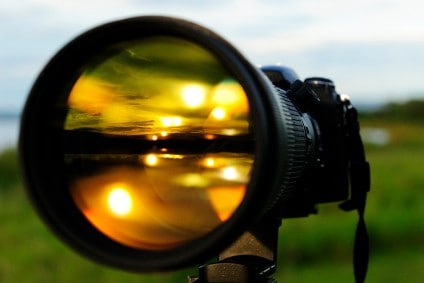
John Fares sent in a question via the Ask a Question page in which he essentially asked why some photographers recommend buying the expensive high-end lenses when there are cheaper lenses of the same focal length available. What's the difference between cheap lenses and expensive lenses? You can read the full question at the end of this article.
First of all, I would NOT recommend that a beginner buy a high-end lens. Why? Because you probably won't see any significant improvement in your photos. Think of lenses as a bottleneck. If the photo is otherwise compelling, the photographer has the skill to shoot with proper technique, and the photographer is skilled in post-processing, then the lens can add to the sharpness, color, and contrast of the photo. HOWEVER, even the sharpest and best-built lens will produce blurry photos in the hands of an amateur.
But if you feel like you are skilled enough to take advantage of a pro lens, here is a list of some of the advantages you'll seen in the professional grade lenses, and why they are different than the cheap kit lenses.
Benefit of Professional Lenses #1: Maximum Aperture. This is probably the most important benefit of an expensive lens. Most low-end lenses have max apertures of f/5.6 at the long end of the lens; however, professional lenses often have max apertures of f/2.8 or even lower. The large apertures offered by professional lenses aides in creating shallow depth of field and light-gathering.
Benefit of Professional Lenses #2: Constant Aperture. Most cheap lenses change the max aperture as you zoom out. For example, the popular Canon 75-300mm lens can achieve an aperture of f/4 at 75mm, but when you zoom out to 300mm, the lens can only achieve an aperture of f/5.6. On many professional lenses, the maximum aperture available on a lens is constant throughout the focal length range. For example, the 70-200mm lens by both Canon and Nikon can achieve an aperture of f/2.8 at the 70mm or 200mm ends.
Benefit of Professional Lenses #3: Focus Motor. More expensive lenses use a silent wave motor, which produces faster and quieter focusing.
Benefit of Professional Lenses #4: Weather Sealing. While all lenses have a certain amount of weather sealing, high-end lenses have loads of it. This makes the lens last much longer without problems. I have rarely seen a kit lens or cheap telephoto lens that doesn't have dust (or even mold…) inside the lens after a year or two of use. This happens much more rarely in professional lenses as long as they are taken care of.
Benefit of Professional Lenses #5: Sharpness. Kind of self-explanatory, but pro lenses are almost always sharper. However, this won't make a bit of difference if you don't use proper technique.
Benefit of Professional Lenses #6: Internal Focus. On cheaper lenses, the physical length of the lens extends as you zoom in. On many professional lenses, the lens focuses without changing the length of the lens. The only reason this matters is when using filters. This creates problems when using certain types of filters.
Benefit of Professional Lenses #7: Contrast. Professional lenses often produce significantly more saturated colors than cheaper lenses.
Benefit of Professional Lenses #8: Chromatic Aberration. Professional lenses produce less-noticeable fringing around edges. This really isn't a big deal unless you're printing or displaying photos large.
Benefit of Professional Lenses #9: Color. The difference in color reproduction is slight, but professional lenses do a bit better.
John's full question:
|
You just kind of know when you’re ready to make that next step. My first quality lens was a 70-200mm f/4 L, and I noticed a huge difference from the very first image I took with it.
Thanks for the post, answered well!
Now that I think about it, I may not need other than the 18-105mm…
to be honest i’m going on a trip and I just read a previous article you wrote on the gear that pros recommend… and it just made sense, the most important thing to remember is to just grab the camera and not bother with the excess equipment since i’m not shooting for a mag in a studio… and at least for now, I will not need more than f/2.8 or 3.5 for that trip (dof can be tweaked in ps if needed).
Cheers
Good information. Even those of us who consider ourselves experienced photographers sometimes get away from why we are spending all of this money. This puts the lens question in perspective.
There is a saying that is making it’s rounds on the podcast circuit. It is a phrase that was started by Michael Reichman of the Luminous Landscape website:
“Ninety nine percent of the lenses out there are better than 99% of the photographers”
That puts it nicely into perspective.
Good easy to understand article. However I somewhat disagree that a pro lens will not make any significant improvement on the photo of the amateur. I have lent my 70-200mm II 2.8 lens 5D Mark III and to a friend who only shoots on automatic and she was delighted to see a significant improvement in sharpness and contrast from her entry level Rebel with a efs 55-250mm lens.
I have kit lenses 6 years old and have zero mold. I also use a 10x loop to inspect them regularly and store then out in the open. I’ve never heard of people constantly experiencing mold two years in after owning these. If so, I would think you’d see multiple threads in discussion forums on this very topic- not so. Weather sealed is great, but not necessary as well.
The most important reason not to waste money on expensive lenses are:
1) High ISO and lower noise on APS-C cameras is getting better and better. Most people can easily do without 2.8’s or less.
2) Crop sensors don’t require high outer edge lens sharpness or lack of light fall off. No FF, no need for expensive glass for most uses.
3) Only 2 percent of pictures are ever printed off. Most people do not print nor own monitors to take full advantage of the resolution their current cameras take.
Many of the benefits you stated have nothing to do with IQ. Color, Saturation and sharpness can be adjusted PP. Furthermore, LR can easily remove CA. The justification for expensive glass outside of professional usage isn’t very compelling. Here’s why a pro might want expensive glass:
1) Better coatings. Flare and CA, while they can be fixed in PP, slow down workflow. Time is money if you do this for a living therefore you get what increases efficiency.
2) Pro expensive zooms offer versatility over primes. Again- time is the factor here. If I was a pro and couldn’t risk capturing the moment to switch out a lens, needed ultimate versatility to increase workflow…..I would opt for expensive constant aperature zoom. 95 percent of the performance of a prime without the hassle of switching out lenses and slowing my workflow.
3) Gallery fine art that requires a high level of exceptional detail and resolution. Prints at 300 DPI two feet from your face and meant to be scrutinized. The advantages here show up in spades IMO.
Outside of extremes, you won’t be able to tell that much of a difference with mid grade glass. Most modern well priced primes offer excellent value. Even using an LED LCD screen won’t yield noticeable differences in glass unless your pixel peeping. Even then. I’ve tried this….I own a 1500.00 Sony Zeiss 1.4 and a 400 dollar Olympus 45mm 1.8. I’ve looked at 200% crops at 1.8, 3.6 and 5.8. Not a major difference…sorry. Sure, the sony has amazing bokeh….but bokeh is a highly subjective quality.
Lastly, speed is an advantage, but you can get speed cheap now in lenses. Plenty of legacy glass that is very fast and super cheap. You just won’t be getting the best nano coatings along with it. Again, unless your a professional I doubt most people will ever benefit from the more expensive glass. Go do the comparisons yourself and judge the results. In terms of emotional engagement, I see no ability for fine glass to drive a higher level of impact on the viewer in most situations. And this is coming from someone who owns all ranges of glass.
@Tom – Some good points but I want to point some things out as well.
First of all, just because chromatic aberration can be REDUCED in Photoshop isn’t a good justification for accepting a lens with the defect. Even when reduced in Photoshop, chromatic aberration makes edges appear softer–and therefore less sharp.
The same is true of contrast. You can certainly boost contrast on detail that is captured in post processing. But when shooting something of very low contrast (say the fine fur on a wolf or bird feathers), if there isn’t enough contrast captured by the lens, the detail does not exist in the image to boost it in Photoshop.
I love post processing and what it can do for my photos, but it’s just not a panacea.
Just wanted to give my opinion on the importance of a lens’ sharpness.
I think APS-C is in need of sharper lenses than FF, because APS-C chops out so much light and then also resolution. An average sharp lens is going to perform better on FF in terms of resolution based on sharpness