You haven't stumbled on just any blog post. This is a series of articles where I will walk you step-by-step through the basics of flash photography. It isn't nearly as in-depth as my online flash photography class, but the articles in this series contain exactly the information I would tell you if you walked into my office and asked me for a crash course on flash photography.
I guarantee I will help you with the technical steps necessary for setting up your flash, but before we get to that, you must learn about light. Skip the first few articles in this series and you will spend the next year learning through trial-and-error what I can simply explain to you right now.
Let's get started…
This morning I wrote the following message to a photographer whose work I was able to critique. This message is, in essence, the same message I have written to dozens or hundreds photographers before.
“Your photos are a joy to see. [Insert a sincere comment here on something I like about their photography–and there is always something]. If I could change one thing in your photos, however, it would be the lighting.
The study of light will improve your photography faster than the study of photography will improve your photography. You see, working with light is what makes you a photographer–ANYONE can learn to use a camera. (Tweet this tip with one click!)
This advice always raises the same questions. Do these sound familiar?
- “So what do you mean by ‘great lighting'? Do you mean the warm yellow light of the magic hour?”
- How much does a proper flash photography setup cost? (Hint: I'll get you started for $150 including the flash)
- I can put a flash on my camera, but I don't know how to do off-camera flash. How do I make the flash fire?
- I have seen photographers using softboxes and umbrellas. I would like to use these tools in my portrait photography. Can you walk me through the setup step-by-step?
In this series, you will learn the answer to all of those questions, but condensed down into only two lessons: Lesson One–What is great light? and Lesson Two–How to manipulate light to match your vision.
The two lessons contained in this series could undoubtedly be learned elsewhere or through your own efforts, so I sincerely thank you for allowing me to take you on this journey into the study of light. It is all that really matters in great photography.
Click the red button below to go to page 2 of this tutorial.
I’m pinning!
@Susan – Thank yoU!
Jim,
I really like this tutorial. I’ve been playing with an off-camera flash and umbrella for a few months now, and your advice will help me take it to the next level. Thanks.
And I did share this on facebook. And I forwarded it to my photo club.
I pinned this, but actually am going to start reading it today. I got to sit in for a short time on a flash photography workshop this weekend and after seeing the results on my own photography, I’m kinda hooked!
I think this is just the primer I was looking for.
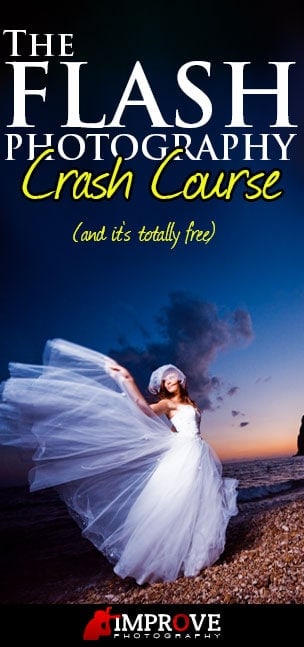
This is an awesome tutorial. I love the photo that you used in the post for pinterest. Did you photographic it?
I express my gratitude as after going through your free crash course of flash photography, which made me forget my shyness from using the off camera flash. I am confident soon I am going to join your online flash photography (medium level ). Please mail me as and when you offer discount.
thank you, thank you, thank you… you’ve made my life (and learning about my passion/hobbie) so simple! i’ve struggled for a long time to understand lighting (only using natural lighting) and up until now, could not afford any extra equipment. i finally have the opportunity to spend some money and have been searching online for tips and tricks on what to purchase. this tutorial has been amazing and so helpful. i cant wait to start practicing the techniques you’ve taught!!!
God bless 🙂
Pinned! And thank you!
Excellent information and very well written (i.e. easy to understand). Thankyou
great quick tips – thanks guys. Maybe I can add a few portrait/family sessions next summer for a summer job during school break.
Pinned, and thanks very much. Admittedly I’m not a beginner (40 years tripping the shutter) but the essence of lighting (beyond ambient) has always eluded me, and my best efforts usually brought me right back to confusion and apathy.
My photo exploits are geared more to nature than people, and of late to high-speed flash in bird photography. Oh yeah, and I still shoot film!
You guys @ improve photography are freaking awesome. Huge fan base here in Australia growing. Will be purchasing the online flash photography class. Many thanks.
Thanks for these lighting tips. I’m currently trying to figure this whole OCF thing out with flashes.
This is still one of the best flash photography blog post online. I just need a refresher quickly and I can find it easily here. Thanks Jim!
good advices! even after many years od prcatice (started 1953, sold first pics 3 years of the local tennis champion). these pics brought me a lot of business in our 780 members tennis-club (my favourites were pets and children, made pics at many private parties and was even working as a pro on a photo-safari of 3 months in 1960, had a lot of work, but the group was very generous with my pay-check! 2001 my first digi-cam (excellent WB, but not yet good enough for my taste), then in 2007 the completely change to digital. i invested much of my earnings for improving my “hobby”-equipment (now 4 digi-bodies and 15 different lenses (5 prime, 10 zooms) and some flashs, tripods and camera-bags. just the right thing for living in africa….
Pinned!
I have some experience with o.c.f. And am just trying to get back to it.
Looking for best photographer in Kurnool ? Hire the professional photographers at an affordable cost.We are specialized in taking candid photographers for birthday functions, weddings, pre-wedding photoshoots, baby photoshoot , Advertisements, Maternity shoot, Portfolio and all type of functions. Call 9966993116 for more details
1
rOWN4HFk
if(now()=sysdate(),sleep(15),0)