Every time I see one of my photography students with the lens hood on backward, I know they don't know what the lens hood does.
The lens hood is designed to reduce flare and protect the lens, among other things.
What Is the Purpose of a Lens Hood?
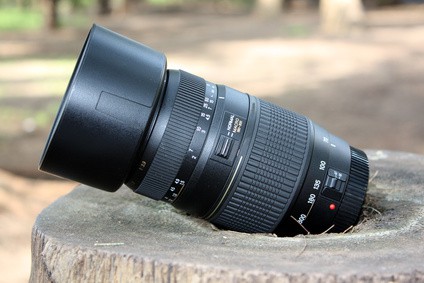
The lens hood is a piece of plastic that clips onto the front of a camera lens and extends beyond it.
Lens hoods serve two primary purposes: (1) reducing lens flare, and (2) protecting the lens from damage.
The intended purpose of the lens hood is simply to reduce lens flare, but the protection it provides to the glass elements of the lens is a beneficial side-effect.
Why Are Many Lens Hoods Shaped so Funny?
What you're probably referring to is the shape of what is called a “petal lens hood.”
The shape of a petal lens hood allows it to extend as far as possible beyond the lens without showing up in the frame.
Lenses are circular, but the pictures we take are rectangular.

If these petal lens hoods were perfectly round, the corners of the hood would be in the picture.
The only thing worse than getting a lens hood in the picture is when you hand your point and shoot to Uncle Harry, who puts his finger right over the lens when he takes a picture… Ugh!
But not all lens hoods are petal lens hoods.
Some lens hoods are completely enclosed without the weird cut-out shape.
This type of lens hood is called a “round lens hood.”

Prime lenses have round lens hoods more often than zooms because they don't have the added difficulty of keeping out of the way as the camera zooms out.
Should I use a lens hood on my camera?
The short answer is yes. I almost always have a lens hood on my camera.
While shooting without a lens hood can still produce great pictures most of the time, if any light happens to bounce into the lens from the sides, the contrast and color in the image are significantly reduced.
Also, it is nice to have a lens hood for protection of the lens.
However, there are some lenses on which a lens hood is simply unnecessary.
I recently saw one of my photography students with a lens hood on his 50mm f/1.8 prime lens.
It looked quite strange because most people don't use a hood on that lens.
The reason is that the plastic on the lens already extends behind the glass of the lens, so the glass is recessed.
Therefore, the lens itself acts as a lens hood.
There is nothing wrong with using a lens hood on such a lens, but it is hardly necessary for most situations.
Do Lenses Come With a Lens Hood or Do I Need to Buy One?
Some lenses come with the hood, and others do not.
Canon generally provides a lens hood for the L series (professional) lenses, but not for the consumer level lenses.
For those lenses, you'll need to head on over to Amazon and buy one for a really affordable price.
If you are either really cheap or just love doing things yourself, you can actually make a lens hood by going to this website and following the directions.
You mention that the plastic on the 50mm prime lens already extends past the glass, but what about when using filters?
Jim, what are the benefits between the petal hoods and the round lense hoods? Are there situations where one is more beneficial than the other?
@Bob – The filter screws on to the fittings of the front element of the lens. The lens hood extends far beyond the filter. Yes, the filter and lens hood can be used simultaneously.
@Caitlin – petal lens hoods are generally better because they allow the lens hood to be longer (and block more direct light) without parts of the lens hood showing up in the corner of the frame.
I’m using a petal hood and i’m capturing the hood in the corners of my photo’s. even if i put it on straight and align it perfectly my canon rebel auto focuses and the hood is seen in the photo.
nic, quit using auto focus.
I just want to ask, what if my 58mm lens hood is seen on the photographs when I turn my zoom lens in 18mm wide, is there a much wider opening lens hood for that 58mm lens?
Use a 58mm to 77 mm step up ring and then use a 77 mm lens hood.
Great information, thanks!
Michele
Thanks for the great article, it really summarizes everything I needed to know about lens hoods! Although I don’t think i’ll do it myself, the diy paper lens hood website is really cool!
hi, is it ok to use petal lens hood with nikon d3100 18-55mm kit?
I have a lens hood on my canon and in some shots you can see the shadows of the hood. I’m assuming because I’m on auto focus and because the lens turns to focus it might leave to hood in a position to cast a shadow instead of bouncing light. Is that true or is there something I’m doing wrong?
oh I should say that I have the petal lens
I know that many photographers prefer to use them when taking pictures over the water to reduce the glare during the daytime. When I first moved up to a DSLR ( Nikon D90 ) it came with a petal type for the kit lens which is a 18-105mm . I took some fireworks shots (at night of course ) at close range and at ground level.. They all had these strange shadows and I thought my lens was dirty. After figuring out what caused them I didn’t make that mistake again. But, they sure make a camera look impressive. LOL
Nice article, I wish you had a “with lens hood / without lens hood” picture with this!
Nice article, I wish you had a “with lens hood / without lens hood” picture with this!
I use one on a 50mm. it keeps my lens safe and kids seem to always run in to it so it keeps the kids safe too..
Does the orientation of a petal lens hood matter?
Yes it does. The small petals go to the long access (ie sides for landscape and top/bottom for portrait orientation). When you put the hood on check that you cannot see it at your wide angle setting. If you can it needs adjustment.
If hoods really did jack squat, there would be many many many pictures on the web both showing, with and without said lens hood to show how it supposedly effects contrast and colors. Never seen them, ergo, its a urban myth and therefore the ol’ hand is used instead.
@Duh: if you really did your research before posting your comment you would find there are plenty of great examples on the internet showing pictures both with and without a lens hood to show how much of a difference there really is. One great example, this was shot with a D40 and a 50/1.8 lens
Could the same or similar be achieved, simply by adding a UV filter in that case? I would love to see a comparison of 1) lens only, 2) lens with hood, 3) lens with UV filter, 4) lens with UV filter and hood
As a beginner photographer (Nikon D80 with 70 – 210mm lens), I am glad to learn about lens hoods, in particular to know what a petal hood is all about. I have an off-topic question however, and that is to learn how those (mostly) sports phtographers can use such large lenses at short range? Seems they all have this massive lens sticking right in the face of the athlete, close enough to highlight his/her blackheads. How do they do that, and why?……..If this is explained in some other article, then please point me to it. Thanks.
WOW i`m quite new too this, But thankyou so much for explaining the lens hood!
I`ve been wondering what it does…and after seening that example on imagesshack it really does show.
I use a a290 55mm lens and i`m still learning to this day!
I am getting there but very slowly.
I want say thats a great example of what a lens hood can do & thanks for sharing your knowledge.
Craig
I’d be wary of assuming people with the lens hood on backwards don’t know what they’re doing. Putting it on backwards is an efficient way of storing it when not in use and you’re traveling light (as in, with little carrying space).
@David – Key word there is when NOT in use. I’m talking about people using the lens with the hood on backwards. Many photographers get the lens and have no idea that it is to be turned around. I see it often in photowalks and the photographer is always amazed when I turn it around for them.
Maybe they are just taken aback by the audacity.
Can I use a Rubber lens hood on my Canon EOS 450 D? I have a Canon lens that goes from 55 to 250. It is a telephoto/zoom lens and I would like to use it for taking pictures at the zoo. Is this a wise thing to do? I want to take pictures of reptiles and amphibians against the glass is this possible with this rubber lens cover and does it reduce the glare
Thanks for your help,
Patti. Mc. 🙂